Gross Taxable Pay UK If you’ve ever stared at your payslip and wondered why the tax figure doesn’t quite match your salary, you’re not alone Gross Taxable Pay UK. Somewhere between “Gross Pay” and “Income Tax” sits a number most people never look at closely — gross taxable pay — and it’s usually the one doing the real work behind your tax bill Gross Taxable Pay UK.
Gross Taxable Pay UK This guide breaks down exactly what gross taxable pay means, how it differs from your headline salary, and why it’s the figure HMRC actually calculates your Income Tax on Gross Taxable Pay UK.
Read More: Self-Employed vs PAYE Tax – Key Differences Explained
Quick Answer: What Is Gross Taxable Pay?
Gross taxable pay is the portion of your earnings that Income Tax is calculated on Gross Taxable Pay UK. It’s your gross pay minus anything that’s tax-free or deducted before tax — most commonly pension contributions made through salary sacrifice, along with certain tax-free benefits or approved expenses. In most cases it’s slightly lower than your total gross salary, which is why your tax deduction often looks smaller than you’d expect if you simply multiplied your salary by a tax rate Gross Taxable Pay UK.
Visit Now: https://www.taxsal.com/
How Payslips Present Your Pay
UK payslips aren’t standardised, so layouts vary between employers and payroll software Gross Taxable Pay UK. Most, however, follow a similar pattern, showing some version of:
- Gross Pay – your total earnings before any deductions
- Taxable Gross Pay (sometimes labelled “Gross for Tax”) – the amount Income Tax is actually calculated on
- Income Tax – deducted based on your taxable gross pay and tax code
- National Insurance – calculated separately, on a slightly different basis
- Net Pay – what actually lands in your bank account
The confusion usually starts because “Gross Pay” and “Taxable Gross Pay” sound like they should be identical Gross Taxable Pay UK. Often they’re close, or even the same figure — but the moment a workplace pension, salary sacrifice scheme, or tax-free benefit enters the picture, the two numbers start to diverge. The rest of this guide explains exactly why Gross Taxable Pay UK.
Key Terms You Need to Know( Gross Taxable Pay UK )
Gross Taxable Pay UK A handful of terms show up again and again on a UK payslip, and they aren’t as interchangeable as they might seem Gross Taxable Pay UK.
| Term | What It Means |
| Gross Pay | Your total earnings before any deductions, including basic salary, overtime, and bonuses |
| Gross Taxable Pay | The portion of your gross pay that Income Tax is calculated on, after tax-free deductions are removed |
| Pensionable Pay | The portion of your pay your pension contributions are based on (not always the same as taxable pay) |
| Net Pay | Your take-home pay after Income Tax, National Insurance, pension, and any other deductions |
| Personal Allowance | The amount you can earn tax-free each year, before Income Tax applies to the rest |
| Tax Code | The code HMRC issues to your employer to show how much tax-free pay to apply |
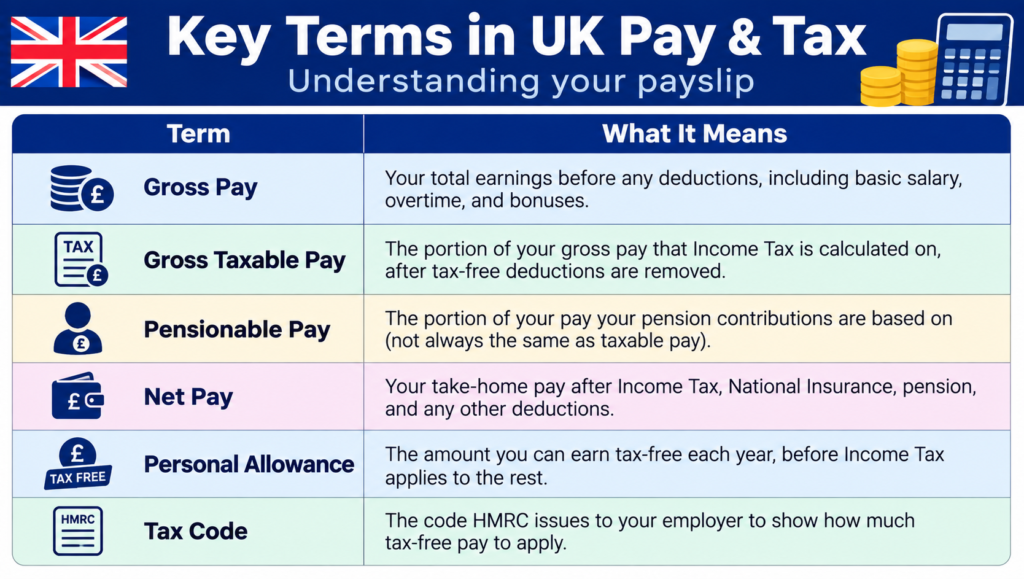
Gross Taxable Pay UK Keeping these definitions straight matters, because a lot of payslip confusion comes from assuming “gross” always means the same thing, when your payslip might actually use two or three slightly different versions of it depending on what each row is used for Gross Taxable Pay UK.
Gross Pay vs Gross Taxable Pay vs Net Pay
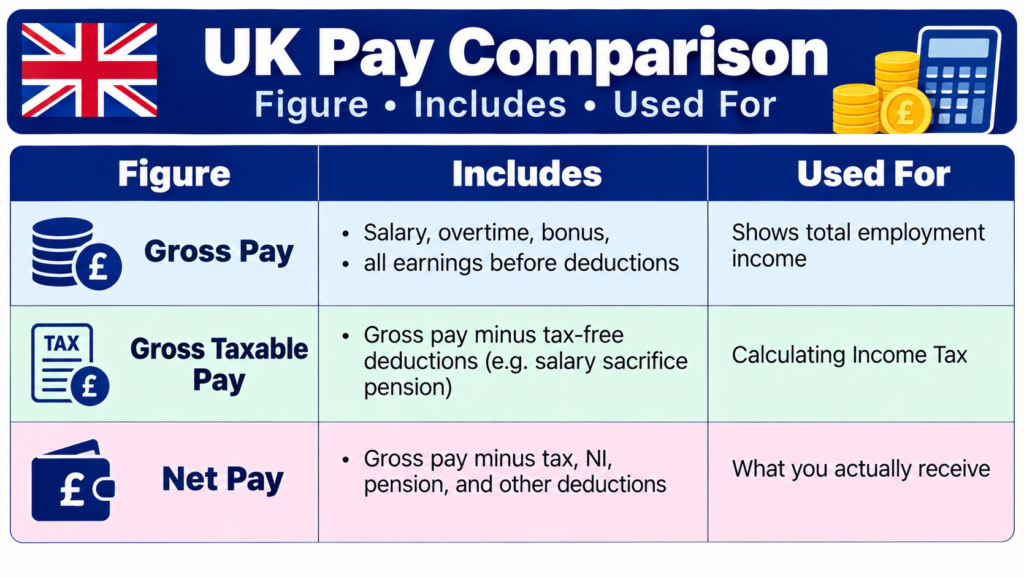
Gross Taxable Pay UK Seeing these three figures side by side is usually the fastest way to understand why a tax deduction looks the way it does Gross Taxable Pay UK.
| Figure | Includes | Used For |
| Gross Pay | Salary, overtime, bonus, all earnings before deductions | Shows total employment income |
| Gross Taxable Pay | Gross pay minus tax-free deductions (e.g. salary sacrifice pension) | Calculating Income Tax |
| Net Pay | Gross pay minus tax, NI, pension, and other deductions | What you actually receive |
Gross Taxable Pay UK Say Sarah earns a gross salary of £32,000 a year and contributes 5% of it to a workplace pension through salary sacrifice — £1,600 a year. Gross Taxable Pay UK Her gross taxable pay is £30,400. Income Tax is calculated on that £30,400, not the full £32,000, which is exactly why two employees on identical salaries can end up with different tax bills depending on how much they sacrifice into a pension Gross Taxable Pay UK.
Why Gross Taxable Pay Matters( Gross Taxable Pay UK )
Gross Taxable Pay UK It’s easy to assume this is a minor payroll technicality, but it has real, practical value Gross Taxable Pay UK.
It explains why your tax bill can be lower than expected Gross Taxable Pay UK. If you’re contributing to a pension through salary sacrifice, or receiving certain tax-free benefits, your gross taxable pay will be lower than your headline salary — and so will your tax bill Gross Taxable Pay UK.
It affects your tax band Gross Taxable Pay UK. Whether you fall into the basic rate, higher rate, or additional rate band depends on your taxable income, not your gross salary Gross Taxable Pay UK. Reducing gross taxable pay through pension contributions can sometimes keep you in a lower band altogether Gross Taxable Pay UK.
It feeds into other calculations too Gross Taxable Pay UK. Some means-tested benefits, student loan thresholds, and even certain mortgage affordability checks look at taxable income rather than gross salary, so understanding the difference can affect decisions well beyond your payslip Gross Taxable Pay UK.
It helps you spot payroll errors Gross Taxable Pay UK. If your gross taxable pay looks unusually high or low compared to what you’d expect, that’s often an early sign a deduction hasn’t been set up correctly, or that a benefit is being taxed when it shouldn’t be Gross Taxable Pay UK.
Common Misconceptions
Gross Taxable Pay UK A few misunderstandings come up again and again when people try to work out their own gross taxable pay Gross Taxable Pay UK.
“Gross pay and gross taxable pay are always the same Gross Taxable Pay UK.” They’re often close, but not identical Gross Taxable Pay UK. Anything taken from your pay before tax — most commonly salary sacrifice pension contributions — creates a gap between the two Gross Taxable Pay UK.
“Bonuses and overtime are taxed differently to salary Gross Taxable Pay UK.” They’re not. Bonuses, overtime, and commission are all added to gross taxable pay and taxed under the same rules as regular salary, even though it can feel like they’re taxed more heavily because of how PAYE spreads tax across the year Gross Taxable Pay UK.
“A higher gross taxable pay always means a bigger tax bill Gross Taxable Pay UK.” Usually true, but not automatically Gross Taxable Pay UK. Your personal allowance, tax code, and which bands your income falls into all play a part, so two people with the same gross taxable pay can still end up with different Income Tax deductions Gross Taxable Pay UK.
“Pension contributions are always taken after tax Gross Taxable Pay UK.” Not necessarily Gross Taxable Pay UK. It depends on whether your employer uses salary sacrifice, a net pay arrangement, or relief at source — each affects gross taxable pay differently, as the comparison table further down shows Gross Taxable Pay UK.
How Gross Taxable Pay Is Calculated( Gross Taxable Pay UK )
Gross Taxable Pay UK Payroll software doesn’t apply a single deduction to reach this figure — it works through a short sequence of additions and subtractions before Income Tax is ever calculated Gross Taxable Pay UK.
Step 1: Start With Total Gross Pay
This is your full earnings for the pay period — basic salary, plus anything else that counts as pay, such as:
- Overtime
- Bonuses and commission
- Shift allowances
- Taxable benefits paid through payroll
Step 2: Add Any Taxable Benefits in Kind
Some benefits are added to your pay for tax purposes even though you never receive them as cash Gross Taxable Pay UK. Company car benefits, employer-provided private medical insurance, and certain other perks can increase gross taxable pay through a system called payrolling of benefits, even though your take-home cash hasn’t changed Gross Taxable Pay UK.
Step 3: Subtract Tax-Free Deductions
This step usually creates the gap between gross pay and gross taxable pay. Common examples include:
- Salary sacrifice pension contributions – reduce your contractual salary, lowering gross taxable pay
- Cycle to work scheme payments – often taken before tax
- Childcare vouchers (for anyone still on a legacy scheme)
- Certain allowable business expenses processed through payroll
Step 4: The Remaining Figure Is Your Gross Taxable Pay
Whatever’s left after those adjustments is the number Income Tax is calculated on, using your tax code and the relevant bands for the year.
It’s a short process, but the order matters. Get the sequence wrong — applying a pension deduction after tax instead of before, for instance — and the whole figure changes, which is exactly where a lot of payroll mistakes happen.
Worked Example: From Salary to Gross Taxable Pay
James earns £3,500 a month. In April, he also received a £200 shift allowance, plus a company benefit worth £40 a month added to his taxable pay. He contributes 6% of his salary to a pension through salary sacrifice.
| Step | Amount |
| Basic Salary | £3,500.00 |
| Shift Allowance | £200.00 |
| Taxable Benefit | £40.00 |
| Total Gross Pay | £3,740.00 |
| Salary Sacrifice Pension (6% of £3,500) | −£210.00 |
| Gross Taxable Pay | £3,530.00 |
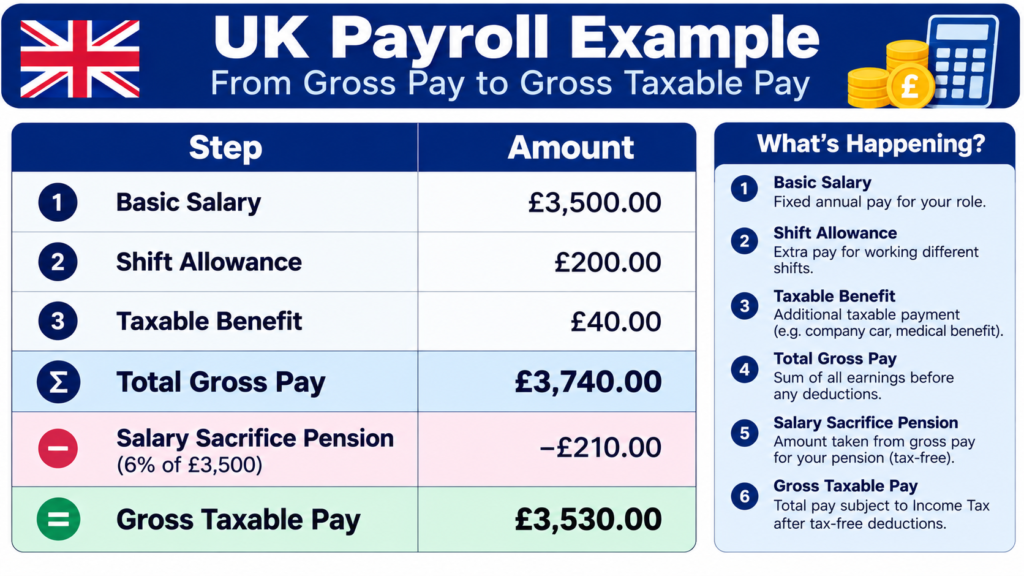
Notice that the pension percentage applies to his basic salary, not his total gross pay — this is common, but not universal, so it’s worth checking how your own employer’s scheme is structured. Income Tax for the month is then calculated on £3,530.00, not the £3,740.00 he actually earned before the benefit was added.
Real-Life Scenario: Same Salary, Different Tax
This is where gross taxable pay really shows its impact. Take two employees, both earning a gross salary of £40,000 a year.
Employee A has no pension contributions and no salary sacrifice arrangements. Their gross taxable pay is the full £40,000.
Employee B contributes 8% of their salary into a pension via salary sacrifice — £3,200 a year. Their gross taxable pay is £36,800.
| Factor | Employee A | Employee B |
| Gross Salary | £40,000 | £40,000 |
| Salary Sacrifice Pension | £0 | £3,200 |
| Gross Taxable Pay | £40,000 | £36,800 |
| Income Tax | Higher | Lower |
| National Insurance | Higher | Lower |
| Pension Pot Growth | None | Building |
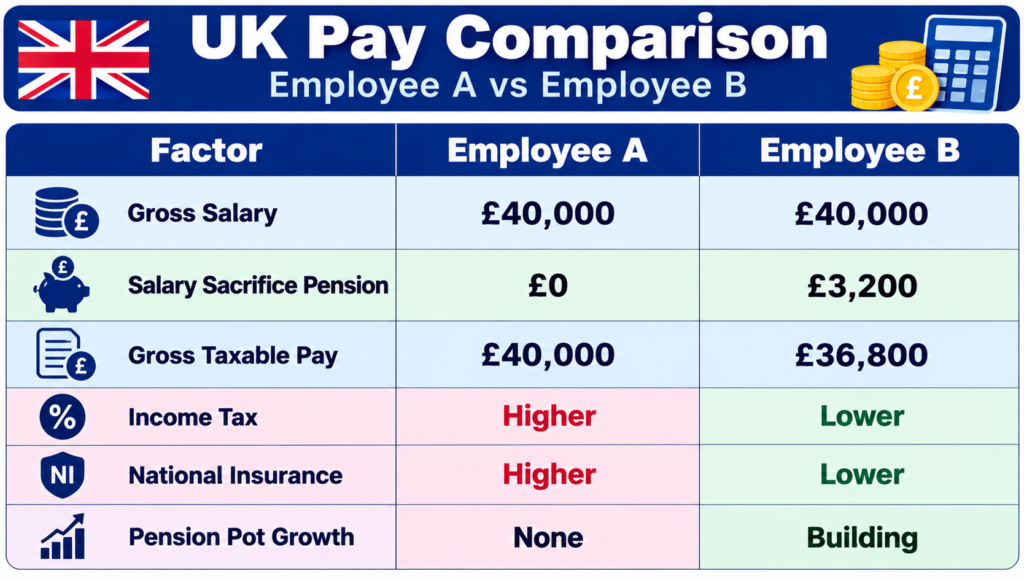
Both employees earn the same headline salary, but Employee B pays less Income Tax and less National Insurance, while also building a pension. It’s one of the clearest reasons salary sacrifice schemes are so widely recommended — the reduction in gross taxable pay works in the employee’s favour on more than one deduction at once.
Common Mistakes to Avoid
A few errors come up repeatedly, whether it’s an employee checking their own payslip or someone estimating tax before accepting a new job.
Assuming gross salary and gross taxable pay are interchangeable when budgeting. Calculate your expected tax using your full salary while you’re on a salary sacrifice pension scheme, and you’ll overestimate your tax bill and underestimate your take-home pay.
Forgetting that bonuses shift the figure for one pay period only. A one-off bonus increases gross taxable pay for that month, which can temporarily push some of it into a higher tax band — it doesn’t mean your ongoing salary has changed.
Mixing up pensionable pay and taxable pay. These aren’t always the same figure. Some pension schemes calculate contributions on basic salary only, while gross taxable pay includes bonuses and benefits too. Checking your pension scheme’s rules separately from your tax calculation avoids confusion.
Overlooking benefits in kind. If your employer payrolls benefits like private healthcare, that value is added to gross taxable pay even though you never see it as cash — which can catch people off guard when the tax deduction looks higher than expected relative to their cash salary.
Assuming last month’s gross taxable pay predicts this month’s tax exactly. PAYE is cumulative in most cases, meaning tax is worked out based on your pay and allowances to date in the tax year, not just the current pay period in isolation. This is why irregular income, like commission or overtime, can cause deductions to fluctuate month to month.
Best Practices for Checking Your Figure
A few habits make it much easier to work out your own gross taxable pay with confidence.
- Check your payslip for a “Taxable Gross Pay” or “Gross for Tax” line. Most modern payroll systems show this explicitly, so you don’t have to calculate it yourself.
- Compare it against your gross pay figure each month. If the two numbers are identical and you’re contributing to a pension, ask your payroll team how the scheme is structured — salary sacrifice should normally create a difference.
- Keep a note of one-off payments. Bonuses and overtime temporarily raise gross taxable pay, so don’t be alarmed if a single month’s tax deduction looks unusually high.
- Review your tax code alongside your gross taxable pay. The two work together — an incorrect tax code applied to a correct gross taxable pay figure still produces the wrong tax deduction.
Gross Taxable Pay and Your Tax Code
Gross taxable pay tells your employer what to apply tax to — but your tax code tells them how much of that figure is tax-free before the remaining rates apply. The two work as a pair, and it’s easy to focus entirely on one while overlooking the other.
For most people on the standard tax code, £12,570 a year is tax-free, and Income Tax only applies to gross taxable pay above that threshold. But emergency tax codes, second jobs, or benefits reported through your tax code (such as company car tax collected via PAYE rather than payrolling) can all change how much of your gross taxable pay is actually taxed — sometimes significantly.
This is one of the more advanced areas of payslip understanding, and it’s exactly where a lot of “why is my tax so high this month” questions come from. Someone can have a perfectly correct gross taxable pay figure and still pay the wrong amount of tax simply because HMRC is using an outdated or incorrect tax code.
Spotting Errors on Your Payslip
Even with correct payroll software, mistakes happen — and gross taxable pay is one of the easier figures to check yourself once you know what to look for.
Compare your gross taxable pay against your contract. If your basic salary hasn’t changed and you haven’t started a new pension or benefit, gross taxable pay shouldn’t move much from month to month beyond normal variation like overtime or bonuses.
Check for duplicate benefits. Occasionally, a benefit already taxed through your tax code (such as a company car) gets accidentally added to gross taxable pay too, effectively taxing it twice. Rare, but worth ruling out if your tax deduction looks unusually high.
Watch for pension contributions that stop appearing. Switching jobs, changing pension providers, or a payroll system change can sometimes cause salary sacrifice deductions to drop off the payslip by mistake, pushing gross taxable pay — and your tax bill — back up without any real change to your pay.
Cross-check cumulative figures at year-end. Your P60 shows your total gross taxable pay for the tax year. If it doesn’t roughly match what you’d expect from adding up your monthly figures, raise it with payroll before filing anything with HMRC.
How Deductions Interact With Gross Taxable Pay
A few common deductions behave differently to how people expect, and understanding the order they apply in clears up a lot of confusion.
| Deduction | Applied Before or After Gross Taxable Pay Is Set | Reduces Income Tax? |
| Salary sacrifice pension | Before (reduces gross taxable pay) | Yes |
| Relief at source pension | After (deducted from net pay, tax relief added separately) | Indirectly, via relief |
| Net pay arrangement pension | Before (reduces gross taxable pay) | Yes |
| Student loan repayment | Calculated on gross taxable pay, but not deducted from it | No |
| Cycle to work scheme | Before (reduces gross taxable pay) | Yes |
| Payroll Giving (charitable donations) | Before (reduces gross taxable pay) | Yes |
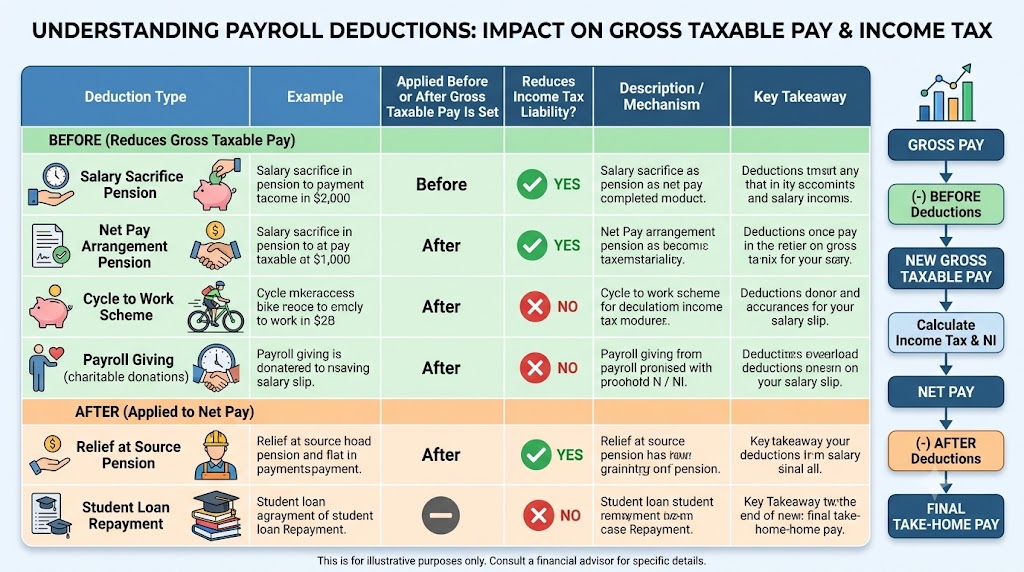
This table answers a question a lot of people ask: why does one pension scheme seem to lower tax immediately, while another doesn’t touch the payslip figure at all? It almost always comes down to whether the contribution is taken before or after gross taxable pay is calculated.
Relief at source pensions are a good example. Your contribution comes out of net pay, then your pension provider claims basic rate tax relief and adds it to your pot. Gross taxable pay on the payslip doesn’t change, even though you’re still getting tax relief — it just happens outside the payroll calculation rather than inside it. Higher rate taxpayers usually need to claim the additional relief separately through Self Assessment.
The £100,000 Trap
One area worth understanding if your income is approaching six figures: once gross taxable pay (technically “adjusted net income” for this purpose, though closely related) passes £100,000, your personal allowance starts reducing by £1 for every £2 earned above that threshold. By £125,140, the personal allowance disappears entirely.
This creates an effective marginal tax rate of around 60% on income in that band for many people — higher than the additional rate band itself. It’s one of the main reasons pension contributions become particularly valuable for people earning just above £100,000: reducing gross taxable pay through salary sacrifice can bring income back under the threshold and restore some or all of the personal allowance.
This is genuinely advanced tax planning, and it’s worth discussing with a financial adviser or accountant if it applies to you, since the numbers shift year to year and the effect on take-home pay is often larger than expected.
Frequently Overlooked Details
A handful of smaller points don’t always get covered, but they matter for a full picture:
- Statutory payments count too. Statutory Sick Pay, Statutory Maternity Pay, and similar payments are included in gross taxable pay and taxed in the same way as regular salary.
- Redundancy pay is different. The first £30,000 of most redundancy payments is tax-free and doesn’t form part of gross taxable pay, though anything above that threshold does.
- Dividends and savings interest don’t appear here at all. Gross taxable pay only covers employment income — other income types are taxed separately through Self Assessment, even though they still count toward your overall tax position.
- Scottish taxpayers use the same gross taxable pay calculation, but different bands and rates apply once that figure is established, since Scottish Income Tax runs its own rate structure.
Key Takeaways
Income above £100,000 has knock-on effects on your personal allowance, making gross taxable pay especially important to manage at that level.
Gross taxable pay is the figure Income Tax is actually calculated on — not your headline gross salary.
It’s usually your gross pay minus tax-free deductions like salary sacrifice pension contributions, cycle to work payments, and Payroll Giving.
Taxable benefits in kind, such as payrolled company cars or medical insurance, can increase gross taxable pay even without extra cash pay.
Two employees on the same salary can have very different gross taxable pay figures depending on how their pension is set up.
Checking your payslip’s “Taxable Gross Pay” line, alongside your tax code, is the quickest way to understand your own deductions.
Final Thoughts
Understanding gross taxable pay UK rules puts you in a much stronger position to make sense of your own payslip, rather than simply trusting that the numbers are right. Once you know it’s your gross pay minus tax-free deductions — not just your salary — a lot of the confusion around your Income Tax deduction starts to clear up.
It’s also one of those figures that quietly affects more than tax alone, from your tax band to your personal allowance to how much your pension contributions are actually saving you. Taking a few minutes to check your gross taxable pay against your own payslip is a small habit that can save a lot of head-scratching later, especially if your income changes, you start a new pension, or you pick up extra hours during the year.
This article is for general information only and reflects HMRC rules at the time of writing. It is not personal tax advice — for guidance specific to your circumstances, speak to a qualified accountant or tax adviser.
FAQ’s
Is gross taxable pay the same as gross pay?
Not always. They’re often close, but gross taxable pay excludes tax-free deductions like salary sacrifice pension contributions, so it can be lower than your total gross pay.
Does gross taxable pay include bonuses and overtime?
Yes. Bonuses, overtime, and commission all form part of gross taxable pay and are taxed under the same rules as regular salary for that pay period.
Why is my gross taxable pay lower than my salary?
This usually happens because of pension contributions taken through salary sacrifice or a net pay arrangement, both of which reduce gross taxable pay before Income Tax is calculated.
Does gross taxable pay affect National Insurance too?
Not directly, in the same way. National Insurance uses its own thresholds and rules, though salary sacrifice pension contributions reduce your NI bill as well as your Income Tax
Where do I find my gross taxable pay on a payslip?
Look for a line labelled “Taxable Gross Pay,” “Gross for Tax,” or similar. If it isn’t shown separately, it likely matches your total gross pay, particularly if you have no pre-tax deductions.
Does a workplace pension always reduce gross taxable pay?
Only if it’s set up as salary sacrifice or a net pay arrangement. Relief at source pensions are deducted after tax, so they don’t change the gross taxable pay figure on your payslip.
Do student loan repayments come out of gross taxable pay?
They’re calculated based on gross taxable pay above your repayment threshold, but the repayment itself is a separate deduction rather than something that reduces the gross taxable pay figure.
Does gross taxable pay include tax-free benefits?
No. Tax-free benefits, such as certain pension contributions or approved expenses, are excluded from gross taxable pay by definition, since they aren’t subject to Income Tax.
Why does my gross taxable pay change every month?
Variable pay like overtime, bonuses, or commission changes gross taxable pay from one pay period to the next, even if your basic salary stays exactly the same.
Can my employer get gross taxable pay wrong?
Yes. Payroll errors do happen, particularly around benefits in kind or pension contributions changing without an update to the payroll system. Comparing your payslip against your contract and P60 periodically is the best way to catch this early.