Bonus National Insurance UK Getting a bonus is one of those moments that feels great right up until payday, when you open your payslip and realise National Insurance has taken a noticeably bigger bite than usual Bonus National Insurance UK. If you’ve ever wondered why a £2,000 bonus doesn’t add £2,000 to your take-home pay, the answer lies in how HMRC treats bonuses for National Insurance purposes Bonus National Insurance UK.
Bonus National Insurance UK rules aren’t complicated once you understand the basics, but they catch a lot of people off guard because bonuses are taxed differently to how most people expect Bonus National Insurance UK. This guide explains exactly how National Insurance is calculated on a bonus, why the deduction can look disproportionately large, how it interacts with Income Tax, student loans and multiple jobs, and what you can do to reduce it Bonus National Insurance UK.
Read More: Understanding Pre-Tax and Post-Tax Deductions in the UK
Quick Answer: How Is National Insurance Charged on a Bonus?
Bonus National Insurance UK A bonus is treated as part of your earnings for the pay period in which it’s paid, so it’s added to your normal salary and National Insurance is calculated on the combined total Bonus National Insurance UK. For 2026/27, employees pay 8% National Insurance on earnings between £12,570 and £50,270 a year, and 2% on anything above that. Because a bonus sits on top of your regular pay for that period, it can push part of your earnings into a higher NI band for that pay period alone, which is why a bonus often feels more heavily taxed than your normal salary Bonus National Insurance UK.
Visit Now: https://taxsal.com/
Key Terms You Need to Know First
Bonus National Insurance UK A few terms come up repeatedly when talking about bonuses and National Insurance, so it’s worth being clear on what they actually mean Bonus National Insurance UK.
Class 1 National Insurance
Bonus National Insurance UK This is the type of National Insurance deducted from your pay through PAYE if you’re an employee. It’s calculated separately from Income Tax, using its own thresholds and rates Bonus National Insurance UK.
Primary Threshold
Bonus National Insurance UK The Primary Threshold is the point at which employee National Insurance starts being charged Bonus National Insurance UK. For 2026/27, it’s £12,570 a year, or £1,048 a month Bonus National Insurance UK.
Upper Earnings Limit
Bonus National Insurance UK This is the point at which the main 8% NI rate stops applying and a lower 2% rate takes over Bonus National Insurance UK. For 2026/27, it’s £50,270 a year, or £4,189 a month Bonus National Insurance UK.
Pay Period
Bonus National Insurance UK National Insurance is calculated on a pay-period basis, not cumulatively across the year the way Income Tax is Bonus National Insurance UK. This distinction is central to why bonuses affect NI the way they do, and it’s covered fully in the next section Bonus National Insurance UK.
Gross Bonus
Bonus National Insurance UK The full bonus amount before any tax or National Insurance is taken off Bonus National Insurance UK. This is usually the figure mentioned in your contract, offer letter, or bonus scheme documentation Bonus National Insurance UK.
How National Insurance Actually Works
Bonus National Insurance UK To understand what happens to a bonus, it helps to know one key fact: National Insurance isn’t calculated cumulatively across the tax year the way Income Tax is. Each pay period is treated on its own Bonus National Insurance UK.
| NI Band | Rate for 2026/27 | Applies To |
| Below Primary Threshold | 0% | Earnings up to £1,048/month |
| Main rate | 8% | Earnings between £1,048 and £4,189/month |
| Upper rate | 2% | Earnings above £4,189/month |
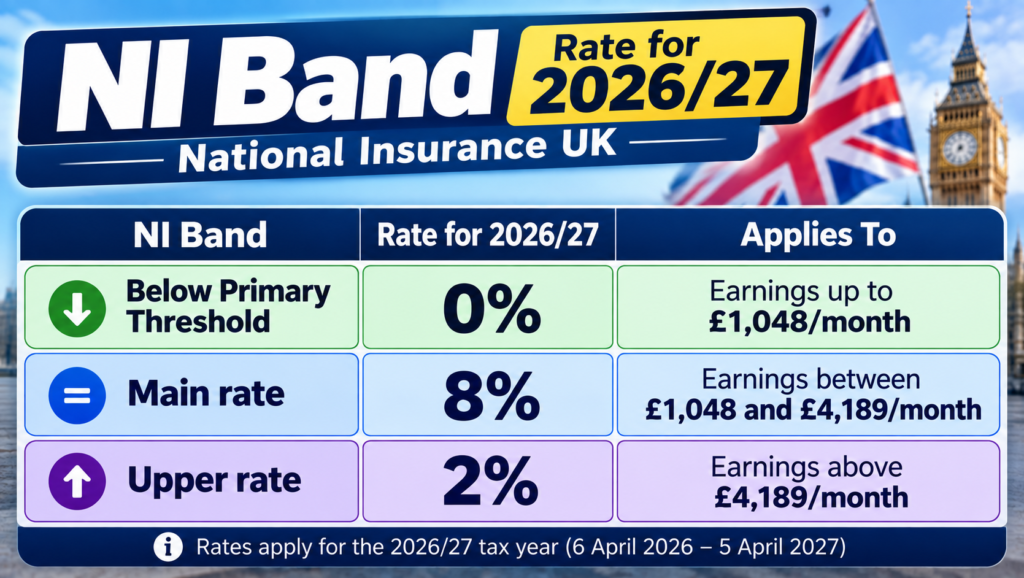
Bonus National Insurance UK With Income Tax, your employer works out roughly how much tax you should have paid so far in the year and adjusts accordingly, spreading the effect of extra income more evenly Bonus National Insurance UK. National Insurance doesn’t do this. Whatever you’re paid in a single pay period is assessed against that period’s thresholds only, with no averaging or smoothing across the rest of the year Bonus National Insurance UK.
Bonus National Insurance UK This is the whole reason a bonus can feel disproportionately taxed Bonus National Insurance UK. It isn’t that bonuses are charged at a higher NI rate — they’re not Bonus National Insurance UK. It’s that adding a lump sum to one month’s pay can push a larger chunk of that month’s earnings into the 8% band, or even into the lower 2% band if your combined pay for that month goes above the Upper Earnings Limit Bonus National Insurance UK.
Why Bonuses Get Taxed the Way They Do
Say your normal monthly salary is £3,000 Bonus National Insurance UK. Under the 2026/27 thresholds, most of that sits comfortably within the 8% NI band, with nothing pushing into the 2% band Bonus National Insurance UK.
Bonus National Insurance UK Now add a £2,000 bonus in the same month Bonus National Insurance UK. Your combined pay for that period is £5,000, which is above the £4,189 Upper Earnings Limit Bonus National Insurance UK. Part of that month’s earnings now falls into the 2% band rather than the 8%. Because the bonus effectively sits on top of your regular pay, it’s the bonus itself that ends up straddling the higher earnings threshold — and because NI is calculated period by period, this doesn’t get corrected or refunded later just because your annual salary wouldn’t normally reach that level Bonus National Insurance UK.
This is different to how many people assume bonuses work Bonus National Insurance UK. There’s no separate “bonus tax rate” for National Insurance — it’s simply that a lump sum added to a single pay period shifts where that period’s earnings fall across the NI bands Bonus National Insurance UK.
A Worked Example
Take someone earning £36,000 a year (£3,000 a month) who receives a £6,000 bonus in one month, paid alongside their normal salary Bonus National Insurance UK.
Without the bonus, that month’s NI would be calculated on £3,000: nothing below £1,048, and 8% on the remaining £1,952, which comes to £156.16.
With the bonus, that month’s pay is £9,000. NI is calculated as:
- 0% on the first £1,048
- 8% on earnings between £1,048 and £4,189 (£3,141), which is £251.28
- 2% on earnings above £4,189 (£4,811), which is £96.22
Total NI for that month: £347.50, compared with £156.16 without the bonus — an increase of £191.34 on a £6,000 bonus.
Notice that the bonus isn’t taxed at a flat, elevated rate. Most of it still falls into the 8% band, with only the portion above the Upper Earnings Limit taxed at 2%. The overall effect looks larger than usual simply because the bonus is concentrated into a single pay period rather than spread across the year.
Why This Topic Matters
Understanding how National Insurance treats bonuses matters for a few practical reasons:
- Budgeting accurately. If you’re expecting a bonus and planning around a specific net figure, knowing how NI actually works prevents an unpleasant surprise on payday.
- Comparing job offers. A role with a larger base salary and small bonus can produce different NI outcomes to one with a lower base salary and a bigger annual bonus, even if the total package looks similar.
- Timing decisions. If you have any control over when a bonus is paid — for example, around a pay rise or a change in employment — understanding pay-period thresholds can help you anticipate the NI impact.
- Making sense of your payslip. Many people assume a payroll error has occurred when they see an unusually high NI deduction in a bonus month. Understanding the mechanics behind it removes that confusion.
Common Misconceptions
A few myths about bonuses and National Insurance come up again and again, and they’re worth addressing directly.
- “Bonuses are taxed at a higher NI rate.” They’re not. The same 8% and 2% rates apply to bonus pay as to regular salary — it’s the pay-period thresholds that shift, not the rates themselves.
- “You’ll get some of it back at the end of the tax year.” Unlike Income Tax, which can be adjusted through your tax code or a refund, National Insurance is generally not reconciled or refunded just because your annual income wouldn’t otherwise have pushed you into a higher band, unless you’ve overpaid across multiple jobs.
- “A bonus paid separately from salary is treated differently.” Whether a bonus is paid in the same payslip as your salary or as a separate payment in the same pay period, it’s still combined for NI purposes if it falls within the same period.
- “Salary sacrifice into a pension has no effect on bonus NI.” It can actually reduce the NI charged on a bonus significantly, since sacrificing part of a bonus lowers the earnings NI is calculated on for that period.
How to Work Out National Insurance on Your Own Bonus
Rather than relying on your payslip to make sense after the fact, it helps to know how to estimate the NI impact of a bonus yourself before it’s paid.
Identify your pay period. Work out whether you’re paid weekly or monthly, since National Insurance thresholds apply differently depending on the period. Most employees are paid monthly, so this guide uses monthly thresholds throughout.
Add the bonus to that period’s salary. Take your normal gross pay for the period the bonus lands in and add the bonus on top. This combined figure is what National Insurance is actually calculated on — not your bonus in isolation and not your annual salary.
Apply the NI bands to the combined total. Work through the thresholds in order: nothing on the first £1,048, 8% on the next portion up to £4,189, and 2% on anything above that. Whatever falls into a higher band because of the bonus is the extra NI the bonus has effectively caused.
Compare against your normal month. Calculate what NI would have been that month without the bonus, then subtract it from the combined figure. The difference is the true NI cost of the bonus, which is usually more informative than looking at the total deduction in isolation.
Factor in Income Tax separately. Remember that Income Tax is calculated cumulatively across the year, while National Insurance is calculated period by period. The tax deducted from a bonus month can behave quite differently to the NI deducted from the same payment, so the two shouldn’t be assumed to move in step with each other.
Comparing Two Bonus Structures
Imagine two employees, both earning a £30,000 base salary, each due a £3,000 annual bonus.
Employee A receives their bonus as a single lump sum in December, paid alongside their normal £2,500 monthly salary. That month’s combined pay is £5,500, which pushes a portion of the bonus into the 2% NI band.
Employee B works for an employer that spreads bonus payments quarterly, with £750 added to salary every three months. Each of those months totals £3,250, which stays comfortably within the 8% band, with nothing tipping into the 2% rate.
Both employees receive exactly the same £3,000 bonus across the year, on the same base salary. But because National Insurance is calculated per pay period rather than annually, Employee A ends up paying slightly more total NI on their bonus than Employee B, purely because of how the payment was timed and split.
This is genuinely useful to know if you’re ever in a position to discuss how a bonus is structured or paid — though in practice, most employers set bonus timing around their own payroll cycle rather than individual preference.
Bonus NI vs Bonus Income Tax: How They Differ
It’s easy to assume Income Tax and National Insurance behave the same way on a bonus, but they don’t.
| Feature | Income Tax on Bonus | National Insurance on Bonus |
| Calculation basis | Cumulative across the tax year | Assessed per pay period only |
| Can be corrected later in the year | Yes, through PAYE adjustments | Generally no |
| Rate applied | Based on your marginal tax band | Based on combined pay for that period |
| Refund possible if overpaid | Yes, through payroll or Self Assessment | Only in specific multi-employment cases |
| Affected by pension salary sacrifice | Yes | Yes |
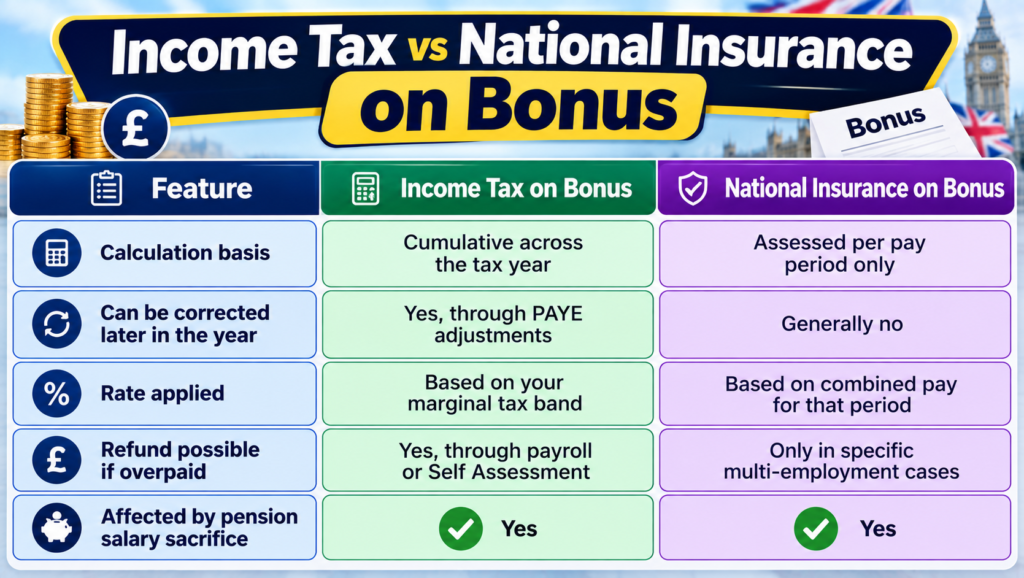
Because Income Tax is cumulative, if a bonus temporarily pushes you into a higher tax band for one month, PAYE often self-corrects over the following months as your average annual income is recalculated. National Insurance doesn’t work this way. Whatever NI band your bonus falls into for that pay period is final, with no automatic smoothing across the rest of the year.
This is the single biggest source of confusion people have when comparing the tax and NI lines on a bonus payslip — they expect both to behave the same way, and they don’t.
Using Salary Sacrifice to Reduce Bonus NI
If your employer offers pension salary sacrifice, applying it to a bonus is one of the most effective ways to reduce both Income Tax and National Insurance on that specific payment.
When you sacrifice part of a bonus into your pension, that portion never counts as pay for tax or NI purposes at all — it goes straight into your pension pot instead. Because it’s removed before the NI calculation happens, you avoid paying National Insurance on the sacrificed amount entirely, rather than simply deferring or reducing it.
Worked comparison: £4,000 bonus, basic-rate taxpayer, no other pay changes that month
| Approach | NI Paid on Bonus Portion | Income Tax Paid on Bonus Portion | Amount Reaching Pension |
| Take bonus as cash | Up to 8% (or 2% on the top slice) | 20% | £0 |
| Sacrifice full £4,000 into pension | £0 | £0 | £4,000 (plus employer’s own NI saving, if passed on) |
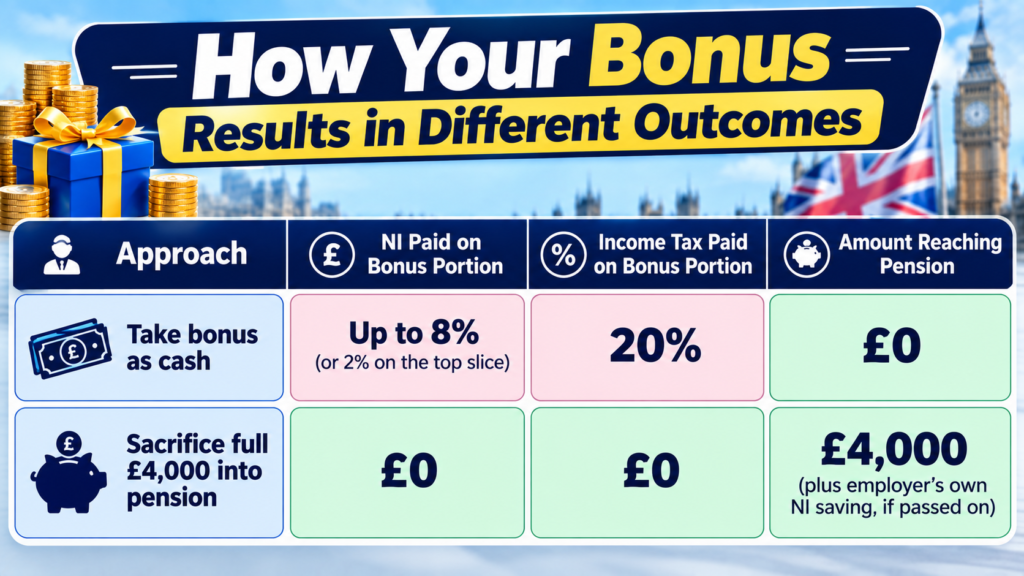
Not everyone wants to put an entire bonus into a pension, and that’s a completely reasonable choice — the point isn’t that sacrifice is always the right answer, but that it’s worth knowing the option exists and understanding exactly what it saves before deciding either way. Many employers will also let you sacrifice a portion of a bonus rather than all of it, which gives you some cash now and some tax-efficient saving for later.
Mistakes to Avoid and Best Practices
A few habits separate people who understand their bonus payslip from those who don’t.
Mistakes worth avoiding:
- Assuming the NI deducted from a bonus is a mistake. A bonus month often does produce a noticeably larger NI deduction than usual, and this is expected behaviour rather than a payroll error.
- Confusing bonus NI with a higher NI rate. The rate itself hasn’t changed — it’s the combined pay for that period crossing into a higher band that increases the deduction.
- Not checking whether Income Tax evens out later. Some people see a large tax deduction in a bonus month and assume it’s permanent, when PAYE often adjusts this over subsequent months. National Insurance won’t correct itself the same way, so it’s worth understanding which of the two you’re actually looking at.
- Overlooking salary sacrifice as an option. Many employees don’t realise a bonus can be sacrificed into a pension at all, and simply accept the cash payment along with the full tax and NI deduction by default.
- Assuming annual salary determines the NI band for a bonus. What matters is the combined pay for the specific period the bonus lands in, not your average monthly or annual earnings.
Practices worth building in:
- Check your bonus payment date against your normal pay cycle. If your bonus is paid in the same period as your regular salary, expect a larger combined NI deduction than either payment would produce on its own.
- Ask your payroll team whether bonuses are processed as part of your normal payslip or separately, since this affects how the pay-period calculation is applied.
- If salary sacrifice is available, request the figures for both options — full cash bonus versus full or partial sacrifice — before deciding, so you can compare the actual NI and tax difference rather than estimating it.
- Don’t assume a large NI deduction in a bonus month reflects your ongoing tax position. It’s specific to that pay period and doesn’t indicate your NI rate has permanently changed.
- If you’re self-employed or receive bonus-like payments through a different structure, check the rules separately — Class 4 National Insurance for the self-employed works differently again, calculated annually on profits rather than per pay period.
Student Loans, Multiple Jobs and Year-End
A bonus doesn’t just affect National Insurance in isolation — it can ripple into other deductions calculated the same way.
Student Loan Repayments
Like National Insurance, student loan repayments are usually calculated on a pay-period basis rather than being smoothed across the year. If a bonus pushes your monthly pay above your plan’s threshold, you’ll see a larger student loan deduction that month, on top of the extra NI. This isn’t a permanent increase in your repayment rate — it’s simply that period’s earnings crossing the threshold, in exactly the same way NI does.
Multiple Jobs
If you have more than one job, each employer calculates National Insurance independently based only on what they pay you. A bonus from one employer doesn’t get combined with salary from another for NI purposes, which means a bonus that looks large relative to one job’s salary won’t push you into a higher NI band because of income from a second job. This is different to Income Tax, where your total income across jobs can matter more depending on how your personal allowance is split.
Year-End Position
Because National Insurance isn’t reconciled cumulatively the way Income Tax is, there’s generally no year-end adjustment that corrects for a bonus month’s higher NI deduction. The one exception worth knowing about is for people who’ve had two or more jobs during the year and may have overpaid NI across the combined total — in that specific situation, it’s possible to claim a refund from HMRC after the tax year ends.
Frequently Overlooked Details
A handful of points rarely get covered in a basic explanation but genuinely matter:
- Employer National Insurance also increases on a bonus, though this cost falls on your employer rather than you — it’s calculated at 15% above the Secondary Threshold and doesn’t appear on your payslip.
- A bonus paid in the final pay period of the tax year can still be subject to full NI, even if it pushes your total annual earnings unusually high for that one month — the period-based rule applies regardless of timing within the year.
- Directors are often treated differently for NI purposes, since company directors can have National Insurance calculated on an annual, cumulative basis rather than period by period, which changes how a bonus affects their NI compared with a standard employee.
- A bonus doesn’t affect your Personal Allowance directly, but if it pushes your total annual income above £100,000, it can start reducing your Personal Allowance for Income Tax purposes — a separate effect from anything happening with National Insurance.
- Non-cash bonuses, such as vouchers or company shares, can be treated completely differently for NI purposes depending on the type of benefit, and shouldn’t be assumed to follow the same rules as a cash bonus.
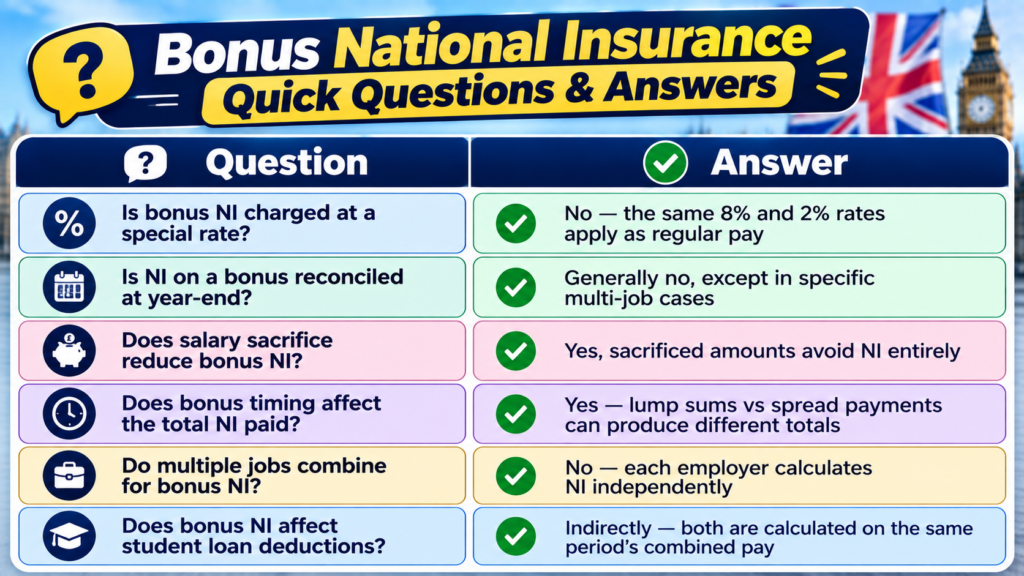
Bonus NI: Quick Reference Table
| Question | Answer |
| Is bonus NI charged at a special rate? | No — the same 8% and 2% rates apply as regular pay |
| Is NI on a bonus reconciled at year-end? | Generally no, except in specific multi-job cases |
| Does salary sacrifice reduce bonus NI? | Yes, sacrificed amounts avoid NI entirely |
| Does bonus timing affect the total NI paid? | Yes — lump sums vs spread payments can produce different totals |
| Do multiple jobs combine for bonus NI? | No — each employer calculates NI independently |
| Does bonus NI affect student loan deductions? | Indirectly — both are calculated on the same period’s combined pay |
Key Takeaways
Multiple jobs, student loan thresholds, and director status can all change how a bonus is treated, so it’s worth checking your own circumstances rather than assuming a standard calculation applies.
National Insurance on a bonus is calculated using the same rates as your normal salary — there’s no separate, higher “bonus rate.”
Because NI is assessed per pay period rather than across the year, a bonus can push part of that period’s earnings into a higher NI band, increasing the deduction for that month specifically.
Unlike Income Tax, National Insurance generally isn’t corrected or refunded later in the year just because a bonus temporarily inflated one month’s earnings.
Salary sacrifice into a pension is one of the most effective ways to reduce or eliminate NI on a bonus payment.
How and when a bonus is paid — as a lump sum or spread across several pay periods — can genuinely change the total NI paid on the same overall amount.
Final Thoughts
Bonus National Insurance in the UK isn’t about a special higher rate — it’s about how National Insurance is calculated period by period rather than across the whole tax year. Once you understand that a bonus simply adds to your normal pay for that specific period, and that NI bands apply to the combined total, the size of the deduction on a bonus payslip stops feeling like a mystery.
Whether you’re trying to predict what a bonus will actually be worth, comparing how different employers structure bonus payments, or considering salary sacrifice to reduce the impact, understanding how bonus National Insurance works in the UK puts you in a much better position to plan around it. If you want to see the exact NI and tax impact of your own bonus, use our free UK salary and bonus calculator to run the numbers against your actual pay and pension setup.
This article is for general information only and reflects UK National Insurance rules and rates for the 2026/27 tax year at the time of writing. It is not personal financial advice — for guidance specific to your circumstances, consult a qualified financial adviser or your employer’s payroll team.
FAQ’s
Do you pay more National Insurance on a bonus?
Not at a higher rate, but often in a higher amount for that pay period. A bonus is added to your normal pay for that period, which can push part of your combined earnings into a higher NI band, increasing the total deduction for that month.
What percentage of NI is deducted from a bonus?
The same rates apply as to regular salary: 8% on combined earnings between £1,048 and £4,189 a month for 2026/27, and 2% on anything above that, with nothing charged below £1,048.
Can I avoid paying National Insurance on my bonus?
You can reduce or eliminate NI on a bonus by sacrificing some or all of it into a workplace pension through salary sacrifice, since sacrificed amounts are removed before NI is calculated.
Does a bonus affect my Income Tax as well as National Insurance?
Yes, though the two are calculated differently. Income Tax is worked out cumulatively across the tax year and can adjust in later months, while National Insurance is assessed separately for each pay period with no automatic correction.
Is bonus National Insurance refunded at the end of the tax year?
Generally no, unless you’ve had two or more jobs during the year and may have overpaid National Insurance across the combined total, in which case a refund can be claimed from HMRC.
Does it matter when my employer pays my bonus?
Yes. A bonus paid as a lump sum in one pay period can result in more total National Insurance than the same amount spread across several pay periods, because NI thresholds apply per period.
Do employers pay National Insurance on bonuses too?
Yes. Employers pay Class 1 National Insurance at 15% on earnings above the Secondary Threshold, including bonus payments, though this cost doesn’t appear on the employee’s payslip.
Does a bonus affect my student loan repayments?
It can. Student loan repayments are usually calculated on the same period’s combined pay as National Insurance, so a bonus that pushes you above your plan’s threshold for that period will increase that month’s repayment.
Are company directors taxed differently on bonuses for NI purposes?
Often, yes. Directors can have National Insurance calculated on an annual, cumulative basis rather than period by period, which changes how a bonus affects their NI compared with a standard employee.
Does putting a bonus into a pension avoid National Insurance completely?
If done through salary sacrifice, yes — the sacrificed portion is removed from your pay before NI is calculated, so no National Insurance is due on that amount at all.