UK Payroll Calendar 2026/27 If you’ve ever stared at your online banking wondering why your pay didn’t land when you expected it to, you’re not alone. UK Payroll Calendar 2026/27 Pay dates feel like they should be simple — the same day every month, like clockwork. UK Payroll Calendar 2026/27 In reality, weekends, bank holidays, and the way payroll teams process BACS payments can shift your actual pay date by a day or two, sometimes more UK Payroll Calendar 2026/27 .
This guide sets out the full UK Payroll Calendar 2026/27, covering monthly and weekly pay dates, how tax weeks and tax months actually work, and why your pay might arrive earlier or later than the date on your contract UK Payroll Calendar 2026/27 . Whether you’re paid on the last working day of the month, the 25th, or every Friday, you’ll find a clear reference here UK Payroll Calendar 2026/27 .
Quick answer: The UK tax year for 2026/27 runs from 6 April 2026 to 5 April 2027. UK Payroll Calendar 2026/27 Most monthly-paid employees are paid on a fixed calendar date (such as the 25th or the last working day of the month), while weekly-paid employees are typically paid every Friday UK Payroll Calendar 2026/27. When a scheduled pay date falls on a weekend or bank holiday, payroll is usually processed on the last working day before it UK Payroll Calendar 2026/27 .
This article walks through everything you need to plan around your pay in the 2026/27 tax year: how the UK tax year is structured, the difference between tax weeks, tax months and calendar months, a full monthly and weekly payroll calendar adjusted for weekends and bank holidays, why your pay date can shift even when your contract states a fixed date, and the misunderstandings that trip up even experienced payroll staff. UK Payroll Calendar 2026/27 By the end, you’ll know exactly which date to expect your pay in any given month, and why UK Payroll Calendar 2026/27 .
Read More: Self-Employed vs PAYE Tax – Key Differences Explained
Understanding the UK Tax Year
Before looking at pay dates, it helps to understand the tax year itself, because UK payroll is built around it rather than around the standard January-to-December calendar UK Payroll Calendar 2026/27 .
The UK tax year runs from 6 April to 5 April the following year. For 2026/27, that means:
- Start date: 6 April 2026
- End date: 5 April 2027
This slightly odd start date goes back centuries, but the practical effect today is simple: your tax code, National Insurance thresholds, and payroll calculations all reset on 6 April, not 1 January UK Payroll Calendar 2026/27 . If you’ve ever wondered why HMRC talks about “tax year 2026/27” instead of just “2026,” this is why UK Payroll Calendar 2026/27 .
Employers use this tax year to divide pay periods into tax weeks and tax months, which don’t always match up neatly with calendar weeks and months. This is one of the most common sources of payroll confusion, and it’s worth getting comfortable with before looking at the actual pay dates UK Payroll Calendar 2026/27 .
Visit Now: https://www.taxsal.com/
Key Terms You Need to Know
A few terms come up repeatedly on any UK payroll calendar UK Payroll Calendar 2026/27 . Understanding them now makes the rest of this guide much easier to follow UK Payroll Calendar 2026/27 .
Tax Week
A tax week is a seven-day period counted from the start of the tax year UK Payroll Calendar 2026/27 . Tax week 1 begins on 6 April. Weekly-paid employees are usually paid according to tax week number, not the calendar week, which is why payslips often show a “week number” rather than a date range UK Payroll Calendar 2026/27 .
Tax Month
A tax month runs from the 6th of one calendar month to the 5th of the next UK Payroll Calendar 2026/27 . Tax month 1 is 6 April to 5 May, tax month 2 is 6 May to 5 June, and so on UK Payroll Calendar 2026/27 . Most monthly-paid employees are paid based on tax months, even if their contract states a specific calendar date like “the 25th of each month UK Payroll Calendar 2026/27 .”
Pay Date vs Pay Period
The pay period is the block of time your pay covers (a tax week or tax month) UK Payroll Calendar 2026/27 . The pay date is the actual day the money is paid into your account. UK Payroll Calendar 2026/27 These aren’t always the same thing — you might be paid on 25 June for work completed up to 5 June, depending on how your employer’s payroll cycle is set up UK Payroll Calendar 2026/27 .
BACS Processing
Most UK employers pay staff via BACS (Bankers’ Automated Clearing Services), which takes three working days to clear UK Payroll Calendar 2026/27 . This is why payroll teams often submit payment instructions a few days before the actual pay date, and why pay can sometimes appear a day early if a bank has processed it ahead of schedule UK Payroll Calendar 2026/27 .
Payroll Frequency
UK Payroll Calendar 2026/27 This refers to how often you’re paid — weekly, fortnightly, four-weekly, or monthly. Monthly is the most common in the UK, but weekly pay is still standard in sectors like retail, hospitality, and construction UK Payroll Calendar 2026/27 .
Why Pay Dates Aren’t Always the Same Date Each Month
This is where most of the confusion happens UK Payroll Calendar 2026/27 . If your contract says you’re paid “on the 28th,” you might assume that means the 28th every single month, without exception. In practice, payroll almost always follows this rule instead:
If the scheduled pay date falls on a weekend or bank holiday, pay is moved to the last working day before it UK Payroll Calendar 2026/27 .
So if the 28th falls on a Saturday, you’d typically be paid on Friday the 27th instead — not the following Monday UK Payroll Calendar 2026/27 . This protects employees from having to wait extra days for money that was already due, but it does mean your pay date moves around slightly throughout the year UK Payroll Calendar 2026/27 .
Bank holidays complicate things further UK Payroll Calendar 2026/27 . The UK has several bank holidays scattered through the 2026/27 tax year, including Easter, the early May bank holiday, the late May bank holiday, and the August bank holiday. Any of these landing near your normal pay date can shift when your money actually arrives UK Payroll Calendar 2026/27 .
Common Misconceptions About Payroll Calendars
A few misunderstandings come up again and again, so it’s worth clearing them up before moving on UK Payroll Calendar 2026/27 .
“My pay date is fixed and never changes UK Payroll Calendar 2026/27 .”
Not quite UK Payroll Calendar 2026/27 . Even with a fixed contractual date, weekends and bank holidays cause it to shift several times a year. What’s fixed is the intended date, not necessarily the actual date the money lands UK Payroll Calendar 2026/27 .
“Being paid weekly means I get paid every single Friday, no exceptions UK Payroll Calendar 2026/27 .”
Mostly true, but bank holidays can occasionally move a weekly pay run forward by a day, particularly around Christmas and Easter, when many payroll teams process early to avoid holiday closures UK Payroll Calendar 2026/27 .
“Tax months are the same as calendar months.”
They’re not. A tax month runs from the 6th to the 5th, which is why your April payslip might actually reflect earnings up to 5 May, not 30 April.
“If my pay date falls on a bank holiday, I’ll be paid the next working day.”
Usually the opposite is true. Most UK employers pay earlier than a weekend or holiday, not later, so employees aren’t left waiting for money that’s already due.
How Payroll Frequency Affects Your Pay
The frequency you’re paid at doesn’t just affect how often money lands in your account — it also affects how your Income Tax and National Insurance are calculated. HMRC applies tax-free allowances proportionally to each pay period, so a monthly-paid employee gets one-twelfth of their annual Personal Allowance applied each month, while a weekly-paid employee gets one fifty-second applied each week.
| Payroll Frequency | Pay Periods Per Year | Typical Sectors |
| Weekly | 52 (occasionally 53) | Retail, hospitality, construction |
| Fortnightly | 26 | Some public sector and agency roles |
| Four-weekly | 13 | Some private sector employers |
| Monthly | 12 | Most office-based and salaried roles |
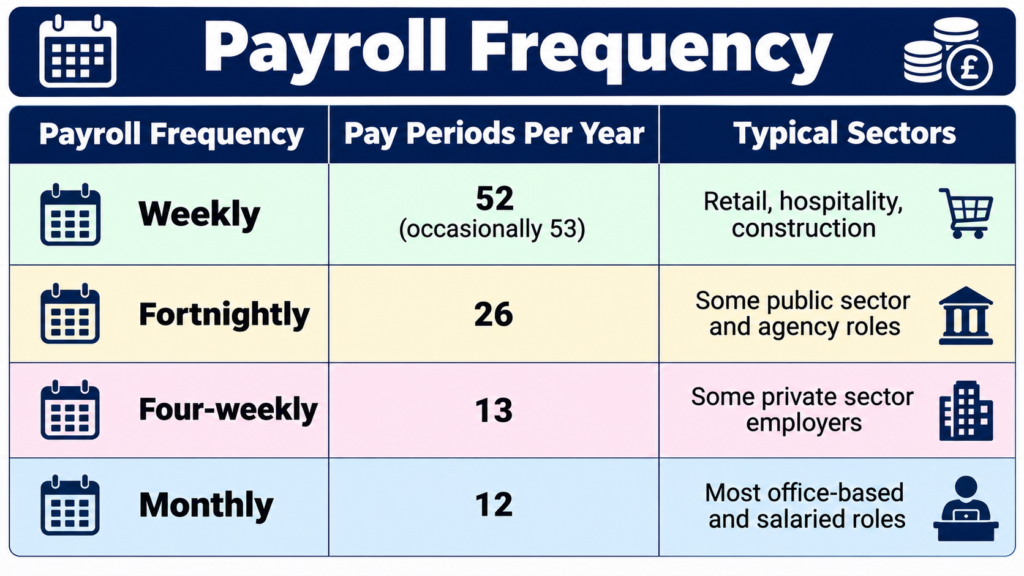
That “occasionally 53” next to weekly pay isn’t a typo — it’s a quirk of how the UK tax year is structured, and it can catch both employees and payroll software off guard. We’ll come back to it under Weekly Pay below.
With the basic structure of the tax year in place, the next step is learning how to work out your own pay date for any given month — and why real pay dates so often move earlier than the date written in your contract.
How to Work Out Your Own Pay Date
Rather than memorising a calendar, it’s worth understanding the logic payroll teams actually use. Once you know the rule, you can work out your own pay date for any month in seconds.
Step 1: Identify your contractual pay date.
Check your contract or offer letter for the wording. It’s usually one of these three formats:
- A fixed calendar date (e.g. “paid on the 25th of each month”)
- The last working day of the month
- A fixed day of the week (e.g. “paid every Friday”)
Step 2: Check whether that date falls on a weekend.
If your contractual date lands on a Saturday or Sunday, assume your pay will arrive on the Friday before, not the Monday after. This is standard practice across almost all UK employers.
Step 3: Check for bank holidays near your pay date.
If a bank holiday falls on or immediately before your usual pay date, payroll is often processed a day or two earlier to allow for bank processing time. This is especially common around Christmas and Easter.
Step 4: Allow for BACS processing time.
Payroll teams typically submit payment instructions three working days before the money actually clears. This doesn’t usually change your pay date, but it explains why payroll departments have earlier internal deadlines than the date you actually get paid.
Step 5: Cross-reference with your specific employer’s policy.
Some employers always move pay forward when a date falls on a non-working day, but a small number move it backward instead. If you’re not sure, your payslip history or HR team will confirm which approach your employer uses.
Worked Examples: How Real Pay Dates Shift
Seeing this in practice makes the pattern much clearer. Here’s how it plays out for a monthly-paid employee on a “25th of the month” contract during the 2026/27 tax year.
Example 1: April 2026
25 April 2026 falls on a Saturday. Following standard practice, pay would be processed on Friday 24 April 2026 instead.
Example 2: May 2026
25 May 2026 falls on a Monday — and it happens to be the Spring bank holiday that year too. With both the weekend rule and the bank holiday overlapping, pay would move to Friday 22 May 2026, three working days earlier than the contracted date.
Example 3: August 2026
Employees paid on the last working day of the month would normally expect 31 August 2026. That date is a Monday and the Summer bank holiday. Pay would shift to Friday 28 August 2026.
Example 4: December 2026
25 December 2026 is Christmas Day itself, and many employers close for several days either side of it. Rather than simply moving pay to the nearest working day, most payroll teams bring December pay forward earlier than usual — commonly to Wednesday 23 or Thursday 24 December — to make sure staff are paid before the office closes for the holidays.
Expert tip: December is the one month where it’s worth checking with HR directly rather than assuming the standard “move to the Friday before” rule applies. Christmas payroll dates vary more between employers than any other month in the calendar.
Weekly Pay: How It Works Differently
Weekly-paid employees follow a different logic entirely. Instead of tracking a calendar date, payroll counts tax weeks from the start of the tax year on 6 April.
If you’re paid every Friday, your pay date simply follows the calendar — Friday to Friday — regardless of which date of the month it lands on. The complication isn’t monthly at all; it’s a quirk that shows up roughly once every five or six years, called “week 53.”
What Is Week 53?
A standard tax year has 52 tax weeks. But because 52 weeks is only 364 days, and the tax year is 365 (or 366 in a leap year), there’s a leftover day or two. In most years, this extra time gets absorbed neatly into week 52. Occasionally, though, it creates a genuine 53rd payday within the same tax year.
This matters because HMRC tax tables are built around 52 or 53 pay periods, and getting the wrong number can affect how much tax-free allowance is applied to that final payment. If you’re weekly paid, it’s worth checking with your payroll department whether the 2026/27 tax year includes a week 53 for your specific payday, since it depends on exactly which day of the week you’re paid.
Important note: Week 53 isn’t a bonus payment — it’s simply an extra pay run that falls within the same tax year due to the calendar math. Your annual salary is usually unaffected; what changes is how tax-free allowances are split across the additional period.
Monthly vs Weekly Pay: A Practical Comparison
| Factor | Monthly Pay | Weekly Pay |
| Pay periods per year | 12 | 52 (occasionally 53) |
| Tax-free allowance applied | 1/12th of annual allowance per period | 1/52nd of annual allowance per period |
| Sensitivity to bank holidays | Can shift pay by several days in some months | Usually shifts by a single day, if at all |
| Budgeting predictability | Easier to plan around fixed monthly bills | Requires more frequent budgeting |
| Common in | Salaried, office-based roles | Retail, hospitality, construction, agency work |
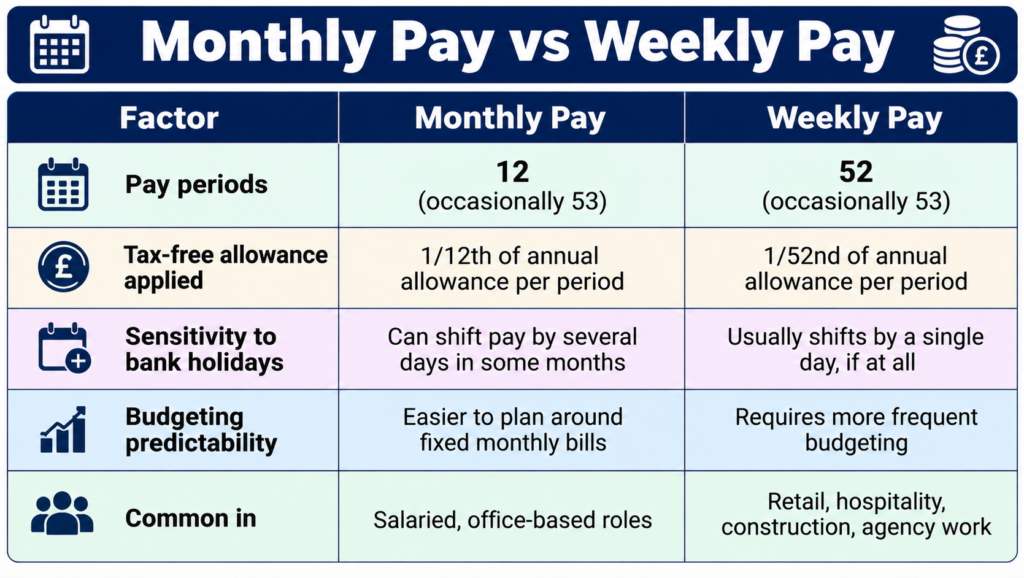
Neither system is better or worse — it depends on your role and how your employer runs payroll. But if you’re moving between a monthly-paid role and a weekly-paid one, it’s worth budgeting for the adjustment period, since the gap between your final weekly payslip and your first monthly one can feel longer than expected.
Common Payroll Calendar Mistakes to Avoid
- Assuming pay always moves to the next working day after a weekend. In the UK, it’s almost always the opposite — pay is brought forward, not pushed back.
- Not accounting for bank holidays that fall mid-week. A bank holiday landing on a Tuesday or Wednesday can still affect BACS processing times even though it isn’t your actual pay date.
- Confusing tax months with calendar months. As covered earlier, a tax month runs from the 6th to the 5th — this trips up a lot of people when comparing payslips to P60s or year-end summaries.
- Forgetting that December pay dates are often non-standard. Applying the usual “move to the Friday before” logic to December can lead to inaccurate expectations, since many employers pay earlier than that rule would suggest.
- Assuming a fixed weekly payday never changes. While rare, bank holidays around Christmas and Easter can occasionally shift a weekly payday forward by a day.
Best Practices for Staying on Top of Your Pay Dates
- Keep a copy of your employer’s payroll calendar if one is provided — many larger organisations publish one at the start of the tax year.
- Set a reminder a few days before bank holidays that fall close to your usual pay date, so you’re not caught off guard by an early or delayed payment.
- If you’re budgeting around a specific pay date, build in a one-to-two-day buffer during months with bank holidays.
- For weekly-paid roles, check with payroll whether the current tax year includes a week 53, particularly if you’re doing your own tax planning.
With the logic behind pay date shifts covered, here’s the full 2026/27 monthly and weekly payroll calendar, with every date adjusted for weekends and UK bank holidays, so you can look up your exact pay date at a glance.
UK Payroll Calendar 2026/27: Monthly Pay Dates in Full
The table below sets out the two most common contract types — last working day of the month and fixed date (25th) — adjusted for weekends and bank holidays using the rules covered above.
| Month | Last Working Day Schedule | 25th of Month Schedule |
| April 2026 | Thu 30 April | Fri 24 April |
| May 2026 | Fri 29 May | Fri 22 May |
| June 2026 | Tue 30 June | Thu 25 June |
| July 2026 | Fri 31 July | Fri 24 July |
| August 2026 | Fri 28 August | Tue 25 August |
| September 2026 | Wed 30 September | Fri 25 September |
| October 2026 | Fri 30 October | Fri 23 October |
| November 2026 | Mon 30 November | Wed 25 November |
| December 2026 | Thu 31 Dec (often brought forward to 23–24 Dec) | Fri 23 December |
| January 2027 | Fri 29 January | Mon 25 January |
| February 2027 | Fri 26 February | Thu 25 February |
| March 2027 | Wed 31 March | Thu 25 March |
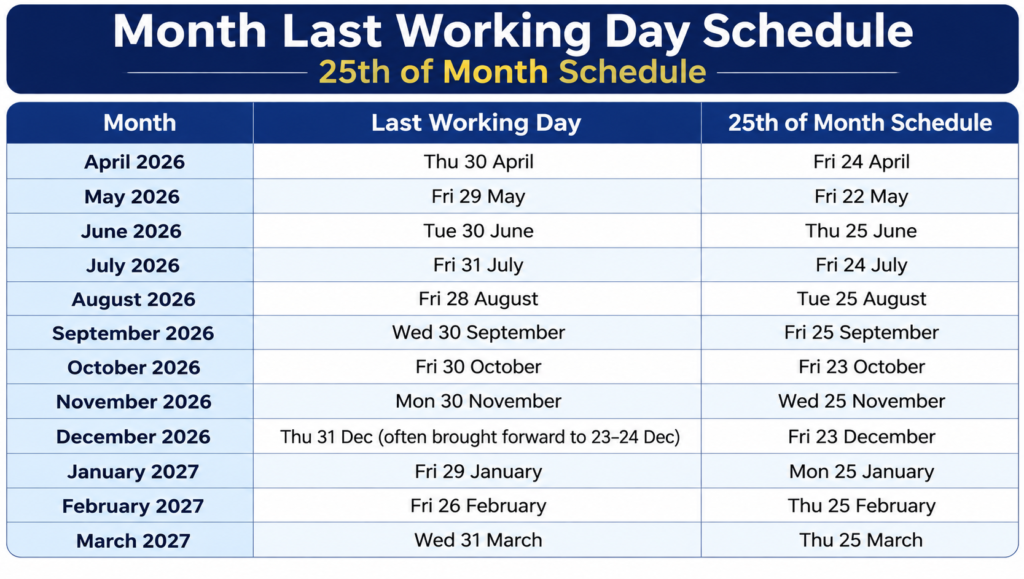
Important note: These dates assume your employer applies the standard “move pay forward if it lands on a non-working day” rule. Some employers use different logic, particularly around Christmas, so always confirm your exact dates with HR or your payslip portal rather than relying solely on a general calendar.
Weekly Payroll Calendar: Tax Weeks 2026/27
For weekly-paid employees on a Friday payday, tax week 1 begins Monday 6 April 2026, with the first payday falling on Friday 10 April 2026. From there, paydays run every seven days through to the end of the tax year.
| Tax Period | First Payday | Last Payday |
| Tax Weeks 1–13 (Apr–Jun) | Fri 10 April 2026 | Fri 26 June 2026 |
| Tax Weeks 14–26 (Jul–Sep) | Fri 3 July 2026 | Fri 25 September 2026 |
| Tax Weeks 27–39 (Oct–Dec) | Fri 2 October 2026 | Fri 25 December 2026 |
| Tax Weeks 40–52 (Jan–Mar) | Fri 1 January 2027 | Fri 26 March 2027 |
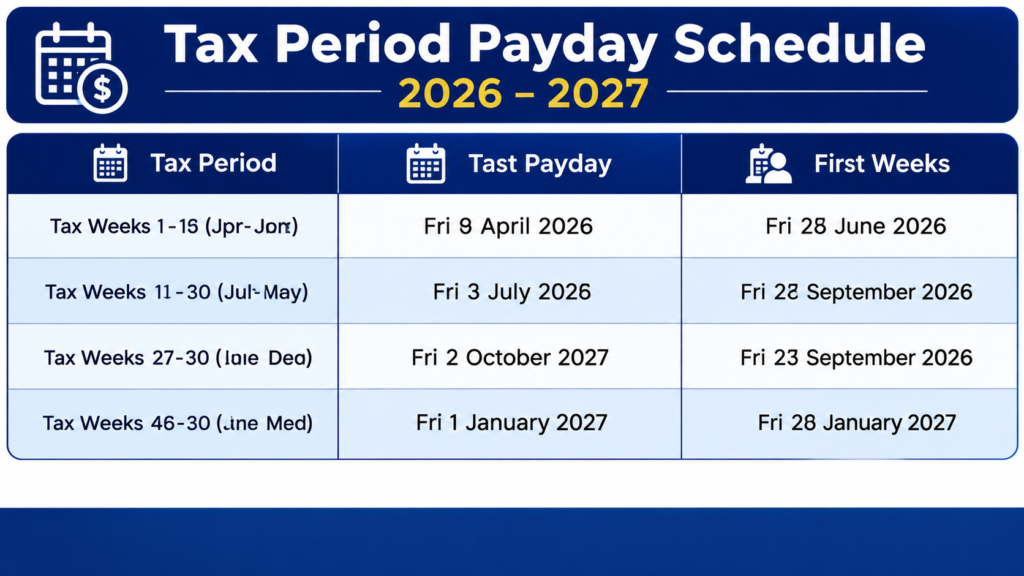
For 2026/27 specifically, the tax year runs exactly 365 days from its 6 April start, leaving one leftover day that falls on Monday 5 April 2027. Since Friday-paid employees never have a payday land on that leftover day, this particular tax year doesn’t produce a week 53 for standard Friday payroll. Employees paid on a Saturday or Sunday should still check with their employer, since the extra day can affect different weekdays differently.
Advanced Tips for Managing Irregular Pay Dates
Align your bill payments to your latest possible pay date, not your earliest. If your pay date shifts between the 22nd and 25th depending on the month, set direct debits for the 26th or later. This avoids failed payments in months where pay arrives a few days earlier than usual.
Watch for months where two adjustments stack. May and August 2026 both combine a weekend and a bank holiday landing close together, which is why pay in those months tends to arrive three or four working days earlier than the contracted date rather than just one.
Don’t assume overtime and bonuses follow the same schedule as your base salary. Some employers process regular salary and variable pay (overtime, commission) on different cut-off dates within the same tax month, even though both appear on the same payslip.
Check your payslip’s tax week or tax month number, not just the date. If you’re comparing payslips across a job change, the week or month number tells you which HMRC period your tax-free allowance applied to — far more reliable than the calendar date alone.
Frequently Overlooked Payroll Details
Most payroll calendars stop at “pay dates move around weekends,” but a few details genuinely catch people out each year:
- Starter and leaver dates can shift which tax week or month a payment falls into, especially if you start or leave a job mid-month.
- Payroll cut-off dates (when your hours or timesheet must be submitted) are usually 5–10 working days before the actual pay date — missing this can push a payment to the following period entirely.
- Bank processing delays, though rare, can occasionally hold up a payment by one working day even when payroll has submitted everything correctly and on time.
- Scottish and Northern Ireland bank holidays differ slightly from those in England and Wales, which means employees in those regions may see slightly different pay date adjustments in months where the holiday dates diverge.
Key Takeaways
Always confirm exact dates with your employer, since practices can vary slightly between organisations.
The 2026/27 tax year runs from 6 April 2026 to 5 April 2027.
Monthly pay is usually based on tax months (6th to 5th), even when your contract states a fixed calendar date.
When a pay date falls on a weekend or bank holiday, UK employers almost always move payment earlier, not later.
December pay dates are frequently brought forward well ahead of Christmas due to office closures.
Weekly-paid employees occasionally see a week 53, though it doesn’t apply to every payday or every tax year.
Final Thoughts
Understanding the UK Payroll Calendar 2026/27 comes down to a handful of simple rules: know your tax year dates, understand the difference between tax months and calendar months, and remember that pay is almost always moved earlier rather than later when it clashes with a weekend or bank holiday. Once you’ve mapped your own contracted pay date against the calendar above, budgeting around it becomes far more predictable.
If you want to check exactly what lands in your account each pay period, use our free take-home pay calculator to see your estimated net pay for any month or week in the 2026/27 tax year.
This article is for general information only and reflects standard UK payroll practice at the time of writing. Individual employers can apply slightly different rules, so always confirm exact pay dates with your own HR or payroll team.
FAQ’s
When does the 2026/27 tax year start and end?
The 2026/27 tax year runs from 6 April 2026 to 5 April 2027.
Why is my pay date different from the date in my contract?
Your contracted date is the intended pay date. If it falls on a weekend or bank holiday, most UK employers move payment to the last working day before it, which can make the actual date look different from what’s written in your contract.
Will I be paid earlier or later if my pay date falls on a bank holiday?
Earlier, in almost all cases. UK payroll practice is to bring pay forward rather than delay it past a holiday.
What is a tax month in UK payroll?
A tax month runs from the 6th of one calendar month to the 5th of the next, rather than following standard calendar months. Tax month 1 of 2026/27 is 6 April to 5 May 2026.
What is week 53 and does it apply to me?
Week 53 is an extra pay period that occurs in some tax years for weekly-paid employees, due to the tax year not dividing evenly into 52 seven-day weeks. Whether it applies depends on your specific payday and the tax year in question — check with your payroll department.
When will I be paid in December if my usual pay date is the 25th?
Since 25 December 2026 is Christmas Day, most employers bring pay forward, commonly to around 23 December 2026, though exact dates vary by employer.
Does my pay date affect how much tax I pay?
No, not directly. Your Income Tax and National Insurance are calculated based on the tax period the payment relates to, not the exact calendar date it lands on.
Are payroll dates the same across England, Scotland, Wales, and Northern Ireland?
The tax year and tax week/month structure are UK-wide, but bank holiday dates differ slightly by region, which can cause minor variations in adjusted pay dates.
How can I find my exact pay date for a specific month?
Check your payslip, your employer’s payroll calendar if one is published, or ask your HR or payroll department directly, particularly around bank holidays and December.
Does being paid weekly or monthly affect how much tax-free allowance I get?
No. Your annual Personal Allowance is simply divided across your pay periods — one-twelfth per month for monthly pay, or one fifty-second per week for weekly pay — so the total tax-free amount over the year is the same either way.