Pre-Tax and Post-Tax Deductions UK If you’ve ever compared your gross salary to what actually lands in your bank account and wondered where the gap went, the answer usually comes down to two things: pre-tax and post-tax deductions Pre-Tax and Post-Tax Deductions UK. Some money leaves your pay before tax is worked out Pre-Tax and Post-Tax Deductions UK. Some leaves after Pre-Tax and Post-Tax Deductions UK. And which category a deduction falls into can quietly change how much tax and National Insurance you end up paying Pre-Tax and Post-Tax Deductions UK.
Pre-tax and post-tax deductions UK rules matter because the order in which money is taken from your salary affects your final take-home pay, not just the total amount deducted Pre-Tax and Post-Tax Deductions UK. Two people with identical salaries and identical pension contributions can end up with different net pay simply because one uses a pre-tax scheme and the other uses a post-tax one Pre-Tax and Post-Tax Deductions UK.
Pre-Tax and Post-Tax Deductions UK This guide walks through what counts as a pre-tax deduction, what counts as a post-tax deduction, why the distinction matters, how to read your own payslip with a clearer eye, and how these rules interact with bonuses, overtime, and multiple jobs Pre-Tax and Post-Tax Deductions UK.
Read More: UK Payroll Calendar 2026/27 – Monthly & Weekly Pay Dates
Quick Answer: What’s the Difference?
A pre-tax deduction is money taken from your gross pay before Income Tax and National Insurance are calculated, which lowers your taxable income and can reduce the tax you owe Pre-Tax and Post-Tax Deductions UK. A post-tax deduction is money taken after tax and National Insurance have already been worked out, so it has no effect on how much tax you pay Pre-Tax and Post-Tax Deductions UK. Common pre-tax deductions include pension contributions under a net pay scheme and salary sacrifice arrangements Pre-Tax and Post-Tax Deductions UK. Common post-tax deductions include union subscriptions, most charitable donations outside Payroll Giving, and court-ordered repayments taken from your already-taxed pay Pre-Tax and Post-Tax Deductions UK.
Visit Now: https://taxsal.com/
Why This Topic Actually Matters
Pre-Tax and Post-Tax Deductions UK Most people glance at their payslip, see the final take-home figure, and move on. That’s understandable — payslips aren’t designed to be read for fun Pre-Tax and Post-Tax Deductions UK. But if you don’t understand which deductions happen before tax and which happen after, a few things can catch you out Pre-Tax and Post-Tax Deductions UK.
Pre-Tax and Post-Tax Deductions UK You might assume a workplace benefit is “free” when it’s actually costing you through reduced taxable pay Pre-Tax and Post-Tax Deductions UK. You might turn down a pension option that would have saved you money simply because you didn’t realise it worked differently to another one Pre-Tax and Post-Tax Deductions UK. Or you might compare two job offers and think they pay the same, when the way deductions are structured means one leaves you with noticeably more in your pocket each month Pre-Tax and Post-Tax Deductions UK.
This matters most when you’re:
- Comparing job offers with different pension or benefit structures
- Deciding whether to increase a workplace pension contribution
- Working out whether salary sacrifice is worth it for childcare, cycle-to-work, or pension
- Trying to understand why your payslip doesn’t match a simple percentage calculation
- Budgeting based on a headline salary rather than what actually arrives in your account
Pre-Tax and Post-Tax Deductions UK Getting this right isn’t about squeezing out every last pound of tax efficiency Pre-Tax and Post-Tax Deductions UK. It’s about understanding your own payslip well enough to make informed decisions Pre-Tax and Post-Tax Deductions UK.
Key Terms You Need to Know First
Pre-Tax and Post-Tax Deductions UK Before going further, it helps to be clear on a handful of terms that get used loosely but actually mean specific things in payroll Pre-Tax and Post-Tax Deductions UK.
Gross Pay
Your gross pay is your full earnings before anything is taken out. It includes your basic salary plus any overtime, bonus, or other taxable pay from your employer.
Taxable Pay
Pre-Tax and Post-Tax Deductions UK Taxable pay is what’s left of your gross pay once pre-tax deductions have been removed Pre-Tax and Post-Tax Deductions UK. This is the figure HMRC actually applies Income Tax to, and it’s often lower than your gross salary Pre-Tax and Post-Tax Deductions UK.
Net Pay
Pre-Tax and Post-Tax Deductions UK Net pay, also called take-home pay, is what’s left after every deduction — pre-tax and post-tax — has been taken out, including Income Tax and National Insurance themselves Pre-Tax and Post-Tax Deductions UK.
Pre-Tax Deduction
A deduction taken from gross pay before Income Tax and National Insurance are calculated Pre-Tax and Post-Tax Deductions UK. This lowers your taxable income, which can reduce the amount of tax and NI you pay Pre-Tax and Post-Tax Deductions UK.
Post-Tax Deduction
Pre-Tax and Post-Tax Deductions UK A deduction taken from your pay after Income Tax and National Insurance have already been calculated and applied Pre-Tax and Post-Tax Deductions UK. It reduces your take-home pay but has no effect on your tax bill Pre-Tax and Post-Tax Deductions UK.
Salary Sacrifice
Pre-Tax and Post-Tax Deductions UK A formal arrangement where you agree to give up part of your salary in exchange for a non-cash benefit, such as extra pension contributions Pre-Tax and Post-Tax Deductions UK. Because your official salary is lower, you pay less Income Tax and less National Insurance on the sacrificed amount Pre-Tax and Post-Tax Deductions UK.
How PAYE Calculates Your Pay in Order
Pre-Tax and Post-Tax Deductions UK It helps to picture this as a sequence, because the order genuinely matters Pre-Tax and Post-Tax Deductions UK. HMRC and your employer’s payroll software don’t simply add up every deduction and subtract it in one go — they work through it in stages Pre-Tax and Post-Tax Deductions UK.
| Step | What Happens |
| 1 | Start with gross pay for the period |
| 2 | Subtract pre-tax deductions (e.g. net pay pension, salary sacrifice) |
| 3 | Calculate Income Tax on the remaining taxable pay |
| 4 | Calculate National Insurance on the remaining pay |
| 5 | Subtract post-tax deductions (e.g. union fees, court orders, relief at source pensions) |
| 6 | What’s left is your net take-home pay |
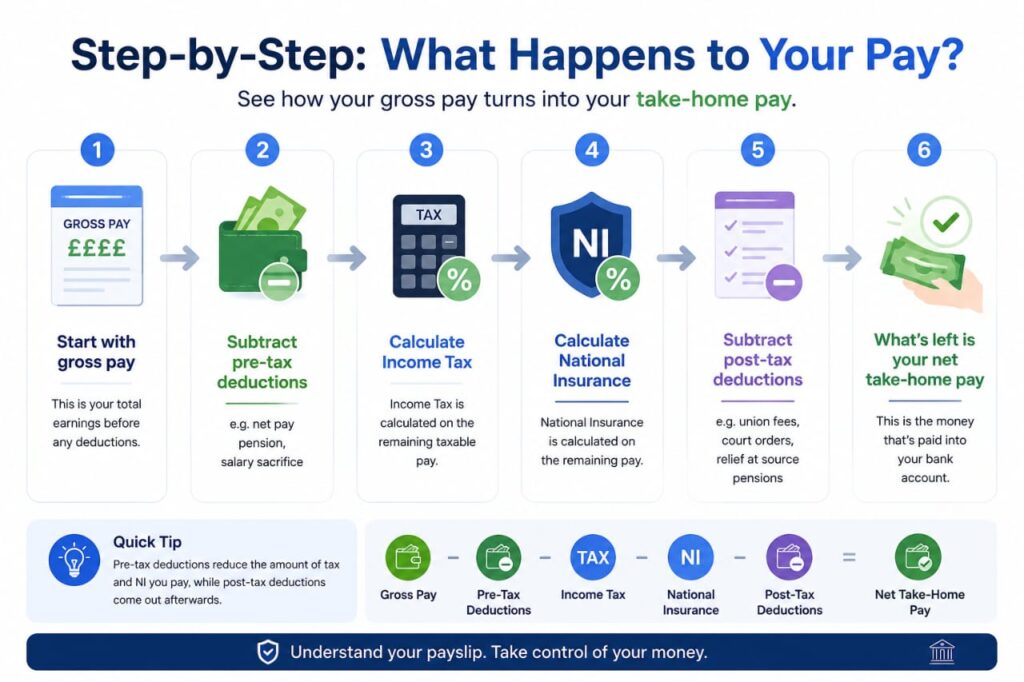
Pre-tax deductions happen at step 2, before tax and NI are worked out at steps 3 and 4 Pre-Tax and Post-Tax Deductions UK. Post-tax deductions don’t come off until step 5, once tax and NI have already been calculated on the higher figure. That single difference in timing is the whole reason the two categories behave so differently Pre-Tax and Post-Tax Deductions UK.
Common Pre-Tax Deductions in the UK
Not every deduction on your payslip qualifies as pre-tax Pre-Tax and Post-Tax Deductions UK. The main ones you’ll come across are:
- Workplace pension contributions (net pay arrangement) — deducted before tax, so you only pay Income Tax on what’s left
- Salary sacrifice pension contributions — reduces both taxable pay and National Insurance
- Salary sacrifice benefits — such as cycle-to-work schemes, electric car schemes, or childcare vouchers where still applicable
- Some employer-arranged childcare schemes — depending on how they’re structured
- Payroll Giving charitable donations — one of the few charitable schemes that qualifies as pre-tax
- Certain professional subscriptions — where HMRC has approved tax relief through payroll
The common thread is that all of these reduce your taxable pay figure before Income Tax and National Insurance are worked out.
Common Post-Tax Deductions in the UK
Pre-Tax and Post-Tax Deductions UK Post-tax deductions come off your pay after tax and NI have already been calculated, so they reduce your take-home figure but not your tax bill Pre-Tax and Post-Tax Deductions UK. Typical examples include:
- Relief at source pension contributions — deducted after tax, with the tax relief added back separately by the pension provider
- Union or professional body membership fees — where not arranged as a pre-tax deduction
- Charitable donations outside Payroll Giving — most workplace giving schemes fall into this category
- Court-ordered deductions and some loan repayments — taken from your already-taxed pay
- Season ticket loan repayments — usually repaid from net pay
A Side-by-Side Example
Say you earn £3,000 a month and want to put £150 a month into your pension Pre-Tax and Post-Tax Deductions UK.
Pre-Tax and Post-Tax Deductions UK If it’s taken as a pre-tax deduction through a net pay scheme, Income Tax is calculated on £2,850, not £3,000 Pre-Tax and Post-Tax Deductions UK. As a basic-rate taxpayer, that saves you £30 in tax that month, so the pension effectively costs you £120 out of your take-home pay, not £150 Pre-Tax and Post-Tax Deductions UK.
If instead the same £150 is taken as a post-tax deduction, Income Tax is calculated on the full £3,000. The £150 then comes off your already-taxed pay in full, so your take-home pay drops by the complete £150 Pre-Tax and Post-Tax Deductions UK.
Same contribution, same salary — but a real difference in what actually leaves your pocket, purely because of when the deduction happens relative to the tax calculation.
Common Misconceptions
A few myths tend to persist around this topic, and they’re worth clearing up early:
- “All pension contributions are treated the same for tax.” They’re not. Net pay and salary sacrifice both reduce taxable pay before tax is calculated, while relief at source contributions come off after tax, with relief added separately.
- “Post-tax deductions are always a bad deal.” Not necessarily — some benefits are only available on a post-tax basis, and the underlying value of the benefit can still make it worthwhile even without the tax saving.
- “Salary sacrifice and net pay pensions work the same way.” They don’t quite. Salary sacrifice also reduces your National Insurance liability, while a standard net pay scheme only reduces Income Tax.
- “Deductions always reduce your salary by the exact amount shown.” As the example above shows, a pre-tax deduction of £150 doesn’t always cost you £150 in take-home pay — the real cost depends on your tax rate.
How to Check Your Own Payslip
Payslips don’t always label deductions clearly, so it helps to have a method for working this out yourself rather than guessing.
Start with your gross pay figure. This sits at the top of most payslips and includes your basic salary plus any overtime, bonus, or commission for that period.
Find your taxable pay or “taxable gross” figure. Many UK payslips show a separate line for taxable pay, sitting just below gross pay. If this figure is lower than your gross pay, the difference is almost certainly a pre-tax deduction — most commonly a pension contribution or salary sacrifice arrangement.
Compare taxable pay with the Income Tax and NI shown. Your Income Tax and National Insurance should be calculated on the taxable pay figure, not your full gross pay. If they’ve been calculated on the higher gross figure, that’s a signal any pension or benefit deduction is being taken post-tax rather than pre-tax.
Check what’s deducted after tax and NI. Everything listed below the tax and NI lines — union fees, court orders, relief at source pension contributions, season ticket loans — is coming off your already-taxed pay. These are your post-tax deductions.
Cross-check against your contract or scheme documentation. If you’re still unsure whether a specific deduction is pre-tax or post-tax, your pension scheme booklet or employee benefits portal will usually state it directly. HMRC’s guidance also distinguishes “net pay arrangement,” “relief at source,” and “salary sacrifice” by name, so matching the term used in your paperwork against these categories clears up most confusion.
A Real-Life Job Comparison
Imagine you’re choosing between two jobs, both offering £32,000 a year with a 5% pension contribution.
Job A runs its pension as a net pay arrangement. Your 5% contribution (£1,600) comes off before tax is calculated, so Income Tax is worked out on £30,400 rather than £32,000.
Job B runs its pension as relief at source. Your 5% contribution is deducted from your already-taxed pay, and the pension provider claims the 20% relief back from HMRC separately.
On paper, both jobs pay the same salary and both take the same 5% pension contribution. In practice, the monthly cash reduction to your take-home pay ends up very close in both cases once relief is applied — but the mechanics on your payslip look completely different, and if Job B instead used salary sacrifice rather than relief at source, you’d actually keep more money each month because of the National Insurance saving as well.
This is why “same salary, same pension percentage” doesn’t automatically mean “same take-home pay.” The structure behind the deduction matters as much as the headline numbers.
Deduction Types Compared
| Deduction Type | Taken Before or After Tax? | Reduces Income Tax? | Reduces National Insurance? |
| Net pay pension | Before | Yes | No |
| Salary sacrifice pension | Before (via lower salary) | Yes | Yes |
| Relief at source pension | After | No (relief added separately) | No |
| Cycle-to-work / EV salary sacrifice | Before (via lower salary) | Yes | Yes |
| Union or professional fees (standard) | After | No | No |
| Court order / attachment of earnings | After | No | No |
| Season ticket loan repayment | After | No | No |
| Student loan repayment | Calculated on gross, deducted separately | No | No |
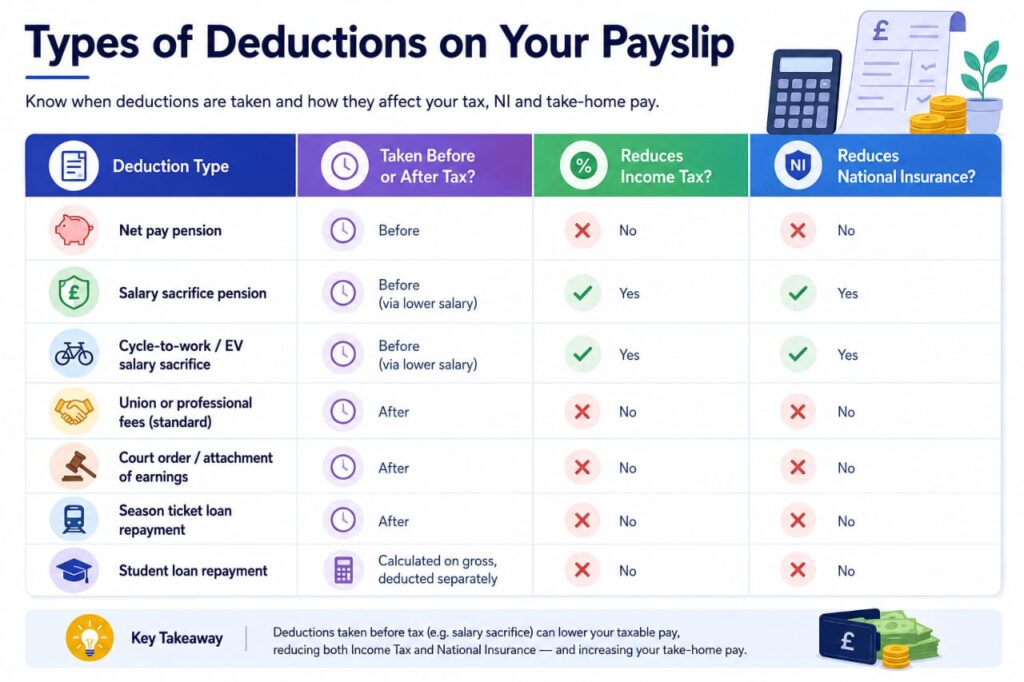
That last row deserves a quick note, because student loan repayments don’t fit neatly into either category. They’re calculated on your gross pay above the relevant threshold, but the repayment itself doesn’t reduce your taxable income the way a pre-tax pension contribution does — it’s simply worked out and deducted as its own line.
Why Salary Sacrifice Saves More Than a Standard Pre-Tax Deduction
Not all pre-tax deductions are equal, and this trips people up more than almost anything else on this topic.
A net pay pension contribution reduces your taxable pay, so you save Income Tax on that amount. But because the contribution is still technically “your money” being redirected into a pension, it doesn’t touch your National Insurance liability.
Salary sacrifice works differently. You formally agree to a lower contractual salary, and your employer pays the sacrificed amount into your pension (or another benefit) on your behalf. Because your official salary is genuinely lower, both Income Tax and National Insurance are calculated on the reduced figure. That second saving on National Insurance is what makes salary sacrifice more efficient than a standard pre-tax pension deduction, even though both are technically pre-tax.
Worked comparison on a £1,000 annual contribution for a basic-rate taxpayer:
| Method | Income Tax Saved | NI Saved | Total Saved |
| Net pay pension | £200 (20%) | £0 | £200 |
| Salary sacrifice | £200 (20%) | £80 (8%) | £280 |
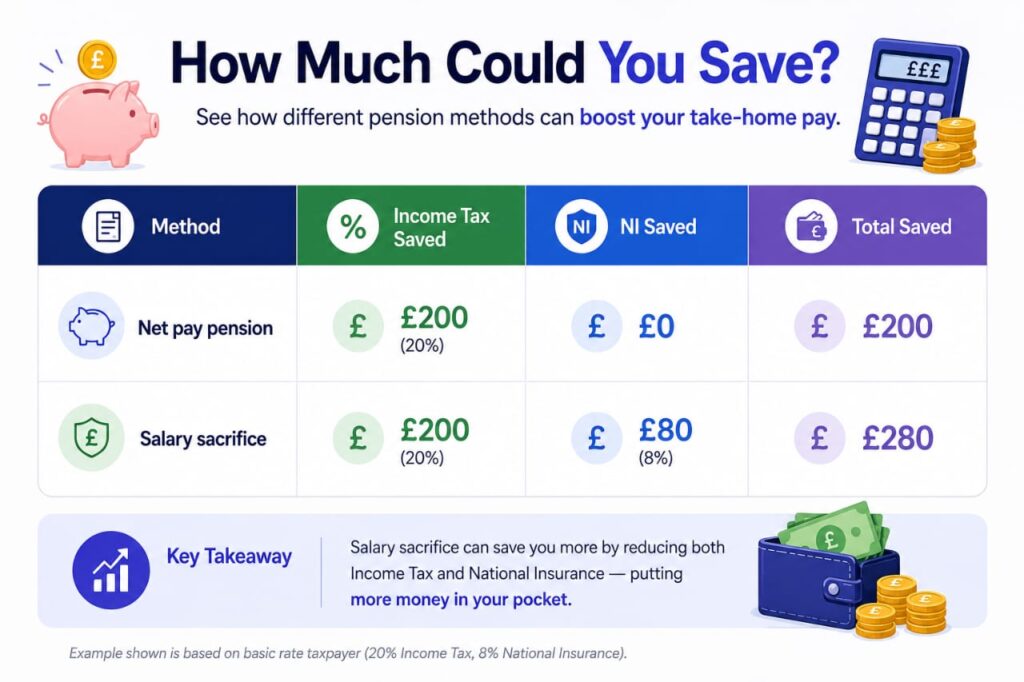
The £80 difference is small on £1,000, but scaled up across a full salary and a full career, it adds up to a meaningful amount of extra retirement saving for exactly the same cost to you each month.
There’s a legal limit worth knowing if your employer offers salary sacrifice: your sacrificed salary can’t be reduced below the National Minimum Wage or National Living Wage rate for your age group. Payroll software should stop this automatically, but if you’re on or close to minimum wage, it’s worth checking your payslip to confirm any salary sacrifice arrangement hasn’t pushed your notional hourly rate below the legal floor. If it has, your employer is required to cap or adjust the sacrifice.
Bonuses, Overtime and Multiple Jobs
Pre-tax and post-tax deductions don’t sit still just because your pay varies month to month. A few situations catch people out more than others.
Bonuses and One-Off Payments
A bonus is added to your gross pay for that period, which can temporarily push you into a higher tax bracket for that pay period alone, even if your annual salary doesn’t normally reach it. If you have a pre-tax pension deduction — particularly salary sacrifice — sacrificing part of a bonus into your pension can be genuinely efficient, because it avoids Income Tax and National Insurance on a chunk of pay that might otherwise be taxed at 40% or higher for that month. Post-tax deductions, by contrast, don’t offer any of this flexibility, since tax has already been calculated before they’re taken.
Overtime
Overtime pay is added to gross pay in the same way as regular salary, and any pre-tax pension percentage will usually apply to it automatically if your contribution is set as a percentage of gross pay. This means working extra hours can quietly increase your pension contribution too, not just your take-home pay — worth knowing if you’re trying to predict your payslip in advance.
Multiple Jobs
If you have more than one job, pre-tax deductions in each job are worked out separately against that employer’s payroll — they don’t combine across jobs. Your personal allowance is normally allocated to one job (usually your main one), which means pre-tax deductions in a second job may not reduce your tax as efficiently, since a chunk of that income could already be taxed at the basic rate with no tax-free allowance left to offset it.
Mid-Year Changes
If you change your pension contribution rate, opt into salary sacrifice, or start a new post-tax deduction partway through the tax year, the effect on your taxable pay and take-home pay applies from that pay period onward — it isn’t backdated or averaged across the year. This is worth remembering if you’re comparing an earlier payslip with a more recent one and the numbers don’t quite line up.
Frequently Overlooked Details
A handful of details rarely make it into the basic explanation but genuinely affect people’s numbers:
- Employer pension contributions never appear as a deduction on your payslip, because they’re paid on top of your salary rather than taken from it — but they still count toward your total pension contributions and your annual allowance.
- Salary sacrifice can affect statutory payments. Statutory Maternity Pay, Statutory Sick Pay, and redundancy calculations are often based on your average earnings, and a lower contractual salary from salary sacrifice can reduce these figures, so it’s worth checking before agreeing to a large sacrifice if you’re planning family leave or are in a role with redundancy risk.
- The order deductions appear on your payslip doesn’t necessarily match the order they’re applied in for tax purposes. Always check the taxable pay figure rather than assuming deductions listed first are pre-tax.
- Some benefits-in-kind are taxed differently again, through your tax code rather than as a payslip deduction at all — company cars and private medical insurance are common examples, and they don’t fit into the pre-tax/post-tax framework in the same way as cash deductions.
Mistakes to Avoid and Best Practices
A few habits separate people who understand their payslip from those who don’t.
Mistakes worth avoiding:
- Assuming a benefit is free because it’s “salary sacrifice.” Salary sacrifice reduces your official salary, which can affect mortgage affordability assessments, means-tested benefit calculations, and statutory maternity or sick pay, since these are often based on your reduced contractual salary.
- Not checking which scheme a workplace pension actually uses. Many employees assume their pension is a net pay scheme by default. It might just as easily be relief at source, particularly with some of the larger auto-enrolment providers.
- Comparing job offers purely on gross salary, without accounting for how each employer structures pension and benefit deductions.
- Overlooking the effect on other calculations. Because salary sacrifice lowers your official salary, it can also reduce your qualifying earnings for pension purposes, so it’s worth checking the contribution is still calculated in a way that doesn’t disadvantage you.
- Forgetting that post-tax deductions don’t reduce taxable income. Some people increase a post-tax charitable donation or union subscription expecting a tax benefit that simply isn’t there under that particular scheme.
Practices worth building in:
- Check your payslip’s taxable pay line every time your deductions change, not just your take-home figure — this is the fastest way to confirm whether a new deduction is pre-tax or post-tax.
- Ask your payroll or HR team directly which pension scheme type you’re on. It’s a completely reasonable question, and the answer changes how much a given contribution actually costs you.
- If salary sacrifice is offered for pension, childcare, or a cycle-to-work scheme, run the numbers before assuming it’s automatically the better option — for very low earners near the personal allowance or minimum wage threshold, a relief at source arrangement can sometimes work out more straightforward.
- Revisit your deductions after a pay rise. A percentage-based pre-tax pension contribution that made sense at one salary might be worth adjusting once more of your income sits in a higher tax band.
- Keep an eye on the qualifying earnings band if your pension contribution is calculated on qualifying earnings rather than full salary, since this affects how much of a salary increase actually flows through to your pension contribution.
Key Takeaways
Bonuses, overtime, multiple jobs, and salary sacrifice can all interact with your tax position in ways that aren’t obvious from a single payslip.
Pre-tax deductions are taken before Income Tax and National Insurance are calculated, which lowers your taxable pay and can reduce what you owe.
Post-tax deductions come off after tax and NI have already been worked out, so they reduce take-home pay without cutting your tax bill.
Salary sacrifice is the most efficient pre-tax option for most people, since it reduces both Income Tax and National Insurance, unlike a standard net pay pension deduction.
Relief at source pensions are technically post-tax deductions, with the government’s tax relief added back separately by your pension provider.
The same deduction amount can cost you differently depending on which method your employer uses — always check your taxable pay line, not just the deduction amount.
Final Thoughts
Understanding pre-tax and post-tax deductions in the UK isn’t about chasing every possible saving — it’s about knowing why your payslip looks the way it does, and being able to compare pay offers, pension options, and workplace benefits on genuinely equal terms. Once you can look at a payslip and identify which deductions are reducing your taxable pay and which are simply coming off your net pay, most of the confusion around take-home pay disappears.
The rules around pre-tax and post-tax deductions in the UK shift slightly each tax year as thresholds and allowances change, so it’s worth checking your own payslip whenever your salary, pension contribution, or benefits change. If you want to see exactly how a specific pre-tax or post-tax deduction would affect your own take-home pay, use our free UK salary calculator to run the numbers against your actual salary and scheme type.
This article is for general information only and reflects UK payroll and tax rules at the time of writing. It is not personal financial advice — for guidance specific to your circumstances, consult a qualified financial adviser or your employer’s payroll team.
FAQ’s
What’s the main difference between pre-tax and post-tax deductions?
Pre-tax deductions are taken from your pay before Income Tax and National Insurance are calculated, which lowers your taxable income. Post-tax deductions are taken after tax and NI have already been worked out, so they don’t affect how much tax you pay.
Is a workplace pension pre-tax or post-tax?
It depends on the scheme. Net pay arrangements and salary sacrifice are pre-tax. Relief at source pensions are technically post-tax, though the pension provider claims back basic-rate tax relief separately and adds it to your pot.
Does salary sacrifice count as a pre-tax deduction?
Yes, and it’s one of the most efficient ones, because it reduces both your Income Tax and your National Insurance, unlike most other pre-tax deductions which only reduce Income Tax.
Do post-tax deductions reduce my tax bill?
No. Post-tax deductions are taken after your Income Tax and National Insurance have already been calculated on your full taxable pay, so they only reduce your take-home pay, not your tax.
Why do two people with the same salary sometimes have different take-home pay?
Because the way their deductions are structured can differ. One person’s pension might be a net pay arrangement while another’s is relief at source or salary sacrifice, and each of these affects tax and National Insurance differently even for identical contribution amounts.
Can salary sacrifice reduce my pay below minimum wage?
No. UK law prevents your sacrificed salary from falling below the National Minimum Wage or National Living Wage for your age group, and payroll systems are required to cap contributions to avoid this.
Are union fees taken before or after tax?
Union and professional body fees are usually a post-tax deduction, meaning they come off your pay after Income Tax and National Insurance have already been calculated.
Does a pre-tax pension contribution reduce my National Insurance?
Only if it’s structured as salary sacrifice. A standard net pay pension contribution reduces your Income Tax but has no effect on your National Insurance.
How can I check whether my own deductions are pre-tax or post-tax?
Compare your gross pay to your taxable pay figure on your payslip. If taxable pay is lower than gross pay, the difference is a pre-tax deduction. Anything listed below the Income Tax and National Insurance lines is typically post-tax.
Do student loan repayments count as pre-tax or post-tax?
Neither, exactly. Student loan repayments are calculated on your gross pay above the relevant threshold but are deducted as their own separate line — they don’t reduce your taxable income the way a genuine pre-tax deduction does.