Self-Employed vs PAYE Tax Working out whether you’ll pay more tax as self-employed or through PAYE isn’t a simple question, even though most people expect a straightforward answer. Self-Employed vs PAYE Tax The truth is, the two systems calculate tax differently, deduct it at different times, and give you very different levels of control over your own money Self-Employed vs PAYE Tax.
If you’ve ever gone from a payslip job to freelancing, or you’re weighing up taking on self-employed work alongside your current role, this is exactly the kind of thing that catches people out Self-Employed vs PAYE Tax. PAYE feels automatic. Self-employed tax feels like a mystery until your first Self Assessment bill lands Self-Employed vs PAYE Tax.
The short answer: Income Tax rates are the same whether you’re employed or self-employed, but how and when you pay differs significantly, and self-employed workers pay a different type of National Insurance, can claim business expenses, and are responsible for calculating and paying their own tax Self-Employed vs PAYE Tax. PAYE deducts tax automatically before you’re paid. Self-employed tax is calculated after the fact, once a year, based on your profit Self-Employed vs PAYE Tax.
This guide breaks down exactly how self-employed and PAYE tax compare, what each system actually deducts, and the concepts you need to understand before doing your own numbers Self-Employed vs PAYE Tax.
Read More: Contractor vs Employee Pay UK – Which Pays More?
What This Guide Covers
This is a complete, practical breakdown built around one goal: helping you understand exactly how your tax bill differs depending on how you work. Self-Employed vs PAYE Tax Across this guide, you’ll get:
- A clear explanation of how PAYE and self-employed tax are structured differently
- The key terms and concepts you need to understand before comparing the two
- A step-by-step method for working out the real difference, with a full worked example
- How business expenses, National Insurance classes, and company structure all change the outcome
- The most common mistakes and misconceptions that trip people up when comparing the two
- A final summary of what genuinely determines which system leaves you better off
Visit Now: https://www.taxsal.com/
PAYE vs Self-Employed Tax: The Basic Difference
PAYE stands for Pay As You Earn Self-Employed vs PAYE Tax. If you’re employed, your employer calculates your Income Tax and National Insurance and deducts it automatically before your salary reaches your bank account. Self-Employed vs PAYE Tax You never see the full amount, and in most cases, you never need to file anything yourself Self-Employed vs PAYE Tax.
Being self-employed works differently. Self-Employed vs PAYE Tax You’re paid gross, meaning nothing is deducted before the money reaches you Self-Employed vs PAYE Tax. Instead, you’re responsible for tracking your income and expenses across the tax year, working out your taxable profit, and paying what you owe through Self Assessment, usually once a year with a possible payment on account halfway through the next one Self-Employed vs PAYE Tax.
Both routes ultimately use the same Income Tax bands Self-Employed vs PAYE Tax. The real differences lie in National Insurance, what you’re allowed to deduct before tax, and who’s responsible for getting the sums right Self-Employed vs PAYE Tax.
Key Terms You Should Understand First
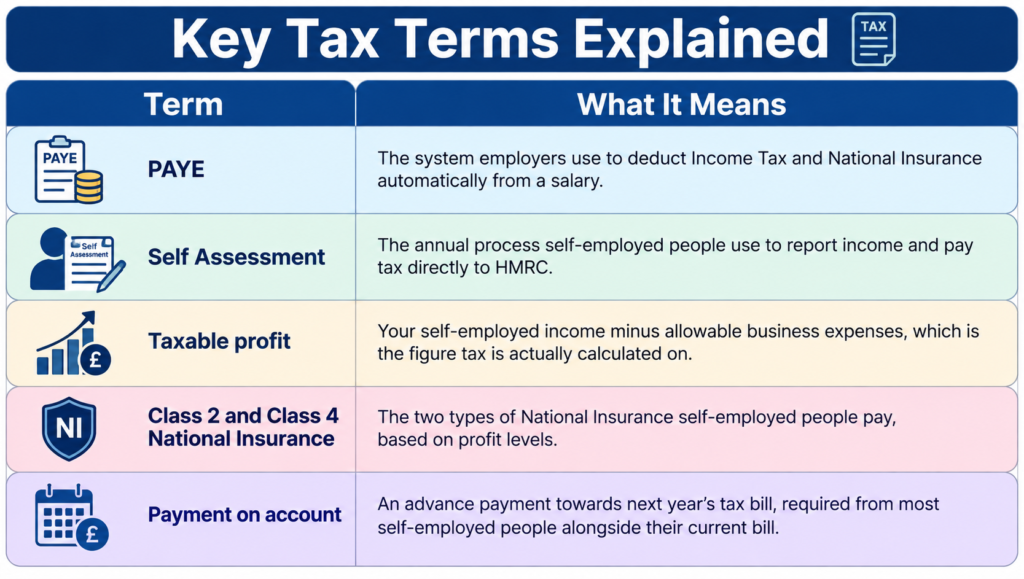
A few terms come up repeatedly throughout this comparison, so it’s worth getting them straight early on Self-Employed vs PAYE Tax.
| Term | What It Means |
| PAYE | The system employers use to deduct Income Tax and National Insurance automatically from a salary |
| Self Assessment | The annual process self-employed people use to report income and pay tax directly to HMRC |
| Taxable profit | Your self-employed income minus allowable business expenses, which is the figure tax is actually calculated on |
| Class 2 and Class 4 National Insurance | The two types of National Insurance self-employed people pay, based on profit levels |
| Payment on account | An advance payment towards next year’s tax bill, required from most self-employed people alongside their current bill |
Payment on account is the one that catches people off guard most often. Self-Employed vs PAYE Tax Many first-time self-employed workers budget for their tax bill, pay it, and then get hit with a second, unexpected charge a few months later, which is actually a prepayment towards the following year, not an extra tax Self-Employed vs PAYE Tax.
Why This Comparison Matters
Understanding the difference between self-employed and PAYE tax isn’t just useful for freelancers. Self-Employed vs PAYE Tax It matters for anyone weighing up a career move, taking on a side hustle alongside employment, or trying to work out whether a contract offer is genuinely worth more than a salaried one after tax Self-Employed vs PAYE Tax.
It also matters because the responsibility shifts entirely. Self-Employed vs PAYE Tax Under PAYE, HMRC and your employer handle the calculations, and mistakes are rare because the system does the work for you. Under Self Assessment, you’re responsible for getting your own numbers right, and errors, missed deadlines, or underpayments can lead to penalties and interest charges Self-Employed vs PAYE Tax.
Get this comparison wrong, and you can end up underestimating your tax bill, missing a payment deadline, or assuming self-employed work is more tax-efficient than it actually is once National Insurance and lost employment benefits are factored in Self-Employed vs PAYE Tax.
Common Misconceptions About Self-Employed vs PAYE Tax
A few myths tend to distort this comparison before anyone runs the actual numbersSelf-Employed vs PAYE Tax.
“Self-employed people pay less Income Tax Self-Employed vs PAYE Tax.” Not true. Income Tax bands and rates are identical whether you’re employed or self-employed. The difference isn’t the rate, it’s what counts as taxable income in the first place, since self-employed workers can deduct legitimate business expenses before tax is calculated Self-Employed vs PAYE Tax.
“Self-employed National Insurance is the same as employed National Insurance Self-Employed vs PAYE Tax.” It isn’t Self-Employed vs PAYE Tax. Employees pay Class 1 National Insurance through PAYE. Self-employed people pay Class 2 and Class 4 National Insurance, calculated differently and often at a lower overall rate on similar profit levels Self-Employed vs PAYE Tax.
“PAYE always means you’ve paid the right amount of tax Self-Employed vs PAYE Tax.” Usually true, but not always Self-Employed vs PAYE Tax. PAYE can get things wrong if your tax code is incorrect, if you have multiple income sources, or if your circumstances change partway through the year Self-Employed vs PAYE Tax. It’s automatic, not infallible Self-Employed vs PAYE Tax.
“Being self-employed automatically means a bigger tax bill at the end of the year Self-Employed vs PAYE Tax.” Not necessarily bigger, just different in timing Self-Employed vs PAYE Tax. PAYE spreads tax across twelve monthly deductions you barely notice. Self-Employed vs PAYE Tax Self-employed tax often arrives as one or two larger payments, which feels heavier even when the total amount owed is similar Self-Employed vs PAYE Tax.
PAYE vs Self-Employed: A Quick Snapshot
Here’s a simplified snapshot of how the two systems compare, using 2026/27 UK tax figures, before the detailed worked example below.
| Factor | PAYE (Employed) | Self-Employed |
| Income Tax bands | Same 20% / 40% / 45% bands | Same 20% / 40% / 45% bands |
| National Insurance | Class 1, deducted automatically | Class 2 and Class 4, calculated on profit |
| Who calculates tax | Employer, automatically | You, via Self Assessment |
| When tax is paid | Deducted each payday | Usually once a year, plus payments on account |
| Expenses | Not deductible in most cases | Allowable business expenses reduce taxable profit |
| Paperwork | Minimal, handled by employer | Annual Self Assessment return required |
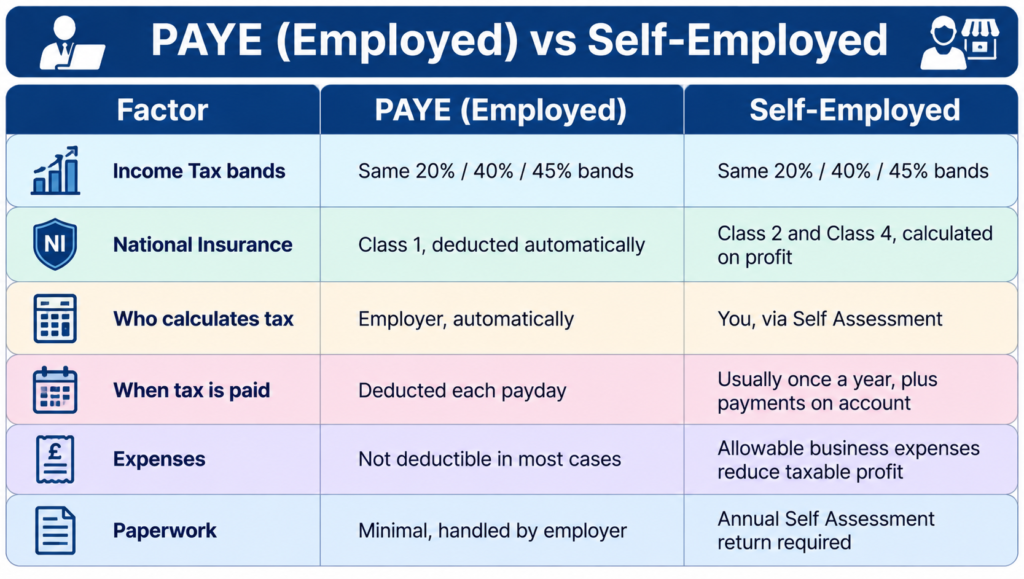
This table only tells part of the story. Self-Employed vs PAYE Tax The real comparison depends on your actual income, your allowable expenses, and how National Insurance is calculated differently under each system, which the next section walks through with full worked numbers Self-Employed vs PAYE Tax.
How to Compare Self-Employed and PAYE Tax: Step by Step( Self-Employed vs PAYE Tax )
Working out your actual tax difference between the two systems takes a bit more than comparing headline rates Self-Employed vs PAYE Tax.
Step 1: Work out your taxable income or profit
For PAYE, this is your gross salary. Self-Employed vs PAYE Tax For self-employed work, it’s your income minus allowable business expenses, such as equipment, travel, a portion of home office costs, and professional fees Self-Employed vs PAYE Tax. This is your taxable profit, and it’s the figure everything else is calculated on Self-Employed vs PAYE Tax.
Step 2: Apply the same Income Tax bands to both
Self-Employed vs PAYE Tax Income Tax works identically for both groups: 0% up to £12,570, 20% between £12,570 and £50,270, 40% between £50,270 and £125,140, and 45% above that. The bands don’t change based on employment status Self-Employed vs PAYE Tax.
Step 3: Calculate National Insurance separately for each system
This is where the two paths genuinely diverge Self-Employed vs PAYE Tax. Employees pay Class 1 National Insurance at 8% on earnings between £12,570 and £50,270, and 2% above that, deducted automatically Self-Employed vs PAYE Tax. Self-employed workers pay Class 4 National Insurance at 6% on profits in the same band, and 2% above it, worked out through Self Assessment Self-Employed vs PAYE Tax.
Step 4: Factor in Class 2 National Insurance for state pension purposes
Class 2 National Insurance stopped being a compulsory weekly charge from April 2024. Self-Employed vs PAYE Tax If your self-employed profits are above the Small Profits Threshold of £7,105, you’re automatically treated as having paid it, protecting your State Pension record without any extra cost. Self-Employed vs PAYE Tax Below that threshold, you can choose to pay it voluntarily at £3.65 a week to avoid a gap in your contribution history Self-Employed vs PAYE Tax.
Step 5: Compare the total tax and NI bill, not just the rate
Once you’ve worked out Income Tax and the relevant National Insurance for both scenarios, add them together and compare the totals. Self-Employed vs PAYE Tax This is the only fair way to see which system actually leaves you with more money Self-Employed vs PAYE Tax.
A Real-Life Example: £45,000 Salary vs £45,000 Self-Employed Profit
Let’s compare someone earning exactly £45,000 under PAYE against someone with £45,000 in self-employed taxable profit, using 2026/27 rates.
Employed, on a £45,000 salary:
- Income Tax: 20% on income between £12,570 and £45,000 = £6,486
- National Insurance (Class 1): 8% on the same band = £2,594.40
- Total deducted: £9,080.40
- Take-home pay: £35,919.60
Self-employed, on £45,000 taxable profit:
- Income Tax: identical calculation, £6,486
- National Insurance (Class 4): 6% on the same band = £1,945.80
- Class 2: treated as paid automatically, no extra cost, since profit is above £7,105
- Total deducted: £8,431.80
- Take-home amount: £36,568.20
In this example, the self-employed worker keeps roughly £648.60 more than the employee on identical income, purely because Class 4 National Insurance is charged at a lower rate than Class 1. That gap tends to widen further up the income scale, since the same 6% versus 8% difference applies across the whole band.
Side-by-Side Summary
| Category | Employed (£45,000 salary) | Self-Employed (£45,000 profit) |
| Income Tax | £6,486 | £6,486 |
| National Insurance | £2,594.40 (Class 1, 8%) | £1,945.80 (Class 4, 6%) |
| Class 2 NI | Not applicable | Treated as paid, no cost |
| Total deductions | £9,080.40 | £8,431.80 |
| Take-home amount | £35,919.60 | £36,568.20 |
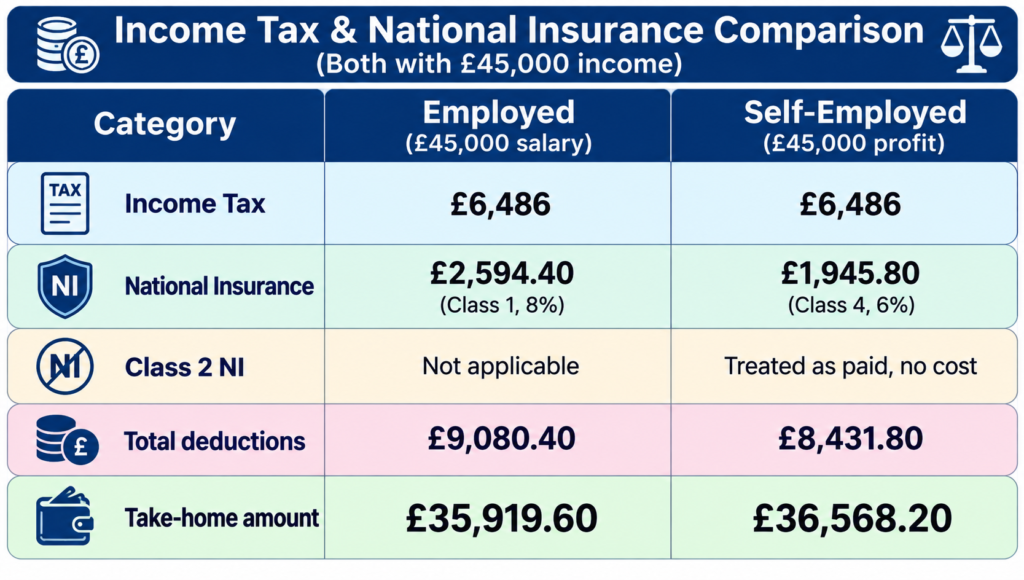
Important note: this comparison only holds if the two figures are genuinely equivalent, meaning the self-employed £45,000 is profit after expenses, not turnover. It also doesn’t include the value of employment benefits like a workplace pension, paid holiday, or sick pay, none of which apply automatically to self-employed income. Those benefits carry real financial value that isn’t reflected in a straight tax comparison.
Why Business Expenses Change the Picture
One of the genuine advantages of self-employment is the ability to deduct legitimate business expenses before tax is calculated. If a self-employed person earns £50,000 in total income but has £8,000 in allowable expenses, such as equipment, software subscriptions, travel between jobs, or a portion of home running costs, their taxable profit drops to £42,000. Tax and National Insurance are then calculated on that lower figure, not the full £50,000.
Employees generally can’t do this. Aside from a narrow set of allowable employment expenses, like certain professional subscriptions or specific equipment required for the job, most of an employee’s salary is taxed in full, with no equivalent deduction available.
This is often where the biggest practical difference between the two systems shows up, not in the tax rates themselves, but in how much income is actually taxable in the first place.
Common Mistakes People Make Comparing the Two Systems
A few recurring errors distort this comparison more than anything else.
- Comparing turnover to salary instead of profit to salary. Self-employed turnover isn’t taxable income. Only profit, after expenses, should be compared to a salary figure.
- Forgetting Class 4 and Class 1 National Insurance are charged at different rates. This is the main source of the tax difference between the two systems, and it’s easy to overlook if you assume National Insurance works the same way for everyone.
- Ignoring the value of employment benefits. A salary comparison that leaves out pension contributions, paid holiday, and sick pay isn’t a complete picture of total compensation.
- Not budgeting for payments on account. Many newly self-employed workers are caught off guard by a second payment due alongside their main tax bill, which is a prepayment towards the following year, not a separate charge.
- Assuming Class 2 National Insurance still costs money. Since April 2024, most self-employed people with profits above £7,105 get their State Pension credit automatically, with nothing to pay.
Best Practices for an Accurate Comparison
- Always compare taxable profit to gross salary, never turnover to salary, and never net pay to gross profit.
- Keep thorough expense records from day one. The more accurately you track allowable expenses, the more accurately your taxable profit, and your tax bill, reflects reality.
- Set aside tax as you earn, rather than waiting until the bill arrives. A common approach is putting 25–30% of self-employed income aside as it comes in, covering both Income Tax and Class 4 National Insurance.
- Factor in the value of lost employment benefits when comparing a self-employed income to a salaried one, particularly pension contributions and paid leave.
- Use HMRC’s official calculators or a qualified accountant for your actual figures, since allowable expenses and reliefs vary by individual circumstances.
Expert Tip: Don’t Just Compare the Rate, Compare the Whole Package
It’s tempting to focus purely on the National Insurance rate difference between Class 1 and Class 4, since 6% versus 8% looks like a clear win for self-employment. But once you add in the value of an employer pension contribution, paid holiday, and Statutory Sick Pay, a PAYE salary can still come out ahead in total value, even with the higher National Insurance rate. The tax comparison is only one part of a much bigger financial picture.
Limited Company Directors Sit Somewhere in Between
Not every self-employed person operates as a sole trader. Many work through a limited company instead, which changes the tax picture again.
| Structure | How Income Is Taxed | National Insurance |
| Sole trader | Income Tax on profit via Self Assessment | Class 4 (6% / 2%), Class 2 treated as paid above £7,105 |
| Limited company director | Small salary plus dividends, company profits taxed via Corporation Tax first | Class 1 on salary portion only, none on dividends |
| Employee (PAYE) | Income Tax on gross salary | Class 1 (8% / 2%), deducted automatically |
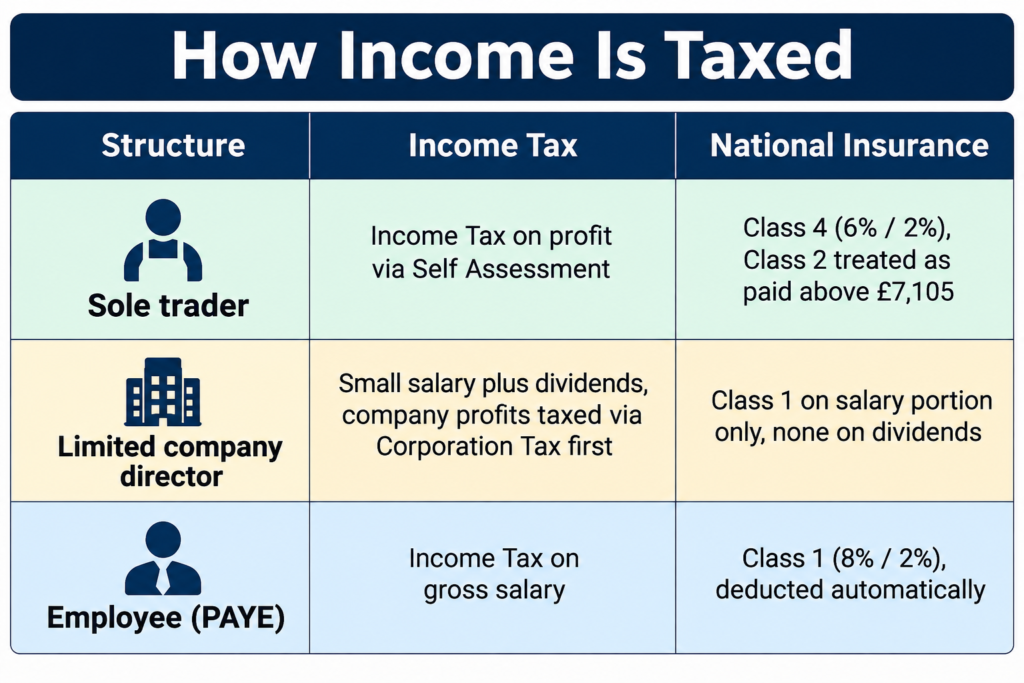
Limited company directors typically take a small salary, often close to the National Insurance threshold, and draw the rest of their income as dividends, which aren’t subject to National Insurance at all. This structure can be more tax-efficient than sole trader status at higher income levels, but it also comes with more admin: Corporation Tax returns, annual accounts, and dividend tax to account for separately.
This is exactly why a fair self-employed versus PAYE comparison needs to specify which type of self-employment is being discussed, since a sole trader, a limited company director, and an employee can all end up with meaningfully different tax outcomes on the same underlying income.
Advanced Tips for Managing Tax Across Both Systems
A few extra considerations help beyond the basic comparison, particularly for people who move between the two or do both at once.
If you’re both employed and self-employed, National Insurance interacts across both. Income from a PAYE job and self-employed profit are assessed separately for Income Tax purposes, but there’s an annual maximum amount of National Insurance you’re expected to pay overall. If your combined Class 1 and Class 4 contributions exceed that cap, you may be able to claim some of it back, which is worth checking if you’re juggling a job and a side business.
Payments on account can be reduced if your income drops. If you know your self-employed profit will be noticeably lower than the previous year, you can apply to HMRC to reduce your payments on account, rather than overpaying and waiting for a refund later.
Registering late for Self Assessment has its own penalty structure, separate from late payment penalties. If you’ve started earning self-employed income, the registration deadline is the 5th of October following the end of the tax year in which you started, regardless of whether you owe any tax.
Employed and self-employed tax codes don’t automatically talk to each other. If you’re employed and self-employed at the same time, your tax-free Personal Allowance is normally applied to your PAYE income first, meaning your self-employed profit is often taxed without a further personal allowance, another detail that surprises people doing this comparison for the first time.
A Frequently Overlooked Point: Timing Changes How Tax Feels, Even When the Total Is Similar
One of the most common misunderstandings in this comparison isn’t about the numbers themselves, it’s about how differently they arrive.
PAYE tax is deducted in small amounts every payday, so it barely registers. Self-employed tax typically arrives as one or two large payments a year, by 31 January and, if payments on account apply, again by 31 July. Even when the total annual tax bill is similar to an equivalent PAYE salary, the self-employed version can feel far more painful simply because of how it’s collected.
This is worth planning around rather than being caught out by. Setting aside a percentage of every self-employed payment as it comes in, rather than treating it as fully available income, is the single most effective habit for avoiding a stressful January.
Self-Employed vs PAYE Tax: Final Comparison at a Glance
| Factor | PAYE (Employed) | Self-Employed |
| Income Tax rate | Same bands as self-employed | Same bands as employed |
| National Insurance rate | Class 1: 8% / 2% | Class 4: 6% / 2% |
| Who calculates tax | Employer, automatically | You, via Self Assessment |
| When tax is paid | Spread across each payday | Once a year, plus payments on account |
| Expense deductions | Very limited | Allowable business expenses reduce taxable profit |
| Pension | Employer contributes automatically | Self-funded |
| Paid holiday and sick pay | Included | Not included |
| Admin burden | Minimal | Ongoing record-keeping and an annual return |
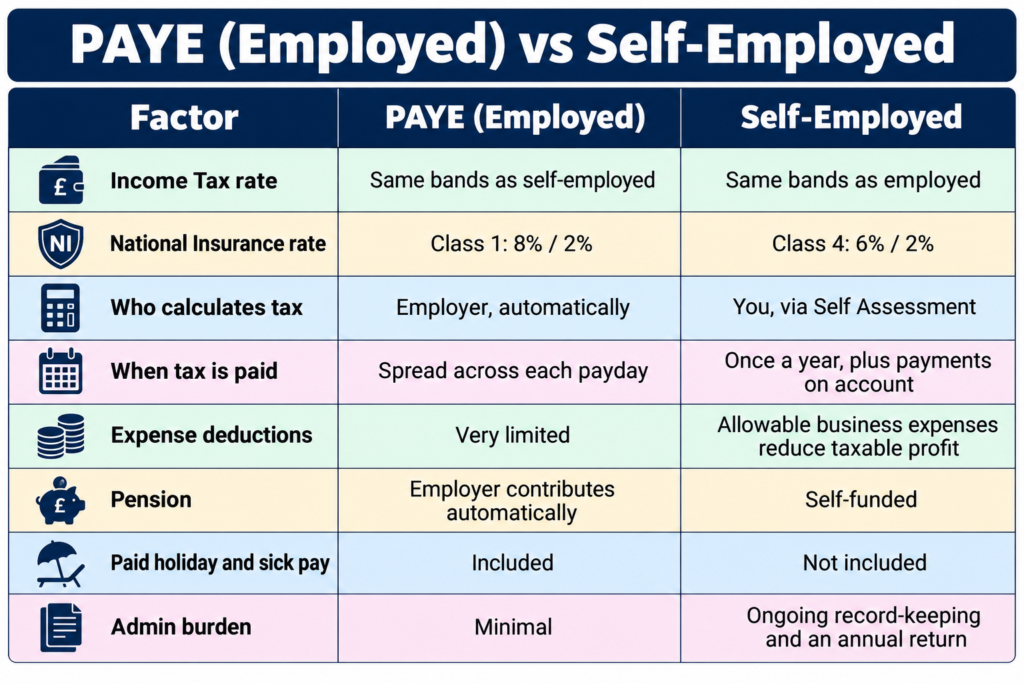
There’s no single winner here. Self-employed workers generally pay a lower rate of National Insurance and can deduct legitimate expenses, which can leave more take-home income on paper. Employees benefit from automatic tax handling, employer pension contributions, and paid leave, which carry real value that doesn’t show up in a raw tax comparison. Which system leaves you better off depends on your income level, your expenses, and how much you value the built-in benefits of employment.
Key Takeaways
Self-employed tax arrives less frequently and in larger amounts, which makes budgeting throughout the year essential, even when the total annual bill is similar to PAYE.
Income Tax bands and rates are identical for employed and self-employed people. The real difference lies in National Insurance and expense deductions.
Class 4 National Insurance (6% / 2%) is lower than Class 1 (8% / 2%), which is the main reason self-employed workers often keep more of an identical income.
Self-employed workers can deduct allowable business expenses before tax is calculated, something employees can rarely do.
Employment benefits like a workplace pension, paid holiday, and sick pay carry real financial value that a pure tax comparison doesn’t capture.
Final Thoughts
When it comes to self-employed vs PAYE tax, the honest answer is that neither system is universally better, they’re simply structured differently. Income Tax works identically for both, but self-employed workers generally benefit from a lower National Insurance rate and the ability to deduct business expenses, while employees benefit from automatic tax handling, employer pension contributions, and paid leave that don’t show up in a straightforward tax comparison.
The most accurate way to compare the two for your own situation is to work out your actual taxable profit or salary, apply the correct National Insurance rate for each, and then weigh in the value of employment benefits you’d be giving up or gaining. Once you’ve done that properly, the decision between self-employment and PAYE becomes less about which system taxes you less, and more about which one genuinely fits your income, your expenses, and how much responsibility you want for managing your own tax.
FAQ’s
Do self-employed people pay less tax than employees?
Income Tax is the same for both. Self-employed workers do typically pay less National Insurance, since Class 4 is charged at 6% compared to the employee rate of 8%, and they can also deduct business expenses before tax is calculated, which can reduce their taxable income further.
What is the difference between Class 1 and Class 4 National Insurance?
Class 1 is paid by employees through PAYE, at 8% on earnings between £12,570 and £50,270 and 2% above that. Class 4 is paid by self-employed people through Self Assessment, at 6% on the same profit band and 2% above it.
Do I still have to pay Class 2 National Insurance if I’m self-employed?
Not usually. Since April 2024, Class 2 is no longer a compulsory payment for most self-employed people. If your profits are above the Small Profits Threshold of £7,105, you’re automatically treated as having paid it, protecting your State Pension record at no cost.
How do I know if I should register as a sole trader or set up a limited company?
It depends largely on your income level and how much admin you’re willing to take on. Sole trader status is simpler with less paperwork, while a limited company can be more tax-efficient at higher income levels, but requires Corporation Tax returns and annual accounts.
Can I be both employed and self-employed at the same time?
Yes, and it’s common. Your Personal Allowance is typically applied to your PAYE income first, and your self-employed profit is taxed separately, so it’s worth understanding how the two interact before assuming your total tax bill will be straightforward.
When do self-employed people pay their tax bill?
The main Self Assessment deadline is 31 January following the end of the tax year, with many self-employed people also required to make a payment on account by 31 July, which counts towards the following year’s bill.
Can self-employed people claim a pension like employees?
Not automatically. Employees benefit from employer pension contributions through auto-enrolment, while self-employed people need to set up and fund their own pension, usually through a personal pension scheme, without any employer contribution.
What expenses can I deduct if I’m self-employed?
Allowable expenses generally include things directly related to running your business, such as equipment, software, travel between work locations, professional fees, and a reasonable portion of home office costs. Personal expenses unrelated to the business aren’t deductible.
Is it worth becoming self-employed just to pay less tax?
Not on its own. While Class 4 National Insurance is lower and expenses can reduce taxable profit, self-employment also means giving up employer pension contributions, paid holiday, and sick pay, along with taking on the responsibility of managing your own tax. The right choice depends on your full financial picture, not just the tax rate.
Does becoming self-employed affect my State Pension?
It can, but usually not negatively if your profits are above £7,105 a year, since you’re automatically treated as having paid Class 2 National Insurance and continue building your State Pension record. Below that threshold, voluntary Class 2 payments can be used to avoid a gap.