Hourly Rate Calculator UK Ever caught yourself in a job interview trying to work out what £32,000 a year actually comes to per hour? You’re not alone. Hourly Rate Calculator UK Whether you’re comparing a salaried role against freelance day rates, working out if a new job offer is actually better, or just curious what your time is worth, converting an annual salary into an hourly rate is one of those calculations everyone needs at some point but rarely remembers how to do Hourly Rate Calculator UK.
The good news is that it’s a simple sum once you know which numbers to use. Hourly Rate Calculator UK This guide walks you through exactly how to calculate your hourly rate from your annual salary, what counts as “working hours,” where the gross and net figures start to diverge, and where people usually go wrong Hourly Rate Calculator UK.
Quick answer:To calculate your hourly rate from your annual salary, divide your annual salary by the number of hours you work in a year. Hourly Rate Calculator UK For a standard 37.5-hour week worked over 52 weeks, that’s 1,950 hours a year Hourly Rate Calculator UK. So a £30,000 salary works out to roughly £15.38 an hour (£30,000 ÷ 1,950) Hourly Rate Calculator UK.
This guide draws on current UK Income Tax, National Insurance, and minimum wage rules, so the figures and examples below reflect how pay actually breaks down on a payslip, not just a theoretical formula Hourly Rate Calculator UK.
Read More: Minimum Wage UK 2026/27 – Current National Minimum & Living Wage Rates
What Does “Hourly Rate” Actually Mean?
Your hourly rate is simply your pay divided by the number of hours you work to earn it. That sounds obvious, but the tricky part is deciding which hours actually count Hourly Rate Calculator UK.
Someone on a £35,000 salary working a standard 35-hour week isn’t earning the same hourly rate as someone on £35,000 working 45 hours a week, even though their annual pay is identical. Hourly Rate Calculator UK The person working longer hours is effectively earning less per hour for the same salary Hourly Rate Calculator UK.
This is exactly why an hourly rate calculator UK is so useful. Hourly Rate Calculator UK It strips away the headline salary figure and shows you the number that actually reflects the value of your time, which is far more useful when comparing job offers, weighing up freelance work, or deciding whether unpaid overtime is worth it Hourly Rate Calculator UK.
Visit Now: https://www.taxsal.com/
Gross Hourly Rate vs Net Hourly Rate
There are two ways to look at your hourly rate:
- Gross hourly rate – your salary before Income Tax, National Insurance, and other deductions, divided by your working hours.
- Net hourly rate – your take-home pay (after tax, NI, pension, and student loan deductions) divided by your working hours.
Most online calculators, including salary comparison tools, quote the gross figure by default because it’s simpler and doesn’t depend on your personal tax code. Hourly Rate Calculator UK But if you want to know what you’re really earning per hour in your pocket, you need to work from your net pay instead. Both are covered in the worked examples further down this guide Hourly Rate Calculator UK.
Key Terms You Need to Understand First
Before working through any calculation, it helps to be clear on a few terms that get used loosely but actually mean different things Hourly Rate Calculator UK.
Annual salary – Your total pay for the year before any deductions. This is the number written in your contract or job offer, sometimes called your gross salary Hourly Rate Calculator UK.
Contracted hours – The number of hours you’re expected to work per week, as stated in your employment contract. This is different from the hours you might actually work if you regularly do unpaid overtime.
Working weeks per year – The number of weeks you actually work, once holiday is taken into account. Most full-time UK employees work 52 weeks a year but take annual leave during that time, which matters depending on how the calculation is structured Hourly Rate Calculator UK.
Full-time equivalent (FTE) – A standard used to compare part-time and full-time roles fairly. Hourly Rate Calculator UK If a full-time role is 37.5 hours a week and someone works 18.75 hours, they’re at 0.5 FTE Hourly Rate Calculator UK.
Statutory annual leave – The legal minimum paid holiday for UK workers, which is 5.6 weeks a year (28 days for someone working five days a week, including bank holidays) Hourly Rate Calculator UK.
Getting these definitions straight matters because two calculators can give you different hourly rates for the same salary, simply because one assumes 37.5 hours a week and the other assumes 40. Hourly Rate Calculator UK Small differences in the working hours figure can shift the final result more than you’d expect Hourly Rate Calculator UK.
The Basic Formula for Converting Salary to Hourly Rate
At its simplest, the formula looks like this:
Hourly Rate = Annual Salary ÷ Total Annual Working Hours
The part people usually get wrong isn’t the division, it’s working out the “total annual working hours” figure correctly. Hourly Rate Calculator UK That depends on:
- How many hours you work each week
- How many weeks you work each year
- Whether you want to include or exclude paid holiday in that hours figure
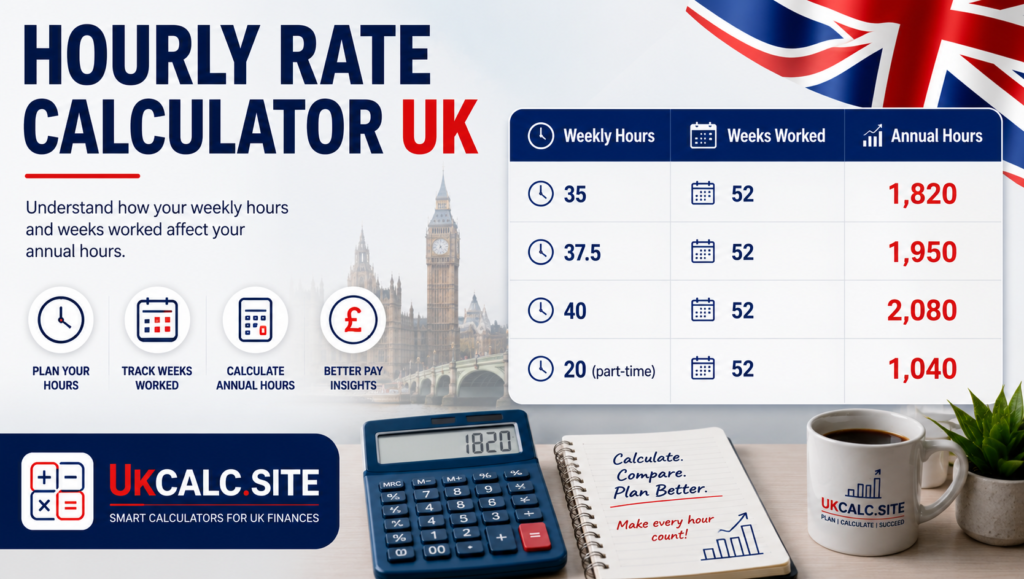
For a typical full-time UK employee working 37.5 hours a week across 52 weeks, that gives 1,950 hours a year. Someone working the more common 40-hour week comes to 2,080 hours a year Hourly Rate Calculator UK.
| Weekly Hours | Weeks Worked | Annual Hours |
| 35 | 52 | 1,820 |
| 37.5 | 52 | 1,950 |
| 40 | 52 | 2,080 |
| 20 (part-time) | 52 | 1,040 |
The step-by-step section below applies this formula to a full worked example, then adjusts it for part-time hours, unpaid overtime, and irregular shift patterns Hourly Rate Calculator UK.
Why This Calculation Matters
Knowing your hourly rate isn’t just a curiosity exercise. Hourly Rate Calculator UK It has real, practical uses:
- Comparing job offers – A £40,000 salary with a 35-hour week is a better hourly deal than a £42,000 salary with a 45-hour week, even though the second number looks bigger on paper Hourly Rate Calculator UK.
- Weighing up freelance or contract work – If you’re considering leaving employment for contract work, your hourly rate gives you a benchmark for setting a fair day rate Hourly Rate Calculator UK.
- Negotiating pay rises – Understanding your current hourly value makes it easier to argue for fair pay when your hours or responsibilities increase Hourly Rate Calculator UK.
- Deciding on overtime – If you’re offered paid overtime, knowing your normal hourly rate helps you judge whether the rate on offer is actually worth your time Hourly Rate Calculator UK.
- Checking against minimum wage – If your hours have crept up without a pay review, converting your salary to an hourly rate is the quickest way to check you’re still comfortably above the National Minimum Wage or National Living Wage Hourly Rate Calculator UK.
Common Misconceptions( Hourly Rate Calculator UK )
“Full-time always means 40 hours a week.” Not in the UK. Many employers use 37.5 hours as standard, and some sectors use 35. Always check your actual contracted hours rather than assuming Hourly Rate Calculator UK.
“My hourly rate should include unpaid overtime.” If you’re regularly working unpaid hours beyond your contract, your effective hourly rate is lower than your contracted rate. It’s worth calculating both figures separately so you can see the real picture, as shown in the unpaid overtime example later in this guide Hourly Rate Calculator UK.
“Paid holiday doesn’t affect the calculation.” Your salary already includes payment for your annual leave, since you’re paid the same whether you’re working or on holiday. Some calculators strip out holiday weeks to show a “per hour actually worked” figure, which will always be higher than a simple 52-week calculation Hourly Rate Calculator UK.
“Gross and net hourly rate are basically the same.” Once Income Tax, National Insurance, and pension contributions are factored in, the gap between gross and net hourly rate can be significant, especially for higher earners crossing into a higher tax band Hourly Rate Calculator UK.
Quick Reference: Annual Salary to Hourly Rate
Here’s a rough guide using a standard 37.5-hour week (1,950 hours a year), before tax and deductions:
| Annual Salary | Approx. Gross Hourly Rate |
| £20,000 | £10.26 |
| £25,000 | £12.82 |
| £30,000 | £15.38 |
| £35,000 | £17.95 |
| £40,000 | £20.51 |
| £50,000 | £25.64 |
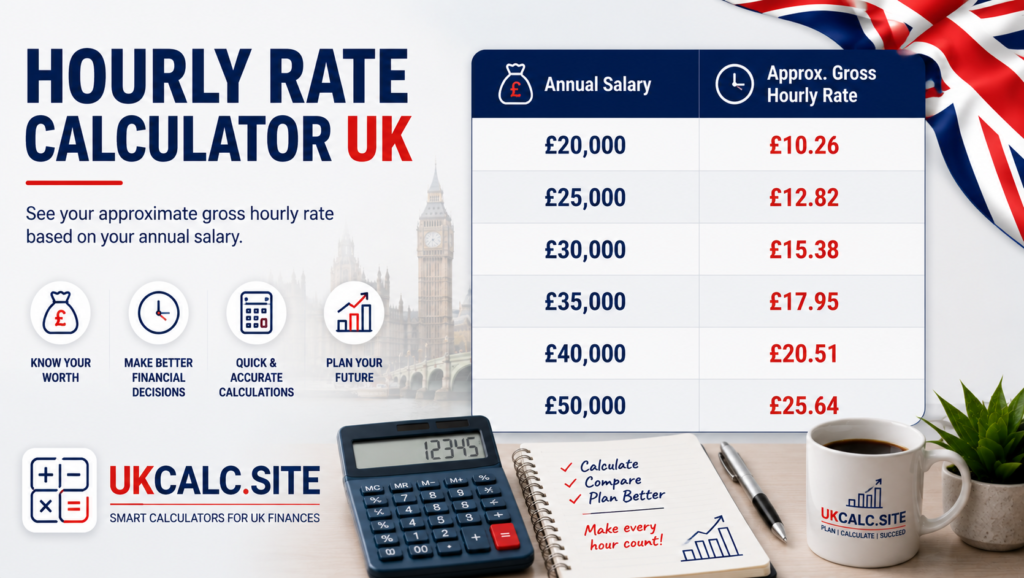
These figures are for illustration only, since your actual hourly rate depends on your specific contracted hours. Hourly Rate Calculator UK The next section breaks the full method down step by step, including how to handle part-time roles, irregular hours, and how to work out your net hourly rate after tax and National Insurance Hourly Rate Calculator UK.
Step-by-Step: How to Calculate Your Hourly Rate
There are five steps to this calculation. Once you’ve worked through it one time, you’ll be able to apply it to any salary in seconds.
Step 1: Confirm Your Annual Salary
Start with the exact figure on your contract or payslip. If you’ve had a pay rise mid-year, use your current salary, not an average of the old and new figures.
Example: Sarah’s contract states an annual salary of £34,000.
Step 2: Work Out Your Contracted Weekly Hours
Check your employment contract for your standard working hours. Don’t guess based on what “full-time” usually means, since this varies a lot between employers and sectors.
Example: Sarah’s contract states 37.5 hours a week.
Step 3: Calculate Your Total Annual Hours
Multiply your weekly hours by the number of weeks in a year (52).
37.5 hours × 52 weeks = 1,950 hours a year
This figure already accounts for paid annual leave, because you’re paid your full salary whether you’re at your desk or on holiday. There’s no need to subtract holiday weeks at this stage.
Step 4: Divide Salary by Annual Hours
Now apply the formula:
£34,000 ÷ 1,950 = £17.44 an hour
That’s Sarah’s gross hourly rate, before Income Tax, National Insurance, or pension contributions come off.
Step 5: Work Out Your Net Hourly Rate
If you want to know what you actually take home per hour, start from your net annual pay instead of your gross salary.
Say Sarah’s take-home pay after tax, National Insurance, and a 5% pension contribution comes to £26,800 a year. Her net hourly rate would be:
£26,800 ÷ 1,950 = £13.74 an hour
That’s a £3.70 gap between what she earns on paper and what actually lands in her bank account per hour worked. This is exactly why it’s worth calculating both figures, especially if you’re comparing a salaried job against freelance or contract work where you’re responsible for your own tax.
Real-Life Scenario: Comparing Two Job Offers
Say you’re choosing between two roles:
| Comparison Criteria | Job A | Job B |
| Annual Salary | £38,000 | £41,000 |
| Weekly Hours | 35 | 40 |
| Annual Hours | 1,820 | 2,080 |
| Gross Hourly Rate | £20.88 | £19.71 |
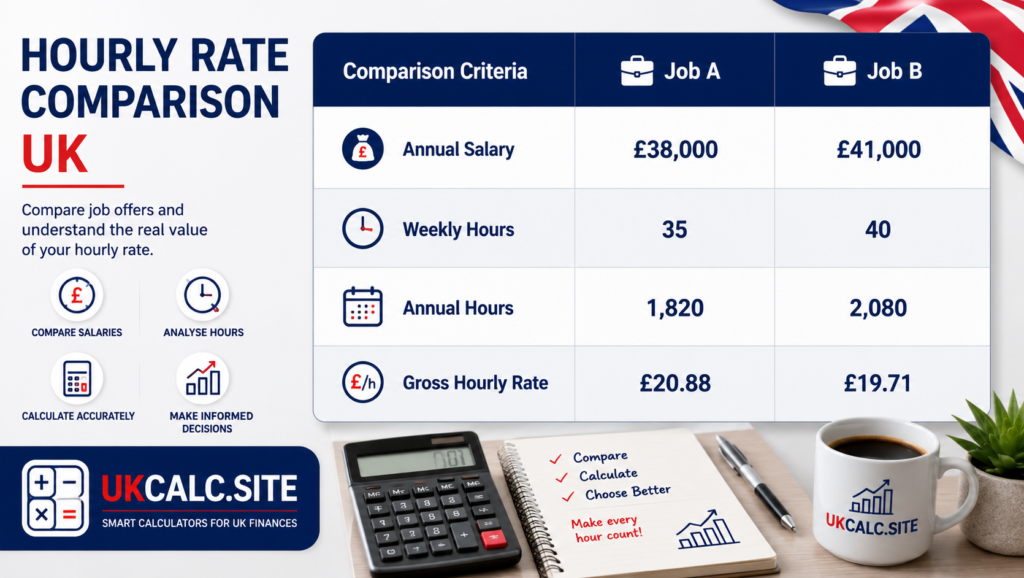
On paper, Job B pays £3,000 more a year. But once the extra five hours a week are factored in, Job A actually pays more per hour. Over a full year, Job B involves working an extra 260 hours to earn that additional £3,000, which works out to just £11.54 an hour for the additional time. Whether that trade-off is worth it depends on what else matters to you, such as flexibility, commute, or career progression, but at least now the decision is based on real numbers rather than the headline salary alone.
Calculating Hourly Rate for Part-Time and Irregular Hours
The formula stays exactly the same for part-time work, but the annual hours figure needs to reflect actual contracted hours rather than a full-time assumption.
Example: James works 22.5 hours a week (three days at 7.5 hours) on a pro-rata salary of £19,500.
22.5 hours × 52 weeks = 1,170 annual hours
£19,500 ÷ 1,170 = £16.67 an hour
If your hours genuinely vary week to week, such as with zero-hours contracts or shift work, the calculation becomes trickier because there’s no fixed “annual hours” figure to divide by. In that case, the more reliable approach is to work backwards over a period you’ve already worked:
- Add up your total gross pay over the last three or six months.
- Add up your total hours worked over the same period.
- Divide pay by hours to get an average hourly rate.
This gives you a realistic figure based on actual hours worked, rather than a theoretical contracted number that may not reflect reality.
Adjusting the Calculation for Unpaid Overtime
If you regularly work more hours than your contract states, without extra pay, your effective hourly rate is lower than your contracted rate.
Example: Priya is contracted for 37.5 hours a week on £36,000 a year, which works out to £18.46 an hour based on 1,950 annual hours. But she consistently works 45 hours a week.
45 hours × 52 weeks = 2,340 hours a year
£36,000 ÷ 2,340 = £15.38 an hour
That’s a difference of over £3 an hour once her actual working pattern is taken into account. Calculating your rate this way is a useful reality check if you suspect your workload has grown without a matching pay review.
Common Mistakes to Avoid
Using 40 hours as a default. Not every full-time role is 40 hours a week. Always check your actual contract rather than assuming.
Forgetting to include or exclude holiday correctly. Since your salary already covers your annual leave, don’t subtract holiday weeks from your 52-week total unless you’re specifically trying to calculate a “per hour actually worked at your desk” figure, which is a different metric entirely.
Mixing up gross and net figures. Comparing your gross hourly rate against someone else’s net hourly rate, or against a freelance day rate that has to cover its own tax and expenses, isn’t a fair comparison.
Ignoring unpaid breaks. If your working day includes an unpaid lunch break, make sure your weekly hours reflect only paid time. A “9 to 5” job with an unpaid hour for lunch is actually a 35-hour week, not 40.
Using monthly figures instead of annual ones. Dividing your monthly salary by your monthly hours can introduce rounding errors, since months vary in length. Working from annual salary and annual hours is more accurate.
Best Practices for an Accurate Calculation
- Always use your actual contracted hours, not an industry assumption.
- Keep gross and net calculations separate, and label them clearly so you don’t confuse them later.
- If your hours vary, calculate an average over at least three months rather than relying on a single week.
- Recalculate whenever your salary, hours, or pension contribution changes, since even a small shift in weekly hours can noticeably move your hourly rate.
- If you’re comparing job offers, calculate the hourly rate for each one using the same method, so you’re comparing like for like.
- Use annual figures rather than weekly shortcuts wherever possible. Dividing a weekly salary by weekly hours is a fine rough estimate, but it’s less accurate than working from annual totals, particularly if your pay includes irregular elements like a monthly bonus or quarterly commission. Working from annual salary and annual hours smooths out these irregularities and gives a more reliable long-term average.
It’s also worth recalculating your hourly rate at least once a year, or whenever your circumstances change. Pay rises, pension contribution changes, and shifts in your working pattern can all move the number more than expected, and it’s easy to lose track of your real hourly value if you’re not checking it regularly.
Factoring in Overtime, Bonuses and Student Loan Repayments
If you regularly receive overtime pay or bonuses, it’s worth working out two separate hourly rates: one based on your base salary alone, and one that includes these extras. Blending them together can be misleading, since bonuses aren’t guaranteed and overtime pay is often calculated at a different rate to your standard hours.
Example: Tom earns a base salary of £30,000 (1,950 annual hours, £15.38 an hour) and also picks up around £2,400 a year in overtime, paid at time-and-a-half.
If he works roughly 80 extra hours a year to earn that £2,400, his blended hourly rate becomes:
(£30,000 + £2,400) ÷ (1,950 + 80) = £32,400 ÷ 2,030 = £15.96 an hour
Notice this blended figure is actually lower than his overtime rate alone, because it averages his lower base rate across more hours. This is a useful check when deciding whether taking on extra overtime hours is genuinely worth it once averaged across the year.
Student loan repayments work differently, since they’re a deduction rather than an addition, and they only kick in once your income crosses your plan’s threshold. If you’re calculating your net hourly rate and you repay a student loan, make sure your net annual pay figure already has those repayments subtracted before you divide by your hours. Otherwise you’ll overstate what you’re actually taking home per hour.
Adjusting for Term-Time or Compressed Hours Contracts
Not everyone works a standard 52-week pattern. Term-time contracts, common in education and some public sector roles, only pay for the weeks actually worked (plus a pro-rated holiday allowance), rather than a full 52 weeks.
If you’re on a term-time contract, don’t use 52 weeks in your calculation. Instead, use the actual number of paid weeks stated in your contract.
Example: A teaching assistant is paid £16,500 a year for 38 working weeks (term time) plus statutory holiday pro-rata, working 32.5 hours a week.
38 weeks × 32.5 hours = 1,235 annual hours
£16,500 ÷ 1,235 = £13.36 an hour
Compressed hours contracts, where someone works their full weekly hours over fewer days (such as four 10-hour days instead of five 8-hour days), don’t change the calculation at all. The weekly hours total is what matters, not how those hours are spread across the week.
Checking Your Rate Against Minimum Wage
Once you’ve calculated your hourly rate, it’s worth checking it against the current National Minimum Wage or National Living Wage rate for your age group. This is especially useful if your hours have increased over time without a corresponding pay review, since it’s easy for an hourly rate to drift downward without anyone noticing.
This check matters most for younger workers, apprentices, and anyone whose responsibilities or hours have grown gradually. If your calculated hourly rate comes out close to or below the current minimum, it’s worth raising with your employer, since minimum wage rules apply regardless of whether you’re paid a salary or an hourly wage.
Comparison Table: Gross vs Net Hourly Rate by Salary
Here’s how the gap between gross and net hourly rate typically widens as salary increases, based on a standard 37.5-hour week (1,950 annual hours) and a basic tax code with no pension contribution:
| Annual Salary | Gross Hourly Rate | Approx. Net Hourly Rate |
| £22,000 | £11.28 | £10.02 |
| £28,000 | £14.36 | £12.15 |
| £34,000 | £17.44 | £14.15 |
| £40,000 | £20.51 | £16.16 |
| £50,000 | £25.64 | £19.20 |
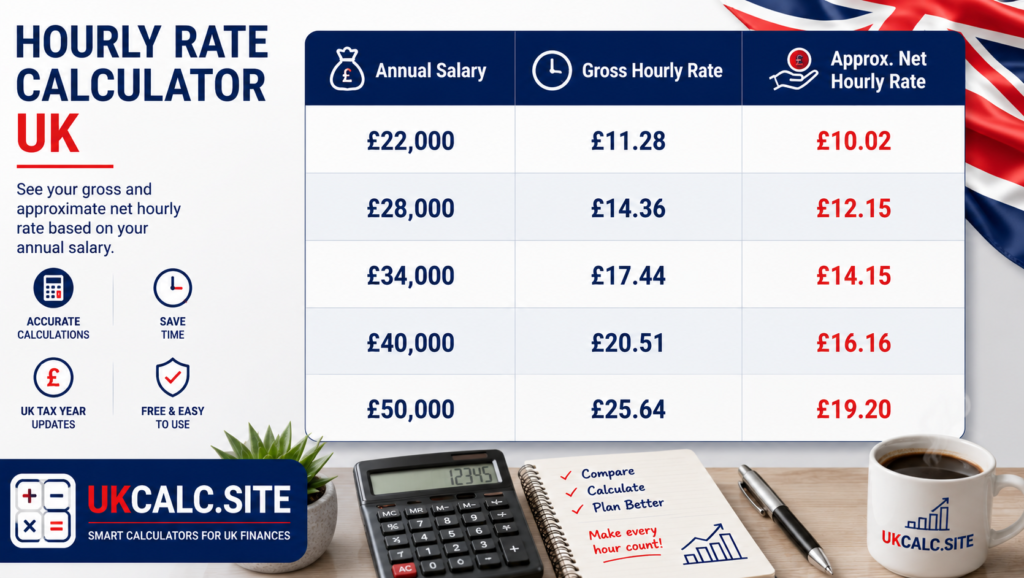
These figures are approximate and will vary depending on your tax code, pension contributions, and whether you repay a student loan. They’re useful as a general guide, but for an exact figure based on your own circumstances, an hourly rate calculator UK that factors in your specific tax and deduction details will always be more accurate than a rough table like this one.
Key Takeaways
- Your hourly rate is your salary divided by your total annual working hours, but getting the hours figure right matters as much as the maths itself.
- A standard 37.5-hour week over 52 weeks gives 1,950 annual hours; a 40-hour week gives 2,080.
- Gross hourly rate (before deductions) and net hourly rate (after tax, NI, and pension) can differ significantly, so it’s worth calculating both.
- Unpaid overtime lowers your effective hourly rate, even though your salary stays the same.
- Part-time, term-time, and irregular-hours contracts all need their own hours figure rather than a default full-time assumption.
- Recalculating your hourly rate periodically is a simple way to check your pay has kept pace with your actual workload.
Final Thoughts
Converting a salary into an hourly rate isn’t complicated once you know which figures to use, but it’s one of those calculations that’s easy to get slightly wrong if you rely on rough assumptions about working hours. Whether you’re comparing job offers, checking your pay against minimum wage, or working out whether unpaid overtime is quietly lowering what you actually earn per hour, the formula stays the same: divide your annual salary by your total annual working hours.
Using a reliable hourly rate calculator UK takes the guesswork out of this process, especially when you want to factor in tax, National Insurance, pension contributions, or a student loan repayment to see your true net hourly rate. Once you’ve run the numbers for your own salary and hours, you’ll have a much clearer picture of what your time is genuinely worth, and that makes it far easier to negotiate pay, compare opportunities, and budget with confidence.
FAQ’s
How do I calculate my hourly rate from my annual salary?
Divide your annual salary by your total annual working hours. For a standard 37.5-hour week worked across 52 weeks, that’s 1,950 hours a year, so a £30,000 salary works out to around £15.38 an hour.
Does my hourly rate calculation include holiday pay?
Yes, if you use 52 weeks in your calculation, since your salary already covers your paid annual leave. You don’t need to subtract holiday weeks separately.
What’s the difference between gross and net hourly rate?
Gross hourly rate is your pay before Income Tax, National Insurance, and pension deductions. Net hourly rate is based on your actual take-home pay, so it’s always lower and gives a more realistic picture of what you earn per hour.
How many hours are there in a working year in the UK?
It depends on your contract, but a common full-time figure is 1,950 hours (37.5 hours a week) or 2,080 hours (40 hours a week), based on 52 working weeks.
How do I calculate my hourly rate if I work part-time?
Use the same formula, but replace the full-time hours figure with your actual contracted weekly hours multiplied by 52. For example, 20 hours a week comes to 1,040 hours a year.
Does unpaid overtime affect my hourly rate?
Yes. If you regularly work extra unpaid hours, your effective hourly rate is lower than your contracted rate, since you’re earning the same salary across more hours.
How do I work out my hourly rate if my hours vary every week?
Add up your total pay and total hours worked over a recent period, such as three to six months, then divide pay by hours to get a realistic average.
Is an hourly rate calculator UK accurate for freelancers?
It’s a useful starting point, but freelancers and contractors also need to cover their own tax, National Insurance, and any unpaid time, so a fair freelance rate is usually higher than an equivalent employee’s hourly rate.
How do I check if my hourly rate meets the National Minimum Wage?
Calculate your hourly rate using your actual hours worked, then compare it against the current minimum wage rate for your age group. If it’s close to or below the threshold, it’s worth reviewing with your employer.
Should I use my monthly salary or annual salary to calculate my hourly rate?
Annual salary is more accurate, since months vary in length and using a monthly figure can introduce small rounding errors into the calculation.