Author name: abubakar0099114@gmail.com

UK Tax Bands
scholarships

UK Tax Bands Explained – Income Tax Rates for 2026/27

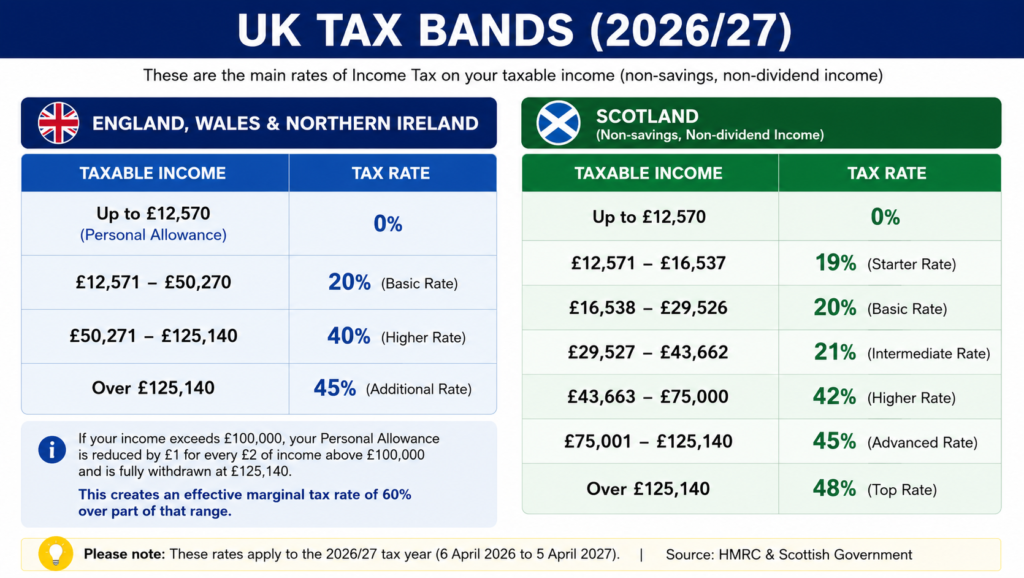
UK Tax Bands If you’ve ever looked at your payslip and thought “wait, why am I paying more tax this month?” — the answer almost always comes down to UK Tax Bands. They decide how much of your income is taxed, at what rate, and where the thresholds sit UK Tax Bands. The tricky part is that most people misunderstand how bands actually work. UK Tax Bands A lot of people assume that once you cross into a higher band, your entire income gets taxed at that higher rate. UK Tax Bands That’s not true, and it’s one of the most common money myths in the UK. This guide breaks down exactly how UK Tax Bands work for 2026/27, with real numbers, comparison tables, and examples you can apply to your own salary UK Tax Bands. Visit Now: https://www.taxsal.com/ What Are UK Tax Bands? UK Tax Bands are the income ranges HMRC uses to decide what percentage of tax you pay on different portions of your earnings. UK Tax Bands Instead of one flat tax rate applied to your whole salary, the UK uses a progressive tax system — meaning the more you earn, the higher the rate on the additional income above each threshold UK Tax Bands. Think of it like filling buckets. UK Tax Bands The first bucket (your Personal Allowance) is tax-free. Once that’s full, the next bucket gets taxed at 20%. Once that one’s full too, anything spilling into the next bucket is taxed at 40%, and so on. This system only applies to England, Wales, and Northern Ireland. Scotland has its own separate set of bands, which we’ll cover further down. UK Tax Bands for 2026/27 Here are the current income tax bands for England, Wales, and Northern Ireland: Band Taxable Income Tax Rate Personal Allowance Up to £12,570 0% Basic Rate £12,571 – £50,270 20% Higher Rate £50,271 – £125,140 40% Additional Rate Over £125,140 45% These thresholds have been frozen since 2021/22 and are set to remain unchanged until 2030/31. That freeze matters more than people realise — as wages rise with inflation, more people get pushed into higher bands even though their real spending power hasn’t grown much. This effect is known as fiscal drag, and it’s one of the main reasons more UK taxpayers are ending up in the higher-rate band each year. Your Personal Allowance: The Tax-Free Bucket Everyone starts with a Personal Allowance of £12,570. This is the amount you can earn each year before Income Tax kicks in at all. There’s a catch for higher earners, though. Once your income passes £100,000, your Personal Allowance starts shrinking — you lose £1 of allowance for every £2 you earn above that threshold. By the time you reach £125,140, your allowance is completely gone. This creates what’s sometimes called the “62% tax trap” between £100,000 and £125,140, because you’re losing allowance and paying 40% tax on the same slice of income at the same time. We’ll break that down with numbers shortly. How UK Tax Bands Actually Work (With Examples) Let’s clear up the biggest misconception first: you don’t pay one flat rate on your whole salary. You only pay each band’s rate on the portion of income that falls within it. Example 1: Salary of £28,000 Example 2: Salary of £55,000 Notice how only £4,730 is taxed at the higher 40% rate — not the full £55,000. This is exactly why a small pay rise that pushes you into the higher band still leaves you better off overall. You never lose money by earning more; you just keep a smaller share of that extra portion. Example 3: Salary of £110,000 (The Allowance Trap) This is where things get more complex. At £110,000, you’re £10,000 over the £100,000 threshold, so your Personal Allowance drops by £5,000 (£1 for every £2 over). The effective tax rate on income between £100,000 and £125,140 works out close to 60%, once you account for the lost allowance. This is why many higher earners in this range use pension contributions or salary sacrifice to bring their taxable income back under £100,000. Read More: UCL Global Undergraduate Scholarship 2026 in UK | Fully Funded Opportunity for International Students Read More: Chevening Scholarship 2026 in UK | Fully Funded Opportunity for International Students UK Tax Bands vs Scottish Tax Bands If you live in Scotland, your Income Tax bands are different from the rest of the UK. Scotland uses more bands with slightly different thresholds and rates, set independently by the Scottish Government. Band Scottish Rate Starter Rate 19% Basic Rate 20% Intermediate Rate 21% Higher Rate 42% Advanced Rate 45% Top Rate 48% The Personal Allowance (£12,570) is the same across the whole UK, including Scotland. Only the bands and rates above that allowance differ. Generally speaking, Scottish taxpayers earning below around £30,000 pay slightly less tax than the rest of the UK, while higher earners tend to pay more. Important: National Insurance rates are identical everywhere in the UK — Scotland’s separate system only applies to Income Tax, not NI. National Insurance and How It Fits In UK Tax Bands only cover Income Tax, but your payslip also shows a National Insurance deduction. For 2026/27, employees pay: Income Tax and National Insurance are calculated separately, but both come out of your gross pay, so it’s worth factoring in both when estimating your real take-home pay. Why Tax Bands Are Frozen (And What It Means for You) Unlike some previous years where bands rose with inflation, the current thresholds have been frozen for several years and are set to stay that way until 2030/31. Here’s why this matters practically: If your salary has increased over the past couple of years, it’s worth double-checking which band you now fall into — you might be paying more tax than you expect, purely because the thresholds haven’t moved with you. Step-by-Step: Finding Your Own Tax Band If you’d rather skip the manual calculation, a good UK tax calculator

Salary Tax UK
scholarships

Salary Tax UK Explained – How Much Tax Will You Pay?

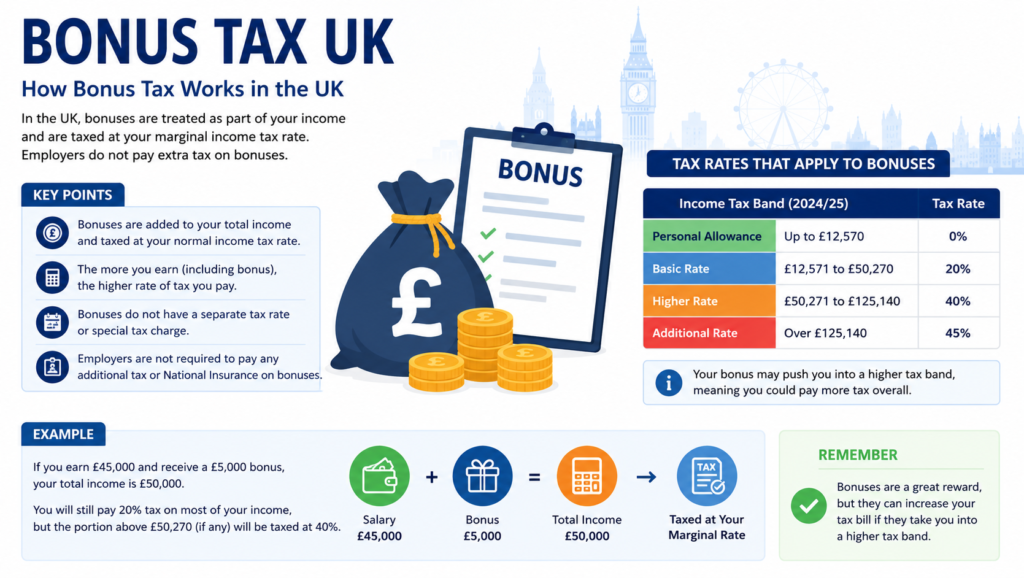
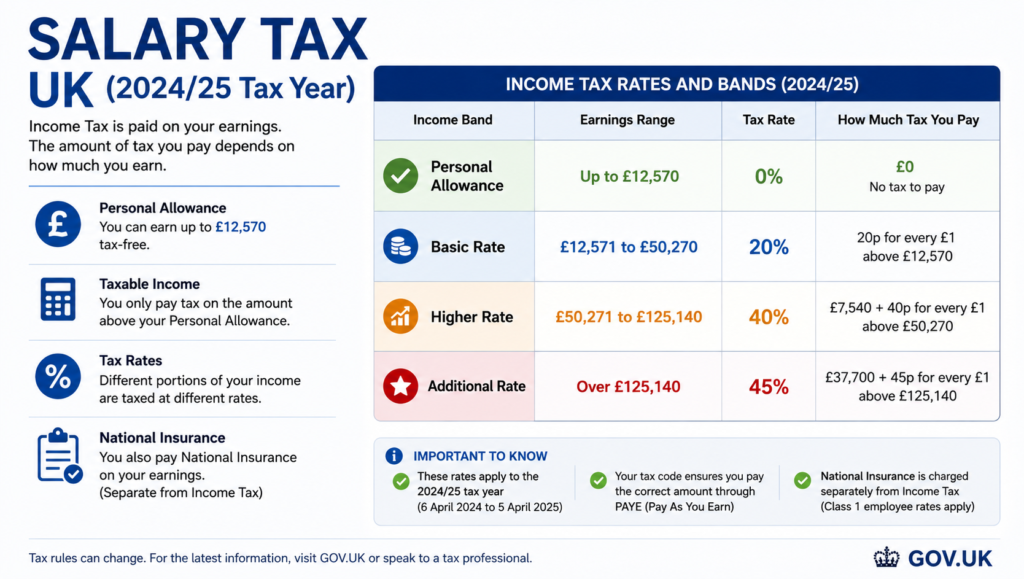
Getting your first payslip — or your tenth — and wondering where a chunk of your salary disappeared to is one of life’s most common financial head-scratchers. If you’ve typed “Salary Tax UK” into Google hoping for a straight answer, you’re in the right place. In this guide, we’ll break down exactly how UK income tax works, what National Insurance actually is, how much you’ll really take home, and how to check your own numbers without needing an accountant. Salary Tax UK No jargon, no confusing spreadsheets — just plain English explanations with real examples Salary Tax UK. Visit Now: https://www.taxsal.com/ What Is Salary Tax in the UK? “Salary tax” isn’t an official HMRC term, but it’s what most people mean when they ask how much of their pay goes to the government. Salary Tax UK In reality, your salary is reduced by two separate deductions: Both are usually taken automatically through PAYE (Pay As You Earn), which means your employer deducts the tax before the money ever reaches your bank account. Salary Tax UK If you’re self-employed, you’ll handle this yourself through Self Assessment instead Salary Tax UK. How Much Tax-Free Income Do You Get? Before any tax is calculated, everyone gets a Personal Allowance — the amount you can earn each year without paying a penny of income tax. For the 2026/27 tax year, the Personal Allowance is £12,570. This means if you earn £12,570 or less in a year, you pay no income tax at all. Salary Tax UK Anything above that is taxed according to which “band” it falls into Salary Tax UK. Important: if you earn over £100,000, your Personal Allowance starts shrinking. Salary Tax UK You lose £1 of allowance for every £2 you earn above £100,000, and it disappears completely once your income reaches £125,140. UK Income Tax Bands for 2026/27 Here’s where most of the confusion comes from. Salary Tax UK People often think if they move into a higher tax bracket, all their income gets taxed at that higher rate. Salary Tax UK That’s not true — only the portion of income within each band is taxed at that band’s rate Salary Tax UK. Tax Band Taxable Income Range Tax Rate Personal Allowance Up to £12,570 0% Basic Rate £12,571 to £50,270 20% Higher Rate £50,271 to £125,140 40% Additional Rate Over £125,140 45% (These bands apply to England, Wales, and Northern Ireland. Salary Tax UK Scotland has its own separate bands — more on that below.) A Simple Example Let’s say you earn £35,000 a year. Now let’s try someone earning £60,000. Notice that only the £9,730 above £50,270 gets taxed at 40%, not the whole £60,000 Salary Tax UK. This is the part most people misunderstand — and it’s exactly why “moving into a higher bracket” rarely means you take home less overall Salary Tax UK. Read More: Queen Elizabeth Commonwealth Scholarships 2026 – Last Date, Requirements & Process Don’t Forget National Insurance Income tax isn’t the only deduction from your salary. Salary Tax UK National Insurance contributions (NICs) are taken separately and go toward things like the State Pension, NHS funding, and certain benefits Salary Tax UK. For employees in 2026/27: So using our £35,000 example again: Combine that with the £4,486 income tax from earlier, and this person’s total deductions come to roughly £6,280 a year, leaving a take-home pay of about £28,720. Salary Tax Examples at Different Income Levels To give you a clearer picture, here’s roughly how much tax and NI you’d pay at common salary levels (figures rounded, England/Wales/NI rates): Annual Salary Income Tax National Insurance Approx. Take-Home £20,000 £1,486 £594 ~£17,920 £30,000 £3,486 £1,394 ~£25,120 £40,000 £5,486 £2,194 ~£32,320 £50,000 £7,486 £2,994 ~£39,520 £75,000 £17,432 £3,494 ~£54,074 £100,000 £27,432 £4,494 ~£68,074 These are estimates for a standard tax code with no student loan, pension contributions, or other deductions factored in — your actual take-home may vary slightly depending on your circumstances. What About Scotland? If you live in Scotland, your income tax works a bit differently. Salary Tax UK The Scottish Government sets its own rates and bands, which currently include more tiers than the rest of the UK — a starter rate, basic rate, intermediate rate, higher rate, advanced rate, and top rate Salary Tax UK. The key thing to know: National Insurance is the same across the whole UK, no matter where you live. Only income tax bands differ for Scottish taxpayers. Common Things That Change Your Tax Bill Your salary tax isn’t always as straightforward as the tables above. Salary Tax UK A few things can shift the numbers: If your payslip doesn’t match what you expected, checking your tax code is usually the first place to start. How to Check Your Tax Code Your tax code appears on your payslip and P60, and it tells your employer how much tax-free income you’re entitled to. The most common code is 1257L, which reflects the standard £12,570 Personal Allowance. If your code looks different, it could mean: It only takes a few minutes to check your tax code through your personal HMRC account, and it’s worth doing at least once a year. Step-by-Step: Working Out Your Own Salary Tax If you’d rather calculate this yourself instead of relying on a table, here’s the process: If numbers aren’t your thing, using a reliable UK salary calculator will do all of this instantly — just make sure it’s updated for the current 2026/27 rates, since thresholds do change from year to year. Salary Sacrifice: A Legal Way to Reduce Your Tax Bill One thing many employees don’t realise is that you can legally lower the amount of tax and National Insurance you pay through salary sacrifice schemes. This is where you agree to give up part of your gross salary in exchange for a non-cash benefit, most commonly pension contributions. Here’s why it works: because the sacrificed amount is deducted before tax and NI are calculated, your taxable income drops. Common examples

Calculate Take Home Pay
scholarships

How to Calculate Take Home Pay in the UK – Complete Step-by-Step Guide

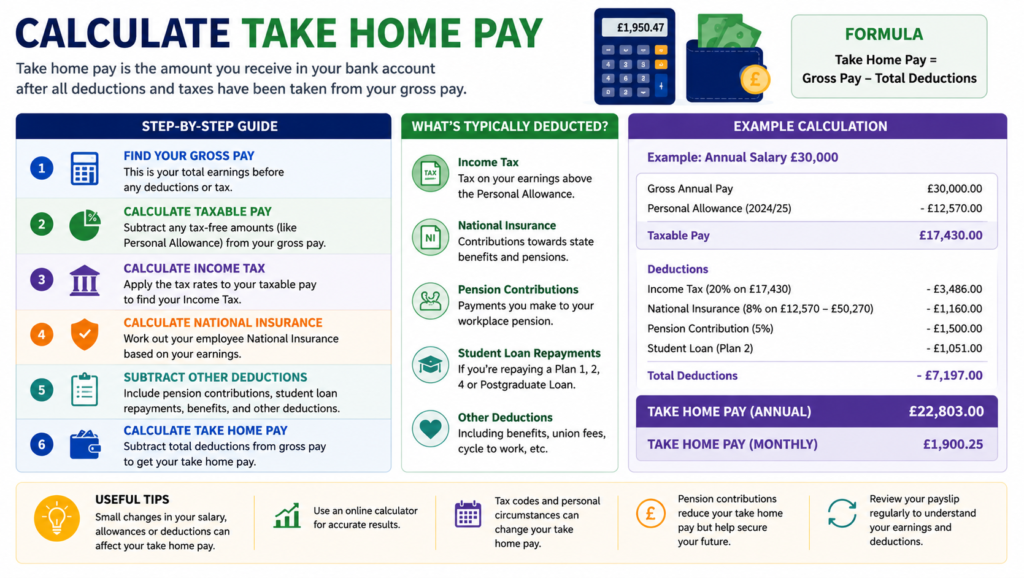
Ever wondered why your salary offer looks so different once it actually hits your bank account? That gap between what you’re offered and what you actually receive comes down to one thing: knowing how to calculate take home pay correctly. Whether you’re negotiating a new job offer, planning a budget, or just trying to understand your payslip better, this guide walks you through the entire process — step by step, with real examples, so you can work out your exact take-home pay with confidence. Visit Now: https://www.taxsal.com/ What Does “Take Home Pay” Actually Mean? Take home pay (also called net pay) is the amount you actually receive after all deductions are taken from your gross salary. Calculate Take Home Pay It’s the real number that matters — the one that determines what you can actually spend, save, or budget with each month. Your gross salary might look impressive on a job offer, but it’s your take-home pay that pays the rent, covers the bills, and funds your lifestyle. The Basic Formula to Calculate Take Home Pay At its core, the formula is simple: Take Home Pay = Gross Pay − Income Tax − National Insurance − Pension Contributions − Other Deductions The tricky part isn’t the formula itself — it’s calculating each of those deductions correctly, since they depend on tax bands, thresholds, and your personal circumstances. Let’s break each one down. Step 1: Start With Your Gross Salary Your gross salary is your total pay before any deductions. This includes: Example: Let’s say your annual gross salary is £35,000, paid monthly. Monthly gross pay = £35,000 ÷ 12 = £2,916.67 We’ll use this figure throughout the guide to show exactly how take-home pay is calculated. Step 2: Apply Your Personal Allowance Before tax is calculated, your Personal Allowance is deducted from your gross income. Calculate Take Home Pay For the 2025/26 tax year, the standard Personal Allowance is: £12,570 This means the first £12,570 of your annual income is completely tax-free Calculate Take Home Pay. For our example: £35,000 − £12,570 = £22,430 taxable income Step 3: Calculate Income Tax Once you know your taxable income, you apply the relevant tax bands. Band Taxable Income Rate Personal Allowance Up to £12,570 0% Basic Rate £12,571 to £50,270 20% Higher Rate £50,271 to £125,140 40% Additional Rate Over £125,140 45% Since £22,430 falls entirely within the Basic Rate band: £22,430 × 20% = £4,486 Income Tax per year Monthly Income Tax = £4,486 ÷ 12 = £373.83 Step 4: Calculate National Insurance National Insurance (NI) is calculated separately from Income Tax and uses its own threshold. Calculate Take Home Pay For most employees, Class 1 NI is deducted once earnings go above a certain weekly or monthly limit. For the 2025/26 tax year, employees pay: Simplified example: If your monthly NI-able earnings are around £2,916, and the threshold is roughly £1,048 per month, NI would apply to the amount above that threshold. (£2,916 − £1,048) × 8% ≈ £149.44 monthly National Insurance (Note: exact NI thresholds are reviewed each tax year, so always check current HMRC rates for precise calculations.) Read More: UK Scholarships 2026: 10 Best Fully Funded Programs Step 5: Deduct Pension Contributions If you’re enrolled in a workplace pension, your contribution is deducted before or after tax, depending on the scheme type Calculate Take Home Pay. Example: If your pension contribution is 5%: £2,916.67 × 5% = £145.83 monthly pension deduction This reduces your taxable income further in most schemes, which can also slightly lower your Income Tax. Step 6: Factor in Other Deductions Depending on your circumstances, you might also have: For this example, let’s assume no additional deductions apply. Step 7: Calculate Your Final Take Home Pay Now let’s put it all together: Item Monthly Amount Gross Pay £2,916.67 Income Tax −£373.83 National Insurance −£149.44 Pension Contribution −£145.83 Take Home Pay £2,247.57 So on a £35,000 annual salary, your monthly take-home pay comes to roughly £2,247.57, depending on your specific tax code and pension setup. Quick Reference: Take Home Pay by Salary (Approximate) Annual Salary Approx. Monthly Take Home £25,000 £1,750 £30,000 £2,050 £35,000 £2,247 £40,000 £2,540 £50,000 £3,100 (These are approximate figures for illustration purposes. Actual take-home pay depends on your tax code, pension contributions, student loan status, and other deductions.) Factors That Affect Your Take Home Pay Your take-home pay isn’t fixed just because your salary is — several factors can shift the final number: How to Calculate Take Home Pay for Hourly Workers If you’re paid hourly rather than a fixed salary, the process is slightly different: Example: If you work 160 hours a month at £15/hour: 160 × £15 = £2,400 gross monthly pay From there, apply the same Income Tax, NI, and pension steps used earlier. Common Mistakes People Make When Calculating Take Home Pay Even small errors in these calculations can lead to inaccurate budgeting, so it’s worth double-checking figures against official HMRC rates or a reliable take-home pay calculator. Why Understanding This Calculation Matters Knowing how to calculate take home pay isn’t just useful for curiosity — it has real, practical benefits: Final Thoughts Learning how to calculate take home pay puts you back in control of your finances. Instead of guessing what you’ll actually receive each month, you can work it out with confidence — whether you’re comparing job offers, planning a budget, or simply making sense of your payslip. Once you understand each step — from gross pay to Personal Allowance, tax, National Insurance, and pension deductions — the whole process becomes far less intimidating. And that clarity is exactly what makes managing your money easier, month after month. FAQ’s

UK Personal Allowance
scholarships

Personal Allowance Explained – How Much Can You Earn Tax-Free?

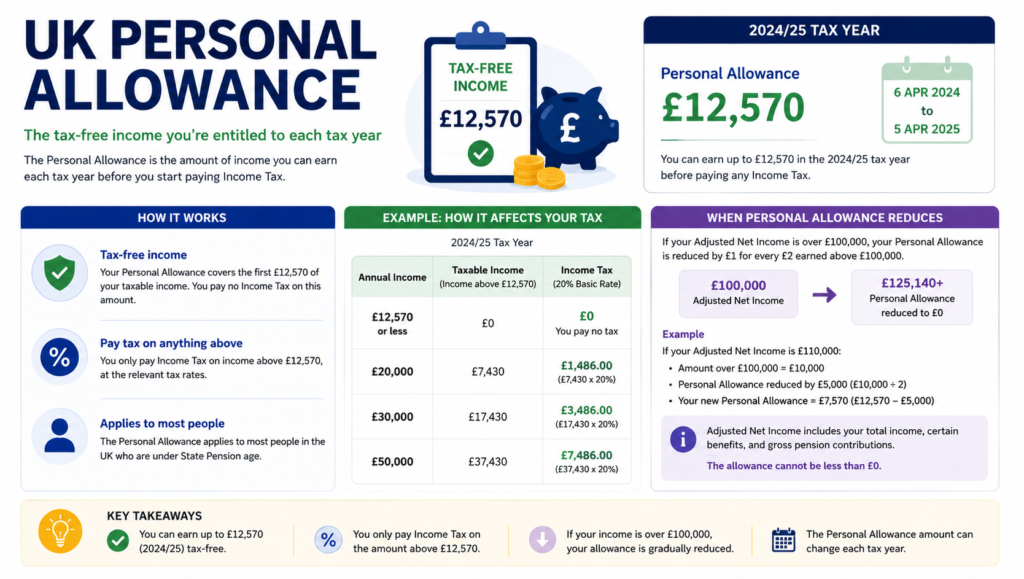
Ever looked at your payslip and wondered why you’re not taxed on every single pound you earn? That’s your UK Personal Allowance at work — and understanding it properly can help you plan your finances, spot payroll mistakes, and even make smarter decisions about pay rises, side income, or pension contributions UK Personal Allowance. In this guide, we’ll break down exactly what the Personal Allowance is, how much you can earn tax-free, who qualifies, and what can reduce or increase it. UK Personal Allowance No jargon, no confusing tax-speak — just a clear, practical explanation UK Personal Allowance. Visit Now: https://www.taxsal.com/ What Is the Personal Allowance? The Personal Allowance is the amount of income you can earn each tax year before you start paying Income Tax. UK Personal Allowance Think of it as a tax-free buffer built into the system — everyone gets it (unless certain conditions apply), and it applies automatically through PAYE if you’re employed UK Personal Allowance. For the 2025/26 tax year, the standard Personal Allowance is: £12,570 This means if you earn £12,570 or less in a tax year, you pay no Income Tax at all. UK Personal Allowance Anything above that threshold is taxed according to the relevant tax bands UK Personal Allowance. How the Personal Allowance Works in Practice The UK tax year runs from 6 April to 5 April the following year. UK Personal Allowance Your Personal Allowance applies across this entire period, not per month or per job. Example: If you earn £24,570 a year, here’s how it plays out: Income Portion Tax Treatment First £12,570 Tax-free (Personal Allowance) Remaining £12,000 Taxed at 20% (Basic Rate) So you wouldn’t pay tax on your full salary — only on the amount above your allowance. Current Income Tax Bands (2025/26) Here’s how the Personal Allowance fits into the wider Income Tax system: Band Taxable Income Tax Rate Personal Allowance Up to £12,570 0% Basic Rate £12,571 to £50,270 20% Higher Rate £50,271 to £125,140 40% Additional Rate Over £125,140 45% Your Personal Allowance sits underneath all of this — it’s the tax-free layer before any of these rates apply. Read More: Bestway Foundation Scholarship 2026: Apply Now Before Deadline Closes Who Gets the Personal Allowance? Most UK residents are automatically entitled to the standard Personal Allowance if: If you’re employed, this is usually reflected in your tax code — most commonly 1257L, which tells your employer how much tax-free income to apply before deducting tax through PAYE. How Your Tax Code Reflects Your Personal Allowance Your tax code isn’t just a random string of letters and numbers — it directly represents your Personal Allowance. Example: Tax code 1257L means: If your tax code looks different, it usually means something has changed — maybe you have additional income, a company benefit, or you owe tax from a previous year. Common Tax Codes and What They Mean Tax Code Meaning 1257L Standard Personal Allowance BR All income taxed at Basic Rate (no allowance applied) 0T No Personal Allowance applied K497 You owe tax that reduces your allowance further NT No tax deducted If your tax code doesn’t match what you expect, it’s worth checking with HMRC or your payroll department, since an incorrect code can mean you’re overpaying or underpaying tax. What Reduces Your Personal Allowance? This is where many people get caught out. Your Personal Allowance isn’t fixed for everyone — it can shrink depending on your income. High Earners (Over £100,000) If your income goes above £100,000, your Personal Allowance starts reducing. UK Personal Allowance For every £2 you earn over £100,000, your allowance drops by £1. Example: If you earn £110,000, that’s £10,000 over the threshold. £10,000 ÷ 2 = £5,000 reduction New Personal Allowance = £12,570 − £5,000 = £7,570 Once your income reaches £125,140, your Personal Allowance disappears completely — meaning your entire income is taxed. This creates what’s often called the “60% tax trap”, because the effective tax rate in this income band can feel much higher than the standard 40% rate, due to the shrinking allowance. Can You Increase Your Personal Allowance? While you can’t simply “boost” your allowance, there are legitimate ways to reduce your taxable income, which can help you stay within a lower band or protect your allowance from shrinking: Marriage Allowance Example If your partner earns £10,000 a year (below the £12,570 threshold), they have £2,570 of unused allowance. They can transfer up to £1,260 of this to you, potentially reducing your tax bill by up to £252 a year. Personal Allowance for Different Income Types The Personal Allowance doesn’t just apply to salary — it applies to your total taxable income, which can include: However, it does not apply to: Step-by-Step: How to Check If You’re Getting the Right Allowance Why Understanding Your Personal Allowance Matters Knowing how the Personal Allowance works isn’t just useful trivia — it has real financial impact: A small misunderstanding here can lead to overpaying tax for months without realising it — which is exactly why it’s worth taking ten minutes to understand properly. Final Thoughts Understanding the UK Personal Allowance gives you a clearer picture of how much of your income is genuinely yours to keep before tax. UK Personal Allowance Whether you’re checking your tax code, planning around a pay rise, or simply trying to make sense of your payslip, knowing how this allowance works puts you in a stronger position. Take a moment to check your own tax code today — it only takes a minute, but it could save you from paying more tax than you actually need to UK Personal Allowance. FAQ’s

UK Payslip Explained
scholarships

How to Read Your UK Payslip – Line by Line Guide

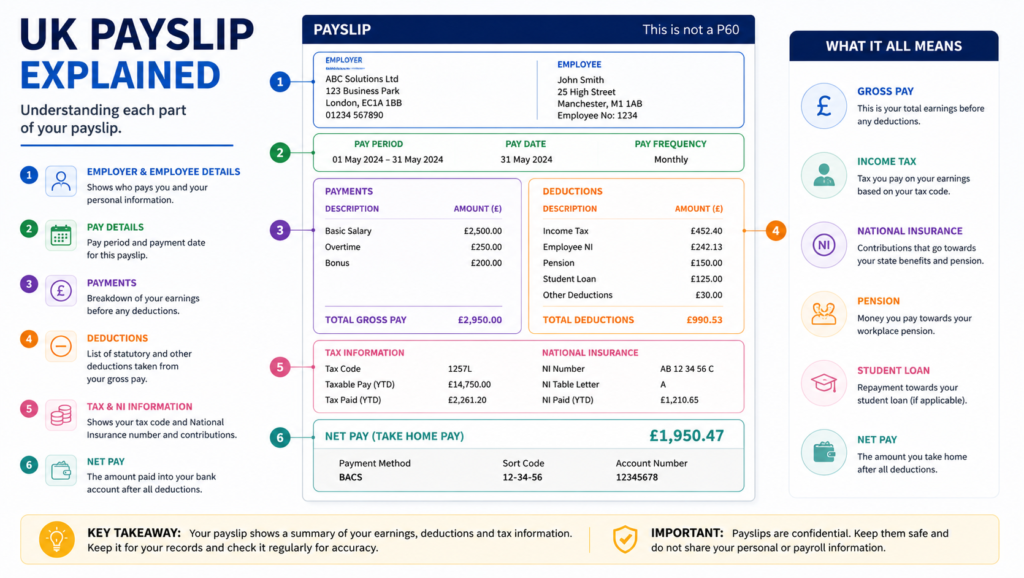
Getting your first payslip — or even your fiftieth — can feel like staring at a foreign language.  UK Payslip Explained Codes, abbreviations, deductions you don’t remember agreeing to, and a “net pay” figure that never quite matches what you expected.  UK Payslip Explained If you’ve ever opened your payslip and thought, “What does any of this actually mean?”, you’re not alone. This guide breaks down UK payslip explained, section by section, so you know exactly where your money is going and why. By the end, you’ll be able to check your own payslip for errors, understand your tax code, and spot the difference between gross pay and take-home pay without needing an accountant to translate it for you. Let’s go through it properly, line by line. Visit Now: https://www.taxsal.com/ What Is a Payslip and Why It Matters A payslip is a document your employer must give you every time you’re paid, whether that’s weekly, fortnightly, or monthly.  UK Payslip Explained It’s not just a formality — under UK law, every employee has a legal right to an itemised payslip, and it must show certain details clearly. Your payslip matters because it’s proof of: If you ever apply for a mortgage, a loan, or even a rental property, payslips are usually the first thing landlords or lenders ask for. So understanding them isn’t just useful — it’s practical. The Basic Structure of a UK Payslip Most payslips, regardless of the company or payroll software used, follow a similar layout.  UK Payslip Explained While the design might differ slightly between employers, the core sections remain consistent: Let’s break each of these down properly. 1. Personal and Employer Information At the top of your payslip, you’ll usually see: This section seems straightforward, but it’s worth checking carefully.  UK Payslip Explained A wrong National Insurance number or an outdated tax code can cause real problems later, including incorrect tax deductions UK Payslip Explained. Example: If your tax code shows something like 1257L, that’s the standard code for most people with one job and the standard Personal Allowance for the 2025/26 tax year. UK Payslip Explained If it looks different — say BR, 0T, or K497 — it’s worth understanding what that means, because it directly affects how much tax you pay UK Payslip Explained. 2. Pay Period and Payment Date This tells you which period the payslip covers — for example, “01/06/2026 to 30/06/2026” — and the actual date you were paid UK Payslip Explained. This is especially important if you’re comparing payslips month to month, since some months have more working days than others, which can slightly affect your pay if you’re on an hourly rate. 3. Gross Pay: The Starting Point Gross pay is your total earnings before any deductions. This includes: Think of gross pay as the full amount your employer has agreed to pay you for your work — before the taxman, National Insurance, or your pension provider take their share. Example: If your annual salary is £30,000 and you’re paid monthly, your gross pay for the month would be: £30,000 ÷ 12 = £2,500 That £2,500 is your starting figure before anything is deducted. 4. Understanding Deductions This is usually where most confusion happens. Let’s go through each deduction one by one. Income Tax Income Tax is calculated based on your tax code and how much you earn. UK Payslip Explained The UK uses a tiered system, meaning different portions of your income are taxed at different rates. For the 2025/26 tax year, the general bands are: Band Taxable Income Tax Rate Personal Allowance Up to £12,570 0% Basic Rate £12,571 to £50,270 20% Higher Rate £50,271 to £125,140 40% Additional Rate Over £125,140 45% So if you earn £30,000 a year, you don’t pay 20% on the whole amount — only on the portion above £12,570 UK Payslip Explained. Read More: UCL Global Undergraduate Scholarship 2026 in UK | Fully Funded Opportunity for International Students National Insurance (NI) National Insurance contributions fund things like the NHS, state pension, and certain benefits. UK Payslip Explained Most employees pay Class 1 National Insurance, calculated based on how much you earn above a certain threshold. Unlike Income Tax, NI is calculated per pay period, not annually, which is why it can look slightly different from month to month if your pay varies. Pension Contributions If you’re enrolled in a workplace pension — which most employees are, thanks to auto-enrolment — you’ll see a deduction here. Typically: Example: If your pension contribution is 5%, and you earn £2,500 that month, £125 would go toward your pension before tax is calculated on that portion (depending on the scheme type). Student Loan Repayments If you have a student loan, repayments are usually deducted automatically once you earn above a certain threshold, which depends on your loan plan (Plan 1, Plan 2, Plan 4, or Postgraduate Loan). Other Deductions Depending on your employer, you might also see: 5. Net Pay: What You Actually Take Home After all deductions are subtracted from your gross pay, what’s left is your net pay — the amount that actually lands in your bank account. Quick example: Item Amount Gross Pay £2,500 Income Tax -£220 National Insurance -£180 Pension Contribution -£100 Net Pay £2,000 This is a simplified example, but it shows the basic flow: gross pay minus deductions equals net pay UK Payslip Explained. 6. Year-to-Date (YTD) Figures Most payslips include a “Year-to-Date” section, showing your total earnings and deductions since the start of the tax year (which runs from 6 April to 5 April) UK Payslip Explained. This is useful for: How to Check Your Payslip for Errors Mistakes happen more often than people realise — wrong tax codes, incorrect NI calculations, or missed pension contributions. UK Payslip Explained Here’s a simple way to check yours: If something doesn’t add up, don’t ignore it. UK Payslip Explained Speak to your payroll or HR department as soon as possible — the earlier a mistake is caught, the

Salary Pay Periods
scholarships

Weekly, Monthly and Annual Salary Explained

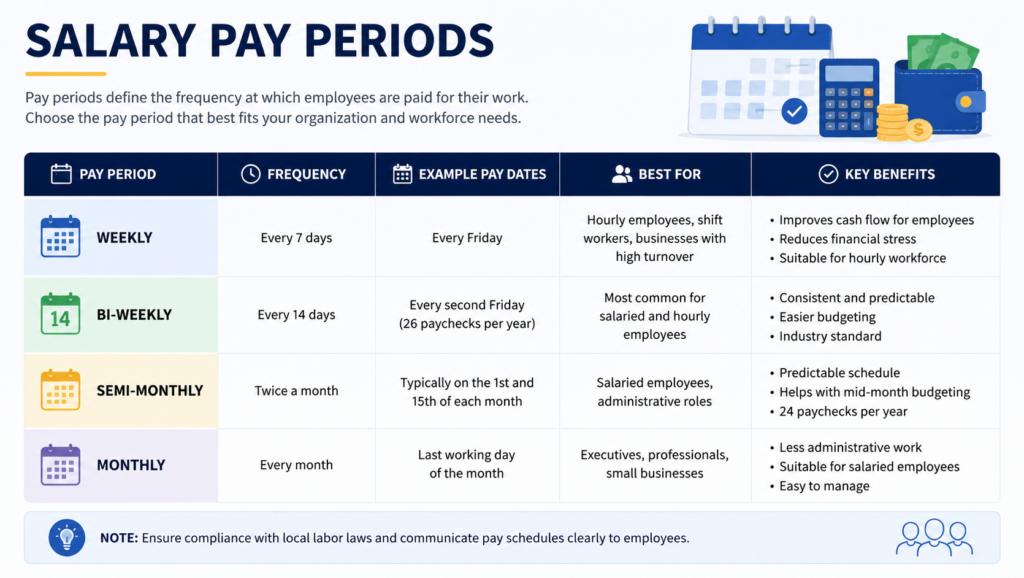
Have you ever tried comparing two job offers, one listing a weekly wage and the other an annual salary, and found yourself doing awkward maths in your head? You’re not alone. Salary Pay Periods Understanding salary pay periods — weekly, monthly, and annual — is one of those things that seems simple until you actually need to compare numbers accurately. In this guide, we’ll break down exactly how these three pay periods work, how to convert between them, and why understanding salary pay periods properly can help you budget better, compare jobs fairly, and avoid confusion on payday. What Are Salary Pay Periods? Salary pay periods simply refer to how often you’re paid and how your earnings are calculated over time. In the UK, the three most common pay periods are: Each of these represents the same underlying income, just measured over different timeframes. Understanding how they connect makes it much easier to compare pay, plan budgets, and check your payslip is correct. Visit Now: https://www.taxsal.com/ Weekly Salary Explained Weekly pay means you receive your wages every week, usually on the same day. Salary Pay Periods This is common for: Example: If you earn £480 a week, that means you’re paid this amount every seven days, regardless of how many weeks are in the month Salary Pay Periods. How to Convert Weekly Pay to Annual Salary To estimate your annual salary from weekly pay: Weekly pay × 52 = Annual salary So, £480 × 52 = £24,960 per year Note that some months have more “pay weeks” than others depending on the calendar, which is why weekly-paid workers sometimes notice slightly different total pay across different months. Monthly Salary Explained Monthly pay is the standard method for most full-time, salaried employees in the UK. Salary Pay Periods You’re paid once a month, typically towards the end of the month or on a fixed date like the 25th or last working day Salary Pay Periods. Example: If your annual salary is £30,000, your monthly pay before deductions would be: £30,000 ÷ 12 = £2,500 per month This is a clean, predictable structure, making it easier to plan monthly bills, rent, or mortgage payments around a consistent income. Annual Salary Explained Your annual salary is the total amount you earn in a full calendar year before any deductions. This is the figure most commonly listed in job adverts and used in official documents like mortgage applications or loan assessments. Example: A job advertised as “£35,000 per annum” means you’ll earn £35,000 across the year, whether you’re paid weekly, monthly, or through another arrangement. Rea More: UK Scholarships 2026: 10 Best Fully Funded Programs Weekly vs Monthly vs Annual Salary: Quick Comparison Pay Period Best For Payment Frequency Common Use Case Weekly Hourly or part-time workers Every 7 days Retail, hospitality, casual work Monthly Salaried employees Once a month Office jobs, full-time roles Annual Contracts and comparisons Once a year (total) Job adverts, mortgage applications This table highlights how each pay period serves a different practical purpose, even though they all represent the same underlying income. How to Convert Between Salary Pay Periods Understanding these simple conversions makes comparing job offers or checking payslips much easier. Weekly to Monthly (Weekly pay × 52) ÷ 12 = Monthly pay Example: (£480 × 52) ÷ 12 = £2,080 per month Monthly to Annual Monthly pay × 12 = Annual salary Example: £2,500 × 12 = £30,000 per year Annual to Weekly Annual salary ÷ 52 = Weekly pay Example: £30,000 ÷ 52 = £576.92 per week Annual to Monthly Annual salary ÷ 12 = Monthly pay Example: £30,000 ÷ 12 = £2,500 per month Why Understanding Salary Pay Periods Matters 1. Comparing Job Offers Accurately If one job advertises £15 an hour and another offers £30,000 a year, converting both into the same pay period lets you compare them fairly, rather than guessing which is better. 2. Budgeting Around Irregular Months Since months vary in length, and some months contain extra pay weeks for weekly-paid workers, understanding your true average monthly income helps avoid budgeting surprises. 3. Understanding Payslips Correctly Knowing your correct pay period helps you check that your payslip matches your contract, especially important if you’ve recently changed jobs, hours, or pay frequency. 4. Mortgage and Loan Applications Lenders often ask for annual income figures, even if you’re paid weekly or monthly. Knowing how to convert your income correctly ensures your application reflects accurate numbers. Step-by-Step: Checking Your Own Salary Conversion Here’s a simple way to check your own pay period conversions: Common Mistakes People Make With Salary Pay Periods Real-World Example: Comparing Two Job Offers Imagine you’re deciding between two jobs: Job Offer Pay Structure Annual Equivalent Job A £550 per week £550 × 52 = £28,600 Job B £2,450 per month £2,450 × 12 = £29,400 At first glance, Job B might look better simply because the monthly figure seems larger, but converting both to an annual equivalent shows Job B actually pays about £800 more per year — a difference you’d miss without doing the conversion. Final Thoughts Understanding weekly, monthly, and annual salary structures isn’t just useful trivia — it’s essential for making informed decisions about job offers, budgeting, and financial planning. Once you understand how these salary pay periods connect and convert into one another, comparing pay becomes far simpler and much more accurate. Next time you’re comparing job offers or reviewing your payslip, take a moment to convert the figures into the same pay period. It only takes a minute, but it can reveal real differences in value that aren’t obvious at first glance. FAQ’s

Gross Pay vs Net Pay
scholarships

Gross Pay vs Net Pay – What’s the Difference?

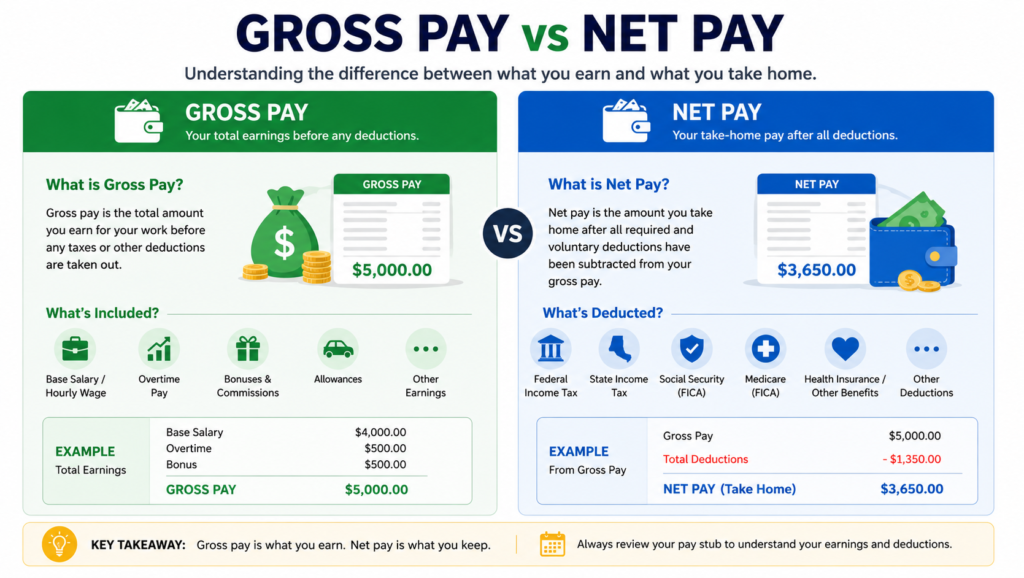
Ever looked at your job offer, seen a salary figure, then opened your first payslip and wondered where the rest of your money went? You’re not imagining things — and you’re definitely not being short-changed. This is simply the difference between gross pay and net pay, two terms that confuse almost everyone starting a new job. In this guide, we’ll break down exactly what gross pay and net pay mean, how one turns into the other, and why understanding the difference matters more than most people realise — especially when budgeting, applying for a mortgage, or comparing job offers. What Is Gross Pay? Gross pay is your total earnings before anything is taken out. Gross Pay vs Net Pay It’s the number you see advertised in job listings and written into your employment contract. Gross pay includes: Example: If your contract says you earn £32,000 a year, that £32,000 is your gross pay — before tax, National Insurance, or anything else is deducted. Visit Now: https://www.taxsal.com/ What Is Net Pay? Net pay, often called take-home pay, is what actually lands in your bank account after all deductions have been made. Gross Pay vs Net Pay This is the real amount you have available to spend, save, or budget with. Net pay is calculated by subtracting the following from your gross pay: Example continued: On a £32,000 gross salary, after tax, National Insurance, and a standard pension contribution, your net pay might come out to around £2,100–£2,200 per month — the exact figure depends on your tax code and personal circumstances. Gross Pay vs Net Pay: Quick Comparison Feature Gross Pay Net Pay Definition Total earnings before deductions Earnings after deductions Shown in job adverts Yes Rarely Used for Tax calculations, mortgage assessments Budgeting, daily spending Includes bonuses/overtime Yes Yes, but taxed What you actually receive No Yes This table sums up the core difference: gross pay is the “headline” figure, while net pay is the real, spendable amount. How Gross Pay Becomes Net Pay: Step-by-Step Understanding the journey from gross to net pay makes payslips far less confusing. Gross Pay vs Net Pay Here’s how it works: Why the Difference Between Gross and Net Pay Matters 1. Job Offer Comparisons Can Be Misleading Two job offers with the same gross salary can result in very different take-home pay, depending on pension contributions, benefits, or student loan deductions. Always compare net pay, not just the headline number. 2. Budgeting Requires Real Numbers If you plan your monthly budget around your gross salary, you’ll likely overestimate how much you actually have to spend. Always base your budget on net pay. 3. Mortgage and Loan Applications Lenders typically look at gross income to assess affordability, but your actual repayment ability depends on your net income. Gross Pay vs Net Pay Understanding both figures helps you judge realistically what you can afford. 4. Understanding Payslips Once you know how gross turns into net, payslips become much easier to read — you’ll immediately spot if something looks off, like an incorrect tax code or missing pension contribution. Common Deductions Explained Simply Income Tax This is a percentage of your earnings paid to the government, based on tax bands. Gross Pay vs Net Pay The more you earn, the higher the percentage on the portion above each threshold. National Insurance (NI) NI contributions fund state benefits like the State Pension and NHS. It’s calculated separately from Income Tax and has its own thresholds. Pension Contributions Most employees are automatically enrolled into a workplace pension. Gross Pay vs Net Pay A percentage of your gross pay goes into this pot, often matched partly by your employer. Student Loan Repayments If you took out a student loan, repayments are automatically deducted once your income crosses the relevant repayment threshold for your loan plan. Read More: PAYE Explained – How Pay As You Earn Works in the UK Gross Pay vs Net Pay: A Real-World Example Let’s say Sarah earns a gross annual salary of £28,000, working full-time in the UK. Item Amount Gross annual salary £28,000 Income Tax Approx. £2,486 National Insurance Approx. £1,624 Pension contribution (5%) £1,400 Net annual pay Approx. £22,490 Gross Pay vs Net Pay So while Sarah’s job advert said £28,000, her actual take-home pay works out closer to £22,490 a year — or roughly £1,874 a month. Gross Pay vs Net Pay This is why checking your net pay is so important before accepting a job or planning your finances. Gross Pay vs Net Pay for the Self-Employed If you’re self-employed, there’s no automatic payroll deduction. Instead: This means self-employed workers need to actively set aside money for tax, rather than seeing it deducted automatically like employees do Gross Pay vs Net Pay. How to Check Your Own Gross and Net Pay Here’s a simple way to check both figures on your payslip: If anything looks unusual, such as a sudden change in tax deducted, it’s worth checking your tax code or asking your payroll department for clarification Gross Pay vs Net Pay. Final Thoughts Understanding the difference between gross pay and net pay isn’t just useful — it’s essential for making smart financial decisions. Gross pay tells you what your job is technically worth on paper, but net pay tells you what you can actually spend, save, or plan around. Next time you receive a job offer or check your payslip, take a moment to look beyond the gross figure. Gross Pay vs Net Pay Understanding exactly how it converts into your net pay will help you budget more accurately, compare job offers fairly, and avoid any surprises when payday arrives. FAQ’s

Salary Sacrifice
scholarships

Salary Sacrifice Explained – Benefits and Drawbacks

If you’ve seen “salary sacrifice” mentioned on your payslip, in a pension scheme, or in a cycle-to-work offer at your job, you’re not alone in wondering exactly what it means. It sounds complicated, but the idea behind it is actually quite simple once you break it down. In this guide, we’ll explain what salary sacrifice is, how it works in practice, and why so many UK employers offer it. We’ll also cover the real benefits and the genuine drawbacks — because while salary sacrifice can save you money, it isn’t the right choice for everyone. What Is Salary Sacrifice? Salary sacrifice is an arrangement between you and your employer where you agree to give up part of your salary in exchange for a non-cash benefit. Instead of receiving that portion of your pay as taxable income, it’s redirected into something like: Because your official salary is lower, you pay less Income Tax and less National Insurance on that reduced amount. Your employer also pays less employer National Insurance, which is why many businesses are happy to offer these schemes. Simple example: Say you earn £30,000 a year and agree to sacrifice £2,000 into your pension. Your taxable salary drops to £28,000. You still get the £2,000 — it just goes into your pension pot instead of your bank account, and you avoid paying tax and National Insurance on it. Visit Now: https://www.taxsal.com/ How Does Salary Sacrifice Work? The process itself is straightforward, but it does require a formal agreement between you and your employer. Here’s how it typically works step by step: This is the key point people often miss: it’s not that you’re avoiding paying for the benefit. You’re still paying for it — just before tax is taken out, rather than after. Common Types of Salary Sacrifice Schemes Not all salary sacrifice schemes work the same way. Here’s a quick breakdown of the most common ones in the UK. Scheme Type What It’s Used For Typical Saving Pension contributions Boosting retirement savings Tax + NI savings on contributions Cycle to Work Buying a bike and equipment Up to 40% off retail price Electric car leasing Leasing an EV through your employer Lower tax than company car schemes Childcare vouchers Paying for registered childcare Tax and NI savings (legacy scheme, closed to new joiners) Additional holiday Buying extra annual leave No tax saving, but useful for work-life balance Pension salary sacrifice is by far the most widely used, since almost every employer offers a workplace pension and the tax savings are significant over time. Benefits of Salary Sacrifice 1. Lower Income Tax and National Insurance This is the main attraction. Because your taxable salary is reduced, you pay less tax and less National Insurance overall. For higher earners, this can also help keep income below key thresholds — like avoiding the tapering of the Personal Allowance above £100,000. 2. Employer Savings Can Be Passed Back to You Employers save on National Insurance too. Many pass some or all of this saving back into your pension as an extra contribution, effectively boosting your retirement pot for free. 3. Bigger Pension Pot Over Time Because contributions go in before tax, more money ends up in your pension compared to contributing the same amount from your take-home pay. Over 20–30 years, this difference compounds significantly. 4. Access to Discounted Benefits Schemes like Cycle to Work or EV leasing let you access products at a lower effective cost than buying them outright, since you’re paying with pre-tax income. 5. No Extra Admin for Employees Once you’re signed up, the scheme runs automatically through payroll. There’s no need to claim anything back or fill out extra tax forms each year. Read More: Take Home Pay Calculator UK – Calculate Your Net Salary After Tax Drawbacks of Salary Sacrifice 1. Lower Official Salary Because your contractual salary drops, this can affect things tied to your salary level, such as: 2. Reduced State Pension Entitlement (in Rare Cases) If your salary drops too close to the National Insurance Lower Earnings Limit, it could affect your qualifying years for the State Pension. This is uncommon but worth checking if you’re on a lower salary. 3. It’s Not Always Reversible Quickly Salary sacrifice arrangements are usually set for a minimum period, often 12 months. If your circumstances change — say you need the extra take-home pay back — you may not be able to opt out immediately. 4. Not Suitable for Everyone If you’re close to the minimum wage, salary sacrifice generally isn’t allowed, since it can’t reduce your pay below the National Minimum Wage or National Living Wage. 5. Impacts Statutory Payments If you’re planning to take maternity or paternity leave soon, a lower salary could reduce the amount of statutory pay you receive, since it’s often calculated based on average earnings. Salary Sacrifice vs Regular Pension Contributions Feature Salary Sacrifice Standard Contribution Tax relief Automatic, no tax paid at all on sacrificed amount Tax relief claimed afterward National Insurance saving Yes No Employer NI saving passed on Sometimes No Effect on official salary Lower Unchanged Effect on mortgage applications Can lower borrowing amount No effect This comparison shows why salary sacrifice is often more efficient — but also why the salary reduction matters for anyone applying for credit or a mortgage soon. Is Salary Sacrifice Right for You? Salary sacrifice tends to work best if: It may be worth avoiding or reconsidering if: If you’re unsure, it’s worth speaking to your payroll or HR team, or a financial adviser, before committing — especially for larger sacrifices like pension contributions. Final Thoughts Salary sacrifice is one of the simplest ways to make your salary work harder — lowering your tax bill while boosting your pension or accessing valuable benefits like cycle schemes or electric car leasing. For most people, especially those focused on long-term pension growth, it’s a smart, tax-efficient option. That said, it’s not a one-size-fits-all solution. If you’re planning a mortgage application, expecting statutory

Emergency Tax UK
scholarships

Emergency Tax Explained – How to Claim a Refund

Ever opened your payslip and noticed way more tax taken off than you expected? If your tax code has “W1”, “M1”, or “X” after it, you’re likely on Emergency Tax Explained. It’s more common than people realise — especially when starting a new job, switching from self-employment, or picking up a second income. The good news: emergency tax is usually temporary, and if you’ve overpaid, you can claim it back.  Emergency Tax UK This guide walks you through what emergency tax actually is, why it happens, and exactly how to get your money back. What Is Emergency Tax? Emergency tax is a temporary tax code HMRC applies when they don’t yet have enough information about your income to calculate your tax correctly.  Emergency Tax UK Instead of using your full year’s earnings to work out your Personal Allowance, your employer taxes you based only on that single pay period — often assuming you have no tax-free allowance at all. This usually results in you paying more tax than you should, at least until HMRC receives your full details and issues a correct tax code. Visit Now: https://www.taxsal.com/ Why Does Emergency Tax Happen? There are a handful of common situations that trigger it: In all of these cases, your employer doesn’t have the full picture of your income history for the tax year, so they apply a temporary code as a safety measure. Read More: Rhodes Scholarship: 7 Powerful Benefits for Students Emergency tax codes usually look like your standard tax code, but with an extra marker attached. The most common ones are: Emergency Code What It Means 1257 W1 Calculated weekly, based only on that week’s pay 1257 M1 Calculated monthly, based only on that month’s pay 1257 X Non-cumulative code, similar effect to W1/M1 BR Basic rate (20%) applied to all income, no tax-free allowance 0T No tax-free allowance at all The “W1” and “M1” tags mean your tax is worked out fresh each pay period, rather than looking at your total earnings across the year.  Emergency Tax UK This is what usually leads to overpayment, since it ignores unused tax-free allowance from earlier months. Example: How Emergency Tax Affects Your Pay Let’s say you start a new job in July without a P45, and you’re placed on a 1257 M1 emergency code. Scenario Normal Tax Code Emergency Tax Code (M1) Monthly salary £2,500 £2,500 Tax-free allowance applied Full year’s allowance spread across months Only that month’s allowance Tax deducted Based on cumulative earnings Based only on this month, ignoring earlier unused allowance Result Correct tax Often overpaid If you’d already been unemployed for part of the year, a normal tax code would account for those unused tax-free months.  Emergency Tax UK An emergency code doesn’t — so you end up taxed as if you’d been earning that amount every month all year. How Much Extra Could You Pay? It depends on your income and how long you’re on the emergency code, but it’s not unusual for people to overpay several hundred pounds in a single month, particularly if: The longer it takes HMRC to issue your correct code, the more you could overpay — which is exactly why it’s worth sorting out quickly rather than waiting for it to fix itself Emergency Tax UK. Step-by-Step: What to Do If You’re on Emergency Tax Step 1: Check Your Payslip Look for your tax code next to your National Insurance number. If it ends in W1, M1, or X, or shows BR/0T unexpectedly, you’re likely on an emergency code. Step 2: Give Your Employer a P45 (If You Have One) If you left a previous job recently, hand your P45 to your new employer as soon as possible.  Emergency Tax UK This gives them your income and tax details for the year, allowing them to apply the correct code without needing HMRC to step in  Emergency Tax UK. Step 3: Complete a Starter Checklist (If You Don’t Have a P45) If you don’t have a P45 — maybe you’re starting your first job, or came from self-employment — ask your employer for a Starter Checklist. This form asks about your employment history and helps assign a more accurate code from the start. Step 4: Contact HMRC Directly If your emergency code hasn’t been corrected after your first payday, or you think you’re being taxed incorrectly, contact HMRC through: Have your National Insurance number, employer details, and recent payslips ready  Emergency Tax UK. Step 5: Wait for Your Tax Code to Update Once HMRC has the correct information, they’ll issue an updated PAYE Coding Notice, and your employer will apply it going forward. Step 6: Check for a Refund Emergency tax often corrects itself automatically.  Emergency Tax UK Once your proper tax code is applied, your employer will usually refund any overpaid tax through your payslip — either as a lump sum adjustment or spread across future pay periods  Emergency Tax UK. How to Claim Back Emergency Tax  Emergency Tax UKIf your tax code isn’t automatically corrected, or the tax year has already ended before you notice the overpayment, here’s how to claim it back: If the tax year has ended and you never claimed, you can usually go back and claim overpaid tax for up to four previous tax years. Emergency Tax on Pensions Emergency tax doesn’t just apply to employment — it’s also common when you first access a pension, particularly if you take a lump sum.  Emergency Tax UK Pension providers often apply emergency tax to the first payment because they don’t yet know your full tax position for the year. This can result in a much larger deduction than expected on that first pension withdrawal.  Emergency Tax UK The process to reclaim it is similar: check your tax code, contact HMRC or your pension provider, and claim back any overpayment using the relevant HMRC form for pension tax refunds. How Long Does It Take to Fix Emergency Tax? In most cases, once your employer has your correct details (through a P45 or Starter Checklist), your tax code updates

UK Tax Code
scholarships

Tax Codes Explained – What Your UK Tax Code Means

If you’ve ever looked at your payslip and seen something like 1257L next to your name, you’ve probably wondered what it actually means — and whether it’s even correct. You’re not alone. UK Tax Code Millions of people in the UK never check their tax code, yet an incorrect one can mean you’re paying too much or too little tax without realising it. This guide breaks down exactly what a UK tax code is, how it’s worked out, what the letters and numbers mean, and how to check whether yours is right. UK Tax Code No jargon, no confusing HMRC-speak — just a straightforward explanation. What Is a UK Tax Code? A UK tax code is a short combination of numbers and letters that tells your employer or pension provider how much tax-free income you’re entitled to before Income Tax is deducted from your pay. HMRC issues this code, and your employer uses it to work out how much tax to take off each time you’re paid. UK Tax Code Think of it as an instruction label: it tells your payroll system “this is how much of this person’s income should be tax-free, and here’s how to treat the rest.” Your tax code isn’t random.UK Tax Code It’s based on your Personal Allowance, any adjustments for benefits, extra income, or previous underpayments, and your specific circumstances that tax year. Visit Now: https://www.taxsal.com/ Where to Find Your Tax Code You don’t need to dig through paperwork to find it. UK Tax Code Your tax code appears on: If you can’t find any of these, you can log into your HMRC personal tax account online and check it in a couple of minutes. How to Read a UK Tax Code: The Numbers The number in your tax code tells you how much tax-free income you get in that tax year. Here’s the simple rule: multiply the number by 10, and that’s roughly your tax-free allowance. For example, the most common tax code is 1257L. That means: 1257 × 10 = £12,570 tax-free income This lines up with the standard Personal Allowance for most taxpayers. Anything you earn above that £12,570 is taxed at the normal rates for your income band. Example: How the Number Works in Practice Let’s say you earn £30,000 a year and your tax code is 1257L. Income Breakdown Amount Total salary £30,000 Tax-free allowance £12,570 Taxable income £17,430 Tax charged on £17,430 (at 20% basic rate) So instead of being taxed on your full £30,000, you’re only taxed on £17,430. UK Tax Code That’s the whole point of the tax-free allowance built into your code. How to Read a UK Tax Code: The Letters The letter tells HMRC (and your employer) something specific about your situation. Here are the most common ones you’ll come across. L – Standard Personal Allowance This is the most common letter. It simply means you’re entitled to the standard tax-free Personal Allowance with no special adjustments. M – Marriage Allowance (Received) You’ve received a transfer of 10% of your partner’s Personal Allowance under the Marriage Allowance scheme. N – Marriage Allowance (Given) You’ve transferred 10% of your Personal Allowance to your spouse or civil partner. T – Other Calculations Involved Your tax code includes other calculations to work out your Personal Allowance, often because of more complex income or benefits. 0T – No Personal Allowance Given You’re getting no tax-free allowance at all — every penny of income in this employment is taxed. UK Tax Code This often happens when you’ve started a new job without giving your employer a P45, or when your allowance has been fully used elsewhere. BR – Basic Rate Tax on All Income All your income from this job or pension is taxed at the basic rate (20%), with no tax-free amount applied. This is common for second jobs. D0 – Higher Rate Tax on All Income All income from this source is taxed at 40%, usually because you’re a higher-rate taxpayer with more than one income stream. D1 – Additional Rate Tax on All Income Similar to D0, but everything is taxed at the additional rate of 45%. UK Tax Code Typically used for a second income when your main income already uses up lower tax bands. K – Tax Code with a “Negative” Allowance A K code means you owe HMRC more than your tax-free allowance can cover — often because of company benefits (like a company car) or previous unpaid tax. Instead of reducing your taxable income, this adds to it. NT – No Tax Rare, but it means no tax is deducted at all. UK Tax Code Usually applies in very specific circumstances agreed directly with HMRC. Read More: GREAT Scholarships UK 2026 — Eligibility, Application Process & Deadlines Explained Common Tax Code Letters at a Glance Letter What It Means L Standard Personal Allowance M Received 10% of partner’s allowance N Transferred 10% of allowance to partner T Other calculations affect your allowance 0T No tax-free allowance applied BR Basic rate (20%) on all income D0 Higher rate (40%) on all income D1 Additional rate (45%) on all income K Extra tax due, added to taxable income NT No tax deducted Why Your Tax Code Might Change Your tax code isn’t fixed forever. UK Tax Code HMRC updates it when your circumstances change, including: Whenever your code changes, HMRC should send you a PAYE Coding Notice explaining exactly why. Emergency Tax Codes: What They Mean If you see a code like 1257 W1, 1257 M1, or 1257 X, you’re on an emergency tax code. This usually happens when: Emergency codes calculate tax based only on that pay period, rather than your full year’s earnings. This can mean you’re taxed more than necessary in the short term — though it usually corrects itself once HMRC has your full details, or you can claim back any overpayment. How to Check If Your Tax Code Is Correct Here’s a simple step-by-step way to check: What

Scroll to Top