
Contractor vs Employee Pay UK If you’ve ever compared a contractor day rate to a salaried job offer and felt like you were comparing two completely different currencies, you’re not imagining it. Contractor vs Employee Pay UK A contractor quoting £400 a day sounds like a fortune next to a £45,000 salary, until you start factoring in tax, National Insurance, holiday pay, sick pay, and the weeks you might not be working at all Contractor vs Employee Pay UK.
This comparison trips up a lot of people, and for good reason. Contractor vs Employee Pay UK Employee pay is straightforward: a salary, a payslip, and predictable deductions each month. Contractor vs Employee Pay UK Contractor pay looks bigger on paper but comes with a completely different set of rules, risks, and responsibilities attached to it Contractor vs Employee Pay UK.
The short answer: contractors can earn significantly more per hour or per day than employees doing similar work, but employees often come out ahead once you add up benefits, job security, and paid time off Contractor vs Employee Pay UK. Which one actually pays more depends on your day rate, how much work you can consistently secure, and how efficiently you manage your tax setup Contractor vs Employee Pay UK.
This guide breaks down exactly how contractor and employee pay compare in the UK, walks through real numbers side by side, and explains what’s genuinely fair to compare and what isn’t Contractor vs Employee Pay UK.
Read More: Part-Time Salary Calculator UK – Estimate Your Take Home Pay
What This Guide Covers
This is a complete breakdown built around one goal: helping you work out which type of pay arrangement actually leaves you better off. Contractor vs Employee Pay UK Across this guide, you’ll get:
- A clear explanation of how contractor pay and employee pay are structured differently
- The key terms you need to understand before comparing the two
- A step-by-step method for running an accurate, like-for-like comparison
- A worked example using real UK numbers, including how IR35 changes the outcome
- The most common mistakes and misconceptions that skew this comparison
- A final summary of what genuinely determines which option pays more for you
Visit Now: https://www.taxsal.com/
Contractor Pay vs Employee Pay: The Basic Difference
An employee is paid a salary or hourly wage through PAYE (Pay As You Earn). Contractor vs Employee Pay UK Your employer deducts Income Tax and National Insurance automatically, pays into your pension if you’re enrolled, and gives you paid holiday, sick leave, and other statutory benefits. Contractor vs Employee Pay UK You get one number on your payslip, and it lands in your account whether business is quiet or booming Contractor vs Employee Pay UK.
A contractor is typically self-employed or operating through a limited company, and is paid a day rate or hourly rate for the work completed, with no automatic deductions and no employment benefits attached Contractor vs Employee Pay UK. Contractor vs Employee Pay UK You invoice for your time, you’re responsible for your own tax, and you don’t get paid for holidays, sick days, or the gaps between contracts Contractor vs Employee Pay UK.
That last point is where most pay comparisons go wrong. Contractor vs Employee Pay UK A £500 day rate looks enormous next to a salary until you realise it only applies to the days you’re actually working, and there’s no guarantee of a full 52 weeks a year Contractor vs Employee Pay UK.
Key Terms You Should Understand First
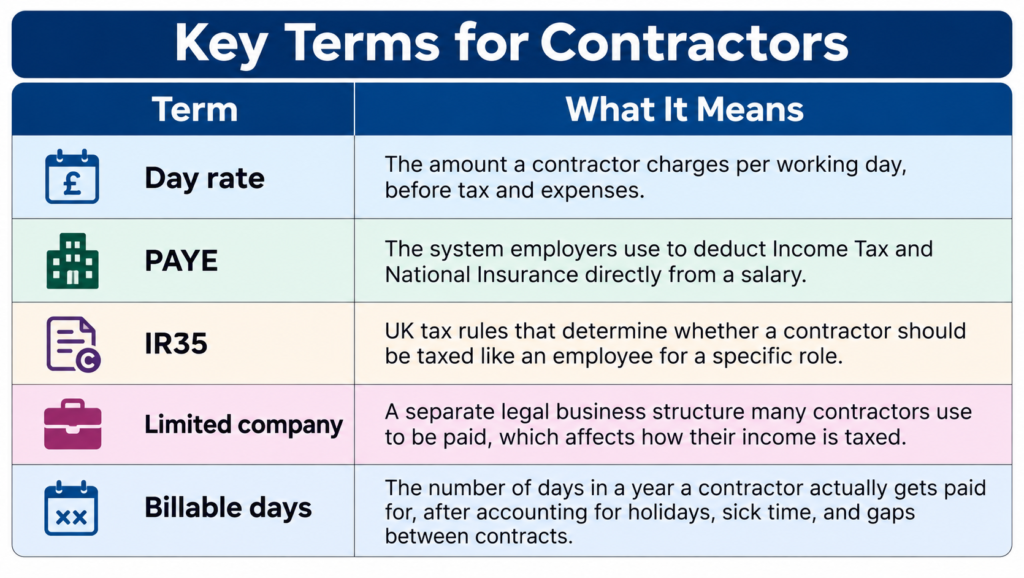
A few terms come up throughout this comparison, so it helps to get them straight early on Contractor vs Employee Pay UK.
| Term | What It Means |
| Day rate | The amount a contractor charges per working day, before tax and expenses |
| PAYE | The system employers use to deduct Income Tax and National Insurance directly from a salary |
| IR35 | UK tax rules that determine whether a contractor should be taxed like an employee for a specific role |
| Limited company | A separate legal business structure many contractors use to be paid, which affects how their income is taxed |
| Billable days | The number of days in a year a contractor actually gets paid for, after accounting for holidays, sick time, and gaps between contracts |
Billable days is the one that catches most first-time contractors off guard Contractor vs Employee Pay UK. A salaried employee is typically paid for around 260 working days a year, holidays included. Contractor vs Employee Pay UK A contractor only gets paid for the days someone is actually paying them, which in practice is often closer to 220–230 days once you account for time between contracts, admin, and unpaid leave Contractor vs Employee Pay UK.
Why This Comparison Matters
The contractor-versus-employee question isn’t just theoretical. Contractor vs Employee Pay UK It affects real decisions: whether to leave a stable job for a higher day rate, whether to negotiate a raise instead of going freelance, and how to judge if a contract offer is actually competitive with a permanent role Contractor vs Employee Pay UK.
It also matters because the two pay structures are taxed differently. Contractor vs Employee Pay UK An employee’s tax is deducted automatically and evenly across the year. Contractor vs Employee Pay UK A contractor working through a limited company typically pays themselves a small salary plus dividends, which are taxed at different rates and give more control over timing, but also come with more responsibility to get it right Contractor vs Employee Pay UK.
Get the comparison wrong, and you can end up either turning down a genuinely better-paid role because the number “looks smaller,” or accepting a contract that pays less than your current job once the maths is done properly Contractor vs Employee Pay UK.
Common Misconceptions About Contractor vs Employee Pay
A few myths tend to skew this comparison before people even run the numbers Contractor vs Employee Pay UK.
“A contractor day rate just needs multiplying by 5 to compare to a weekly salary Contractor vs Employee Pay UK.” Not quite. Contractor vs Employee Pay UK That calculation assumes 52 fully billable weeks a year, which almost never happens. Gaps between contracts, holidays, and sick time all reduce the real annual total Contractor vs Employee Pay UK.
“Contractors pay much less tax than employees Contractor vs Employee Pay UK.” Not automatically. Contractors working through a limited company do have more flexibility over how they’re taxed, particularly through dividends, but they’re also responsible for Corporation Tax, accountancy costs, and their own pension contributions Contractor vs Employee Pay UK. The net advantage is often smaller than people expect, and IR35 rules can remove much of it for contracts that resemble employment Contractor vs Employee Pay UK.
“Employee salaries are always ‘safer,’ so they’re always worth less than contracting Contractor vs Employee Pay UK.” Salaries come with far more built-in value than the number on the payslip suggests: paid holiday, sick pay, employer pension contributions, and job security all have a real financial value that doesn’t show up until you actually need them Contractor vs Employee Pay UK.
“If the day rate looks higher, contracting always pays more Contractor vs Employee Pay UK.” Only if you can keep the work consistent Contractor vs Employee Pay UK. A £450 day rate sitting idle for two months a year can easily fall behind a stable £55,000 salary once you do the full-year maths Contractor vs Employee Pay UK.
Quick Snapshot: Employee vs Contractor Pay
Here’s a simplified snapshot of how the two commonly stack up using 2026/27 UK tax figures, before the detailed worked example below Contractor vs Employee Pay UK.
| Factor | Employee (PAYE) | Contractor |
| Income Tax | Deducted automatically, 20% / 40% / 45% bands | Depends on structure (PAYE, sole trader, or limited company) |
| National Insurance | 8% between £12,570–£50,270, 2% above | Different rates apply depending on structure |
| Paid holiday | Statutory minimum, usually 28 days including bank holidays | None, unless self-funded |
| Sick pay | Statutory Sick Pay may apply | None, unless self-funded |
| Pension | Employer contributes automatically (auto-enrolment) | Self-funded, no employer contribution |
| Income during gaps | Guaranteed while employed | None between contracts |
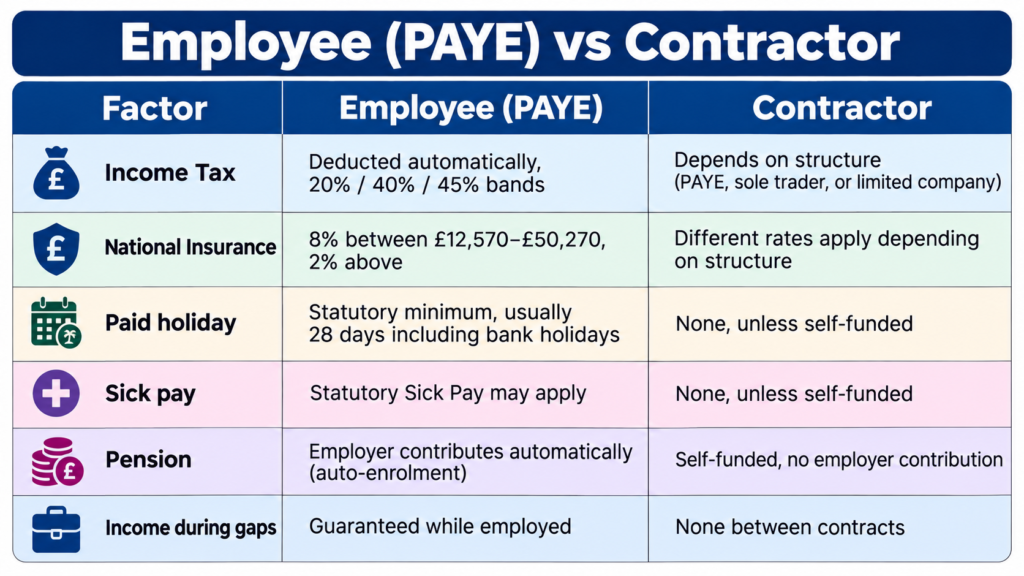
This table only tells part of the story. Contractor vs Employee Pay UK The real comparison depends on the actual day rate, the actual salary, and how many days a contractor genuinely works in a year, which is exactly what the next section walks through with full worked numbers Contractor vs Employee Pay UK.
How to Compare Contractor and Employee Pay: Step by Step
Working out which option actually pays more isn’t complicated, but it does need a few extra steps beyond just comparing headline numbers.
Step 1: Work out your realistic billable days
Start with 260 working days a year (52 weeks × 5 days), then subtract time you won’t be paid for as a contractor: holidays, sick days, and any expected gaps between contracts. Most contractors land somewhere between 210 and 230 billable days a year once this is accounted for honestly.
Step 2: Calculate your gross contractor income
Multiply your realistic billable days by your day rate. This gives you a gross annual figure that’s directly comparable to a salary, rather than the inflated number you get from assuming a full 260-day year.
Step 3: Deduct tax based on your actual structure
How this works depends on whether you’re a sole trader, operate through a limited company, or fall inside IR35 on a contract. Each route produces a different tax outcome, covered in detail below.
Step 4: Subtract the costs unique to contracting
Accountancy fees, business insurance, your own pension contributions, and any admin time you’re not being paid for all come off your final number. Employees don’t have these deductions.
Step 5: Compare like for like
Once you’ve got a realistic net figure for both options, compare them on the same basis, ideally annual take-home pay after tax, pension, and unavoidable costs, not gross day rate against gross salary.
A Real-Life Example: £450 Day Rate vs £55,000 Salary
Let’s put this into practice with a common scenario: a contractor offered £450 a day compared to a permanent role paying £55,000.
The employee, on £55,000:
- Receives a full 260 paid working days a year, holiday included
- Pays Income Tax and National Insurance automatically through PAYE
- Gets an employer pension contribution on top of salary
- Has Statutory Sick Pay and paid holiday built in
The contractor, on a £450 day rate:
- Works a realistic 220 billable days in the year, accounting for a 4-week gap between contracts and some admin time
- Gross annual income: £450 × 220 = £99,000
At first glance, £99,000 gross looks dramatically higher than £55,000. But the comparison isn’t finished yet, because the contractor’s £99,000 hasn’t had tax taken off, hasn’t covered a pension, and doesn’t include the cost of running a limited company.
Rough Net Comparison
| Comparison | Employee (£55,000 salary) | Contractor (£99,000 gross via limited company) |
| Income Tax | Deducted via PAYE across the year | Paid via salary + dividends split |
| National Insurance | 8% between £12,570–£50,270, 2% above | Lower Employee NI on small salary, none on dividends |
| Pension | Employer contributes automatically | Self-funded from remaining income |
| Accountancy costs | None | Typically £1,000–£1,800 a year |
| Paid holiday/sick pay | Included | None, already factored into billable days |
| Approximate annual net | Roughly £42,000–£44,000 | Roughly £62,000–£68,000, depending on structure and expenses |
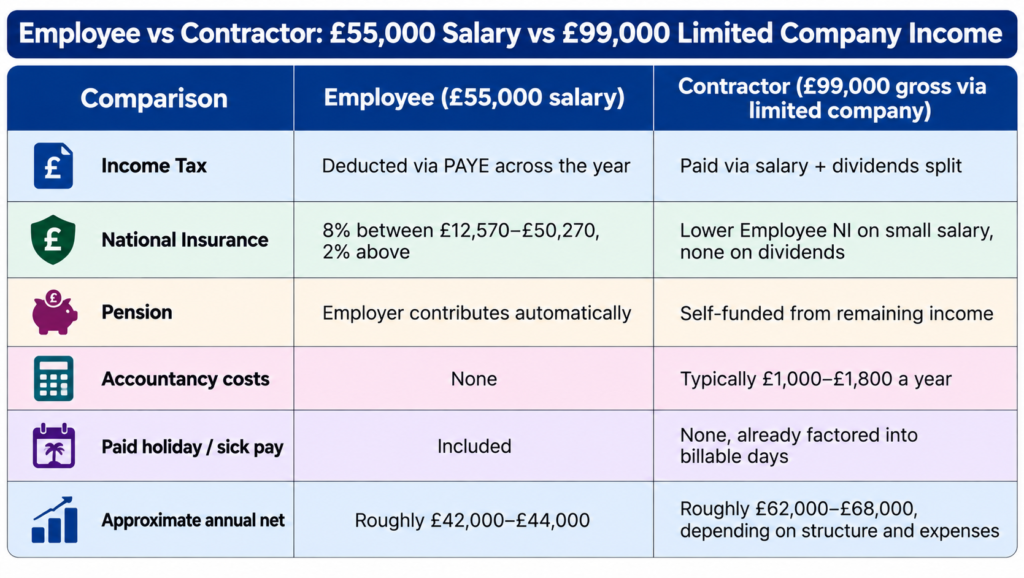
Even after tax, accountancy fees, and self-funded pension contributions, the contractor in this example likely still comes out ahead in take-home terms. But the gap is far smaller than the raw £99,000 vs £55,000 comparison suggests, and it depends entirely on hitting 220 billable days consistently.
Now change one variable: if that same contractor only secures 160 billable days that year because of a slow market or a longer gap between contracts, gross income drops to £72,000, and the net advantage over the salaried role narrows significantly, sometimes disappearing entirely once costs are factored in.
This is the core lesson: contractor pay is only as strong as its consistency. A high day rate with unreliable work can end up paying less than a stable salary.
Understanding IR35 and Why It Changes the Numbers
IR35 is one of the biggest variables in this comparison, and it’s often misunderstood.
IR35 rules exist to determine whether a contractor is genuinely working independently, or whether the role is close enough to employment that it should be taxed the same way. If a contract is judged to be “inside IR35,” the contractor pays Income Tax and National Insurance in a way that closely mirrors an employee, significantly reducing the tax efficiency that limited company contracting normally offers.
If a contract is “outside IR35,” the contractor retains more flexibility to be paid through a salary and dividends split, which is usually where most of the tax advantage comes from.
Important note: since 2021, for most medium and large private-sector clients, it’s the client, not the contractor, who determines IR35 status. This means a contractor doesn’t always have full control over which tax treatment applies to a given contract, and it’s worth checking before assuming a day rate will be as tax-efficient as expected.
Common Mistakes People Make When Comparing Pay
A few recurring errors skew this comparison more than anything else.
- Assuming a full working year of billable days. This is the single biggest distortion. Always build in realistic gaps, especially in the first year of contracting.
- Comparing gross day rate to net salary. Make sure both sides of the comparison are either gross-to-gross or net-to-net, never a mix of the two.
- Ignoring employer pension contributions. A salaried employee’s pension is effectively extra pay that doesn’t show up on the headline salary figure, and it’s easy to forget when comparing numbers.
- Forgetting accountancy and admin costs. Running a limited company isn’t free, and these costs quietly eat into the contractor’s advantage.
- Not accounting for IR35 status. A day rate on an inside-IR35 contract can be worth noticeably less, after tax, than the same rate on an outside-IR35 contract.
Best Practices for Making an Accurate Comparison
- Use a realistic billable-days estimate, not a best-case one. If you’re new to contracting, err on the conservative side for your first year.
- Get a proper net income estimate from an accountant or a reliable calculator, rather than doing rough mental maths on gross figures.
- Factor in non-financial value, like job security, mortgage eligibility, and predictable income, which matter more to some people than others.
- Revisit the comparison annually. Day rates, salary offers, and your own personal circumstances, such as family commitments, a mortgage, or risk tolerance, change, so a comparison that made sense two years ago might not hold today.
- Check IR35 status before accepting any contract offer, since it materially changes the tax outcome.
Expert Tip: Build a Buffer, Not Just a Day Rate
Experienced contractors often think in terms of a target annual income rather than just a day rate. If you know you need £60,000 net a year and expect realistic gaps between contracts, work backwards to figure out the day rate you actually need to charge, rather than accepting whatever rate is offered and hoping the maths works out.
Limited Company vs Sole Trader vs Umbrella Contracting
Not all contractors are taxed the same way, and this affects the comparison further.
| Structure | How Pay Is Taxed | Best Suited For |
| Sole trader | Income Tax and Class 2/4 National Insurance on profits, via Self Assessment | Simpler setups, lower income, less admin |
| Limited company | Small salary plus dividends, subject to Corporation Tax on profits first | Higher earners looking for more tax efficiency, outside-IR35 contracts |
| Umbrella company | Taxed like an employee via PAYE, minus umbrella fees | Inside-IR35 contracts, or contractors wanting minimal admin |
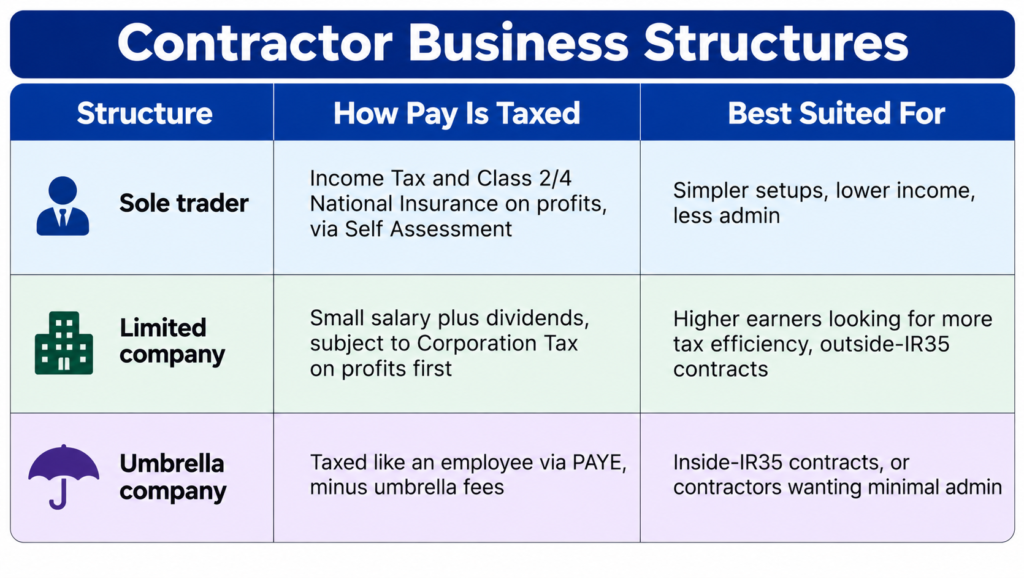
The limited company route is generally the most tax-efficient for higher earners on outside-IR35 contracts, but it also comes with the most admin: annual accounts, Corporation Tax returns, and ongoing accountancy costs. Sole trader status is simpler but less efficient at higher income levels. Umbrella companies remove the admin entirely but bring pay closer to standard employee levels once fees are factored in.
Getting this structural decision right can shift the final take-home comparison by several thousand pounds a year, which is exactly why the raw day rate alone never tells the full story.
Advanced Tips for Getting an Accurate Picture
A few more considerations tend to separate a rough guess from a genuinely accurate comparison.
Model more than one scenario. Rather than comparing a single day rate to a single salary, run the numbers at your realistic billable-days estimate, and again at a more conservative one. If both scenarios still favour contracting, that’s a far stronger signal than a single best-case calculation.
Account for mortgage and lending impact. Lenders often view contractor income differently to a stable salary, sometimes requiring a longer trading history or additional documentation. This doesn’t affect your actual pay, but it’s a genuine financial consequence worth factoring in if a mortgage application is on the horizon.
Think about IR35 status changing mid-contract. A contract that starts outside IR35 can occasionally be reassessed, particularly if the working arrangement changes. It’s worth checking status periodically rather than assuming it’s fixed for the life of a contract.
Don’t ignore notice periods and contract length. A three-month rolling contract carries more income risk than a fixed twelve-month one, even at the same day rate. Shorter, less secure contracts should arguably be priced higher to reflect that risk.
A Frequently Overlooked Point: The Value of Benefits Isn’t Optional
It’s easy to treat employer pension contributions, paid holiday, and sick pay as “nice extras” rather than real income, but they have a genuine cash value that should be added to a salary before comparing it to a day rate.
For example, a 5% employer pension contribution on a £55,000 salary is worth £2,750 a year, money a contractor would otherwise need to set aside from their own income. Add in the value of guaranteed paid holiday and Statutory Sick Pay, and a salary’s real value is often meaningfully higher than the number printed on the offer letter. This is one of the most consistently underestimated factors in the contractor-versus-employee comparison, and it’s worth adding back in before drawing a final conclusion.
Quick Comparison: Which Pays More, At a Glance
| Situation | Likely to Pay More |
| High day rate with consistent, near-continuous contract work | Contracting |
| Day rate only marginally higher than salary equivalent | Employment, once benefits are included |
| Frequent gaps between contracts | Employment |
| Outside-IR35 contract with limited company structure | Contracting |
| Inside-IR35 contract | Often closer to employment, once umbrella or PAYE deductions apply |
| Strong preference for job security and predictable income | Employment (value beyond pure pay) |
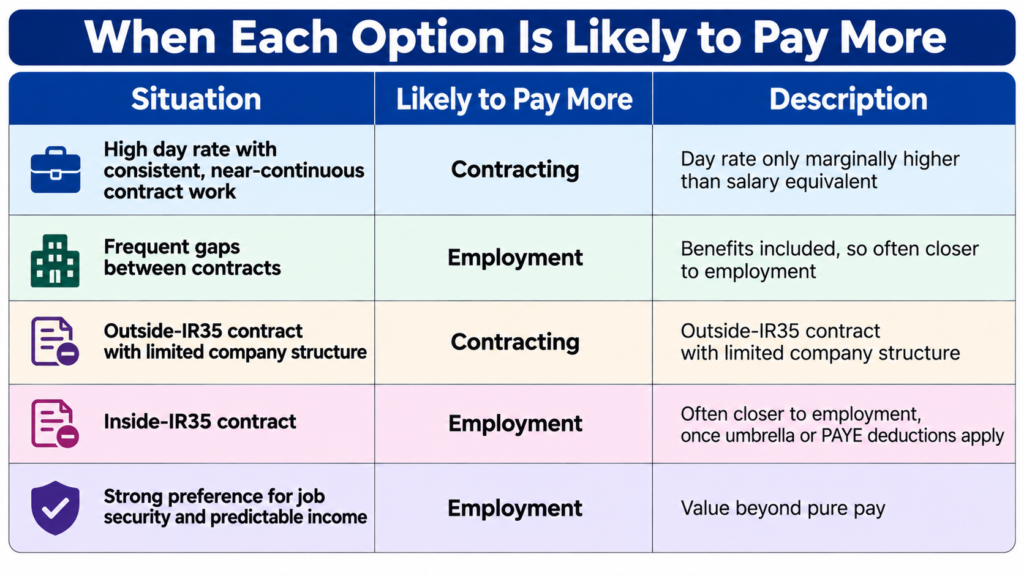
There’s no single answer that applies to everyone. The honest conclusion is that contracting has a higher ceiling, but employment has a higher floor. Which one pays more for you personally depends on how consistently you can secure work, how tax-efficient your contracting structure is, and how much you value the certainty a salary provides.
Key Takeaways
Contracting typically has a higher income ceiling, while employment offers a more stable, predictable floor, and the right choice depends on personal risk tolerance as much as the numbers themselves.
A contractor day rate needs to be measured against realistic billable days, not a full 260-day working year, before it can be fairly compared to a salary.
Employer pension contributions, paid holiday, and sick pay all add real financial value to a salary that doesn’t appear in the headline number.
IR35 status significantly affects how tax-efficient contracting actually is, and it’s not always within the contractor’s control.
Limited company contracting is generally the most tax-efficient route for higher earners on outside-IR35 work, but it comes with admin and accountancy costs.
Final Thoughts
There’s no universal winner in the contractor vs employee pay UK comparison; it genuinely depends on your day rate, how consistently you can secure work, your IR35 status, and how much you value the security a salary provides. Contracting tends to offer a higher income ceiling for those with steady, outside-IR35 work, while employment offers a more predictable floor once pension contributions, paid holiday, and sick pay are properly accounted for.
The best way to answer the question for your own situation is to run the numbers honestly: use realistic billable days, compare net figures rather than headline ones, and factor in the benefits that don’t show up on a payslip but still carry real financial value. Once you’ve done that, the choice between contracting and employment becomes far less about which number looks bigger, and far more about which arrangement genuinely fits your income needs and appetite for risk.
FAQ’s
Do contractors really earn more than employees in the UK?
Often, yes, especially on outside-IR35 contracts with a strong day rate and consistent work. But once realistic gaps between contracts, self-funded pension contributions, and accountancy costs are factored in, the gap is usually smaller than the raw day rate suggests, and can disappear entirely with inconsistent work.
How do I compare a day rate to an annual salary?
Multiply your day rate by a realistic number of billable days a year, typically 210–230 once holidays, sick time, and gaps between contracts are accounted for, then compare that gross figure to a salary using consistent tax assumptions on both sides.
What is IR35 and why it matter fodoes r pay comparisons?
IR35 is a set of UK tax rules that determine whether a contractor should be taxed like an employee for a specific role. Contracts judged “inside IR35” are taxed closer to standard employment, reducing the tax advantages that usually make contracting more profitable.
Is it worth becoming a contractor just for higher pay?
Only if the work is likely to be consistent and the contract is genuinely outside IR35. If contract availability is uncertain, a stable salary with employer pension contributions and paid leave can end up being the better financial outcome, not just the safer one.
Do contractors pay more or less tax than employees?
It depends on their business structure. Limited company contractors on outside-IR35 contracts often pay less tax overall through a salary and dividends split, but sole traders and inside-IR35 contractors typically see a tax outcome much closer to standard employment.
Does a contractor get holiday pay or sick pay?
No, not automatically. Contractors are responsible for funding their own time off, which is why realistic pay comparisons should always subtract unpaid time from the total number of billable days in a year.
Is contracting riskier than being an employee?
Financially, yes. Contractors don’t have guaranteed income between contracts, statutory redundancy protections, or the same lending flexibility with mortgage providers. That risk is part of why day rates are typically higher than equivalent salaries.
How much should I charge as a contractor to match a specific salary?
Start with your target net annual income, add back tax, National Insurance, pension contributions, and accountancy costs, then divide by your realistic number of billable days. This gives a day rate that should match your target income, rather than just guessing a number that “sounds high enough.”
Can a contractor pay into a pension like an employee?
Yes, but it isn’t automatic. Contractors need to set up and fund their own pension contributions, usually through a personal pension or, for limited company contractors, employer contributions from the company itself, which can be more tax-efficient than paying in from post-tax income.
Does going from employee to contractor affect mortgage applications?
Often, yes. Lenders may ask for a longer trading history, additional accounts, or documentation compared to a standard payslip-based application. It’s worth checking with a mortgage adviser before making the switch if a mortgage application is planned in the near future.