Part-Time Salary Calculator UK Working part-time hours doesn’t mean your payslip is simple. Part-Time Salary Calculator UK You’ve still got Income Tax, National Insurance, maybe a pension deduction, and possibly a student loan repayment — all applied to a smaller number of hours, which can make the maths feel more confusing rather than easier Part-Time Salary Calculator UK.
If you’ve ever tried to work out what £11.50 an hour actually turns into once tax and deductions are taken out, or you’re comparing two part-time job offers with different hours, a part-time salary calculator UK tool takes the guesswork out of it. Part-Time Salary Calculator UK Enter your hours and hourly rate (or your part-time salary), and it shows you exactly what should land in your bank account Part-Time Salary Calculator UK.
In short: A part-time salary calculator UK estimates your take-home pay by converting your hourly rate and hours worked into gross pay, then applying your Personal Allowance, Income Tax, National Insurance, pension contributions, and any student loan repayments to show your net income per week, month, or year Part-Time Salary Calculator UK.
This guide walks through how part-time pay is worked out in the UK, what makes it different from a standard full-time salary calculation, and the real-world scenarios — multiple jobs, term-time contracts, variable hours — that most calculators don’t account for. Part-Time Salary Calculator UK All figures use 2026/27 tax year rates and are rounded for clarity Part-Time Salary Calculator UK.
Read More: How to Calculate Hourly Rate from Annual Salary UK
What Is Part-Time Pay in the UK?
There’s no strict legal cut-off that defines “part-time” — it simply means working fewer hours than a full-time employee at the same organisation, which is usually somewhere between 30 and 40 hours a week. Most part-time workers fall somewhere between a few hours a week and around 30 hours Part-Time Salary Calculator UK.
Part-time employees have the same legal rights as full-time staff, just worked out proportionally. Part-Time Salary Calculator UK That includes:
- The National Minimum Wage or National Living Wage, depending on age
- Paid holiday, calculated pro rata based on hours worked
- Pension auto-enrolment, if you meet the earnings threshold
- The same Income Tax and National Insurance rules as anyone else
That last point is where a lot of confusion comes from. Part-Time Salary Calculator UK People sometimes assume part-time work is taxed differently, or at a lower rate, simply because the pay is lower. Part-Time Salary Calculator UK It isn’t. The tax system applies the same bands and rates to everyone — what changes is how much of your income actually falls into the taxable portion Part-Time Salary Calculator UK.
Visit Now: https://www.taxsal.com/
Key Terms You Need to Know First
Before working through any calculation, it helps to be clear on what each term actually means Part-Time Salary Calculator UK.
Gross pay — Your total earnings before any deductions. Part-Time Salary Calculator UK For part-time work, this is usually hours worked multiplied by your hourly rate, or your agreed part-time salary before tax Part-Time Salary Calculator UK.
Net pay (take-home pay) — What’s left after Income Tax, National Insurance, pension contributions, and any other deductions have been taken out. This is the figure that actually reaches your bank account Part-Time Salary Calculator UK.
Personal Allowance — The amount you can earn each tax year before you start paying Income Tax. Part-Time Salary Calculator UK For most people, this is £12,570 Part-Time Salary Calculator UK.
Pro rata — A Latin term used constantly in part-time pay discussions. It simply means “in proportion.” Part-Time Salary Calculator UK A pro rata salary is what your annual pay would be if you worked full-time hours, scaled down to reflect your actual hours Part-Time Salary Calculator UK.
National Minimum Wage / National Living Wage — The legal minimum hourly rate you’re entitled to, based on your age. Part-Time Salary Calculator UK From April 2026, the National Living Wage for workers aged 21 and over is £12.71 an hour, with lower rates for younger workers and apprentices Part-Time Salary Calculator UK.
Tax code — A short code your employer uses to work out how much of your pay is tax-free. Part-Time Salary Calculator UK The standard code for most people is 1257L Part-Time Salary Calculator UK.
Understanding these terms matters because part-time job adverts and contracts often quote a pro rata salary, not what you’ll actually be paid for the hours you work. Part-Time Salary Calculator UK Knowing the difference stops you from misjudging what a job offer is really worth Part-Time Salary Calculator UK.
Full-Time vs Part-Time Salary: What Actually Changes
The mechanics of tax and National Insurance don’t change based on your hours — but the practical effect on your pay does. Part-Time Salary Calculator UK Here’s a simple comparison to show what stays the same and what shifts Part-Time Salary Calculator UK.
| Factor | Full-Time | Part-Time |
| Income Tax bands and rates | Same | Same |
| National Insurance rates | Same | Same |
| Personal Allowance (£12,570) | Applies in full | Applies in full |
| Chance of earning below Personal Allowance | Lower | Higher |
| Pension auto-enrolment threshold | More likely to be met | Depends on hours and pay |
| Holiday entitlement | Full statutory minimum | Calculated pro rata |
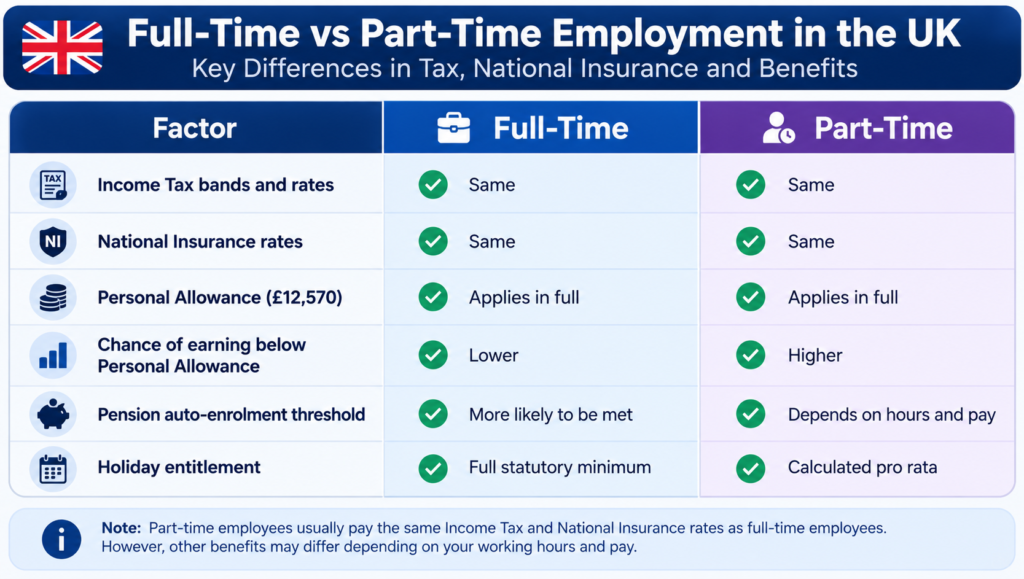
The key difference isn’t the rules — it’s that part-time earnings are more likely to sit below, or close to, the Personal Allowance threshold. Part-Time Salary Calculator UK That means many part-time workers pay little or no Income Tax at all, while others working more hours or at a higher rate can still cross into taxable territory Part-Time Salary Calculator UK.
Why Part-Time Pay Calculations Trip People Up
A few things make part-time pay harder to estimate than full-time salary, even though the underlying tax system is identical:
Irregular hours. If your hours change week to week, your gross pay changes too, which means your tax and National Insurance can vary from one pay period to the next Part-Time Salary Calculator UK.
Multiple jobs. Working two part-time jobs means your Personal Allowance is usually only applied to one of them (normally your main job), so the second job can be taxed at a flat rate from the first pound earned Part-Time Salary Calculator UK.
Weekly vs monthly thresholds. Tax and National Insurance thresholds are set annually but applied per pay period Part-Time Salary Calculator UK. If your income fluctuates, a higher-earning week can trigger deductions that a lower-earning week wouldn’t Part-Time Salary Calculator UK.
Pension auto-enrolment cut-offs. You’re only automatically enrolled into a workplace pension if you earn above a set threshold. Some part-time workers sit just under this line, others just over it, which changes what comes out of their pay.
Common Misconceptions About Part-Time Pay
“Part-time work is taxed at a lower rate.” Not true. The same Income Tax bands and National Insurance rates apply regardless of your hours. Lower pay often means less tax simply because less of your income exceeds the tax-free threshold.
“I won’t pay any tax if I only work a few hours.” This depends entirely on your hourly rate and total annual earnings, not the number of hours itself. Someone working 15 hours a week at a high hourly rate can still pay Income Tax.
“My pro rata salary is what I’ll take home.” Pro rata salary is a gross figure, calculated before tax, National Insurance, or pension deductions. Your actual take-home pay will always be lower.
“Part-time workers don’t get a pension.” Auto-enrolment is based on earnings and age, not employment status. Many part-time workers are enrolled automatically if they meet the threshold.
Part-Time Hourly Rate to Annual Salary (Quick Reference)
To give you a sense of how hourly pay scales up, here’s a rough guide based on common part-time hour patterns, using gross (before-tax) figures.
| Hourly Rate | 16 hrs/week | 20 hrs/week | 25 hrs/week | 30 hrs/week |
| £12.71 (NLW) | £10,566 | £13,218 | £16,523 | £19,827 |
| £14.00 | £11,648 | £14,560 | £18,200 | £21,840 |
| £16.00 | £13,312 | £16,640 | £20,800 | £24,960 |
| £18.00 | £14,976 | £18,720 | £23,400 | £28,080 |
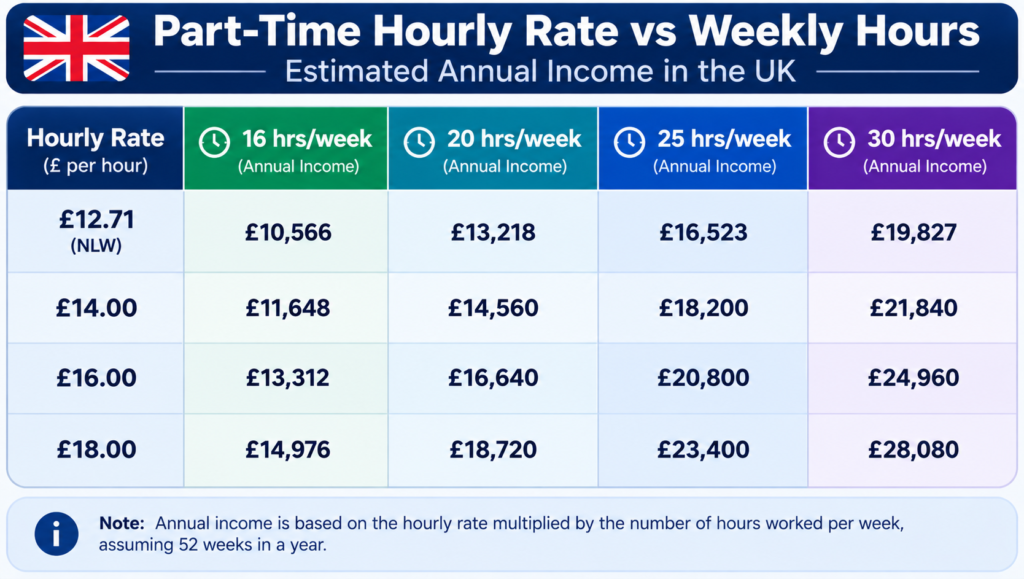
These figures are gross annual estimates based on 52 working weeks and don’t account for tax, National Insurance, or pension deductions — which is where the actual step-by-step calculation comes in.
How to Calculate Part-Time Take-Home Pay: Step by Step
Working out your real take-home pay follows the same core process as any UK salary calculation. The difference is that each figure tends to be smaller, so it’s worth being precise rather than rounding as you go.
Step 1: Work Out Your Gross Pay
Start with the basics: hours worked multiplied by your hourly rate.
Example: You work 20 hours a week at £14.00 an hour.
Weekly gross pay = 20 × £14.00 = £280.00
Monthly gross pay (weekly × 52 ÷ 12) = £1,213.33
Annual gross pay = £280 × 52 = £14,560
This is your starting figure before anything is deducted, and it’s the number most job adverts and pro rata salaries are based on.
Step 2: Apply Your Personal Allowance
Everyone gets the same Personal Allowance regardless of how many hours they work.
Monthly Personal Allowance = £12,570 ÷ 12 = £1,047.50
For our example, monthly gross pay is £1,213.33, so:
£1,213.33 − £1,047.50 = £165.83 taxable income for the month
Notice how close this is to zero. This is exactly why many part-time workers pay very little Income Tax — a large chunk of their monthly pay sits within the tax-free allowance.
Step 3: Calculate Income Tax
Once you know your taxable income, apply the relevant rate. Anything within the Basic Rate band is taxed at 20%.
£165.83 × 20% = £33.17 Income Tax for the month
That’s a small deduction compared to what a full-time salary at the same hourly rate would generate, purely because less of the monthly pay clears the tax-free threshold.
Step 4: Calculate National Insurance
National Insurance works on its own weekly or monthly threshold, separate from the Personal Allowance. Once your pay goes above the primary threshold, employee NI is charged at 8% up to the upper earnings limit.
Using a monthly NI threshold of roughly £1,048:
£1,213.33 − £1,048 = £165.33 above the threshold
£165.33 × 8% = £13.23 National Insurance for the month
(NI thresholds are reviewed each tax year, so always check the current HMRC figures before relying on this for a real payslip.)
Step 5: Deduct Pension Contributions (If Applicable)
Not every part-time worker is automatically enrolled into a workplace pension — it depends on your age and earnings. If you are enrolled, and your contribution is 5%:
£1,213.33 × 5% = £60.67 monthly pension deduction
This comes out before you receive your pay, but it’s money going toward your own retirement rather than being lost.
Step 6: Factor In Student Loan Repayments (If Applicable)
Repayments only kick in once your income crosses your plan’s threshold. Many part-time workers on lower hours sit below this threshold entirely, meaning no student loan deduction applies at all. If your earnings do cross the threshold, repayments are calculated as a percentage of income above it, in the same way as for full-time workers.
Step 7: Work Out Your Final Take-Home Pay
Now bring it all together:
| Item | Monthly Amount |
| Gross Pay | £1,213.33 |
| Income Tax | −£33.17 |
| National Insurance | −£13.23 |
| Pension Contribution | −£60.67 |
| Take-Home Pay | £1,106.26 |
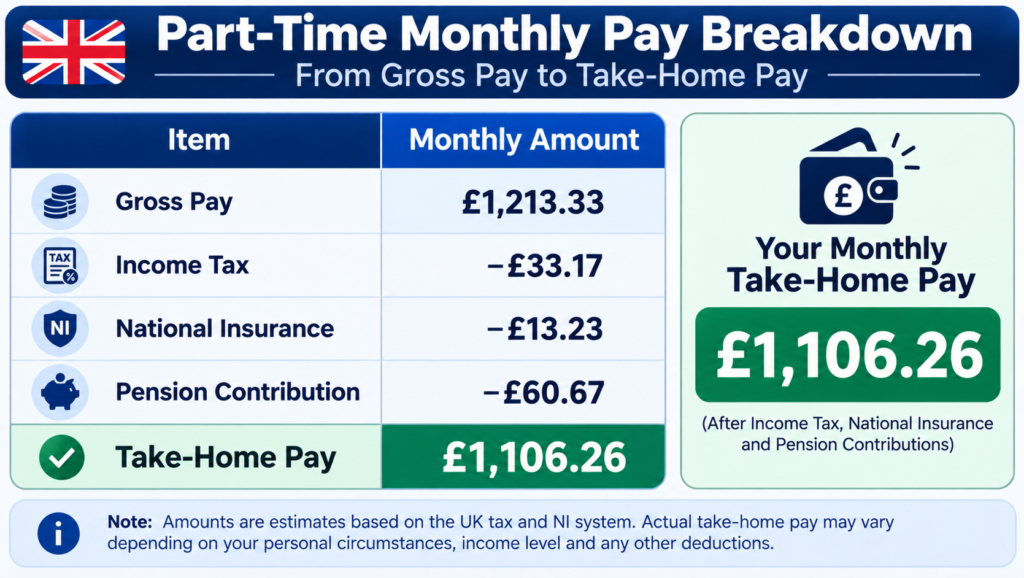
So on 20 hours a week at £14.00 an hour, with a 5% pension contribution, your estimated monthly take-home pay comes to roughly £1,106.26. Without the pension deduction, that figure would be closer to £1,166.93.
Real-Life Scenario: Comparing Two Part-Time Roles
Numbers make more sense side by side. Say you’re choosing between two part-time offers with different hours and rates.
| Factor | Role A | Role B |
| Hourly rate | £13.00 | £16.50 |
| Hours per week | 25 | 18 |
| Weekly gross pay | £325.00 | £297.00 |
| Monthly gross pay | £1,408.33 | £1,287.00 |
| Estimated monthly Income Tax | £72.17 | £47.83 |
| Estimated monthly NI | £28.83 | £19.12 |
| Estimated monthly take-home | £1,307.33 | £1,220.05 |
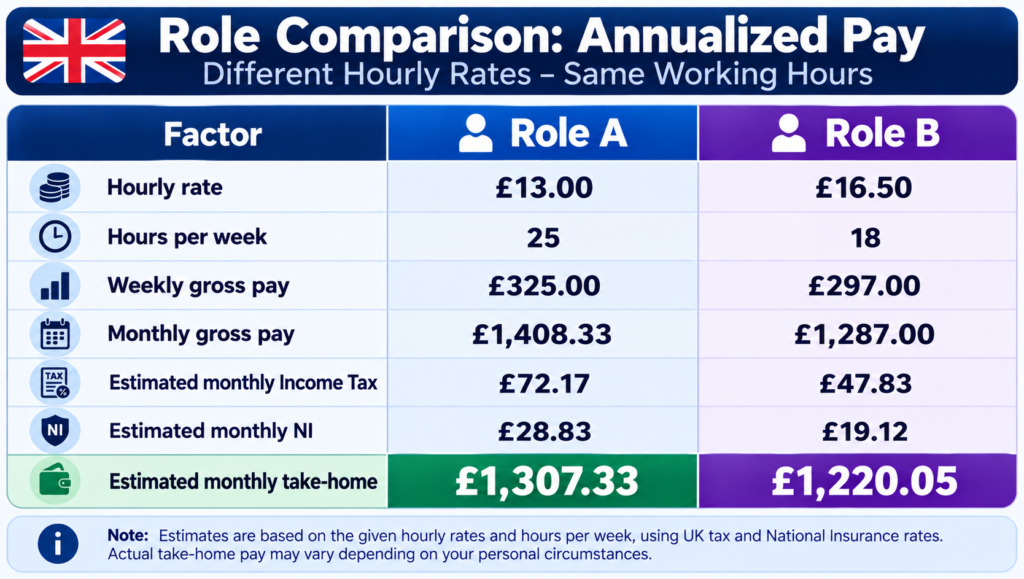
Role A pays a lower hourly rate but more hours, so the gross pay and take-home pay both come out higher overall. Role B has a better hourly rate but fewer hours, which means less taxable income overall but also fewer total hours worked. Neither is automatically the better choice — it depends on whether you value the higher hourly rate or the higher total income, and how those extra hours fit around the rest of your life.
This is exactly the kind of comparison a part-time salary calculator is built for: turning two different pay structures into a single, comparable monthly figure.
Part-Time Pay and Multiple Jobs
If you work two part-time jobs, your Personal Allowance is normally only applied to one of them — usually whichever you tell HMRC is your main job. Your second job is then often taxed using a different tax code, commonly BR (Basic Rate), which taxes all of that income at 20% from the very first pound, with no tax-free allowance applied.
Example: You earn £600 a month from your main job and £400 a month from a second job.
- Main job: Personal Allowance applies as normal, so most or all of this may be tax-free
- Second job: Taxed at 20% from £0, so Income Tax = £400 × 20% = £80
This catches a lot of people out. Two part-time jobs that individually look tax-free can still result in real Income Tax being paid on the second one, simply because of how the allowance is split. If this happens to you and you believe your allowance should be divided differently between jobs, HMRC allows you to request a change to how your tax codes are split.
Common Mistakes When Calculating Part-Time Pay
- Using annual salary tools without adjusting for actual hours. A calculator built for full-time salaries can give a misleading picture if it assumes a standard 37.5 or 40-hour week.
- Assuming a second job is tax-free just because the pay is low. As shown above, a second job can be taxed at 20% from the first pound earned.
- Ignoring pension auto-enrolment thresholds. Some part-time workers are surprised by a pension deduction they didn’t expect, while others assume they’re enrolled when they’re actually below the qualifying threshold.
- Not accounting for variable hours. If your hours change weekly, your tax and NI can shift slightly from one pay period to the next, even if your hourly rate stays the same.
Best Practices for Estimating Part-Time Pay Accurately
- Always start from your actual contracted or expected hours, not a rounded estimate.
- Check whether your job is your “main” employment for tax purposes if you have more than one.
- Confirm your tax code on your payslip — the default 1257L doesn’t apply to everyone.
- If your hours vary, calculate pay based on a typical week rather than your busiest or quietest one.
- Re-check your numbers whenever your hourly rate, hours, or tax code changes, rather than relying on an old calculation.
Expert tip: If you’re weighing up a pay rise, extra shifts, or a second part-time job, calculate the difference in take-home pay rather than gross pay. A £50 increase in weekly gross earnings rarely means an extra £50 in your pocket — once Income Tax, National Insurance, and pension contributions are factored in, the real increase is often noticeably smaller, especially if the extra earnings push you past a threshold you were previously sitting under.
Part-Time Pay in Practice: Scenarios Beyond the Basics
The step-by-step process above is useful, but most people working part-time hours have circumstances that don’t fit a single, tidy example — term-time-only contracts, seasonal work, zero-hours arrangements, or juggling study alongside a job.
Term-Time-Only Contracts
If you work term-time only — common in schools, nurseries, and some administrative roles — your annual salary is usually calculated by taking a full-time equivalent salary and reducing it based on the weeks you actually work, then spreading that reduced amount evenly across 12 months.
Example: A role advertised as £22,000 full-time equivalent, worked 39 weeks a year instead of 52:
£22,000 ÷ 52 × 39 = £16,500 actual annual salary
That £16,500 is then usually paid in equal monthly instalments across the full 12 months, even though you’re not working during the school holidays. This smooths out your income, but it also means your monthly gross pay looks lower than “hours worked that month × hourly rate” would suggest — which can be confusing if you’re checking it against a calculator.
Zero-Hours and Variable-Hours Contracts
With no fixed weekly hours, gross pay changes every pay period, which means Income Tax and National Insurance can shift slightly too. HMRC applies tax and NI thresholds per pay period, not as a flat average, so a busy week can trigger a higher NI deduction than a quiet one — even if your overall average hourly rate stays the same.
The most reliable way to estimate take-home pay here is to calculate it for a typical week or month, then treat that as a guide rather than a guarantee.
Part-Time Work Alongside Full-Time Study
Students working part-time still pay Income Tax and National Insurance under the same rules as everyone else — there’s no special student exemption based on being enrolled in education. What often protects student earnings from tax is simply that part-time hours during term time tend to sit below the Personal Allowance threshold, not any student-specific relief.
If you also have a student loan from a previous course or are repaying one during your studies, repayments only apply once your income crosses your plan’s threshold, exactly as with any other part-time worker.
Frequently Overlooked Factors
A few details catch part-time workers out more than anything else:
Holiday pay isn’t separate money — it’s already in your pay. Most part-time workers accrue holiday pay pro rata, but unless you’re paid rolled-up holiday pay (now largely restricted to irregular-hours workers), it’s usually paid when you actually take leave, not as an extra lump sum.
Payslip frequency affects how thresholds apply. Weekly-paid part-time workers have Income Tax and NI thresholds applied weekly, while monthly-paid workers have them applied monthly. Two people earning the same annual total can see slightly different deduction patterns depending on how often they’re paid.
Emergency tax codes happen more often in part-time and casual work. Starting a new part-time job without giving your employer a P45 can trigger an emergency tax code, which may overtax you temporarily until HMRC corrects it.
A pay rise can trigger pension auto-enrolment. If extra hours or a rate increase pushes your earnings above the auto-enrolment threshold, you may find a pension contribution appearing on your payslip that wasn’t there before.
Comparing Offers Properly
When comparing part-time roles, gross hourly rate alone can be misleading. Two useful comparison points to add:
- Effective take-home hourly rate — your net pay divided by hours worked, which accounts for tax, NI, and pension
- Annual take-home pay — useful when comparing roles with different hours, since it reflects total yearly income rather than just the rate
| Comparison Point | Why It Matters |
| Gross hourly rate | Useful for comparing pay per hour, but ignores deductions |
| Net (take-home) hourly rate | Shows what you actually earn per hour worked |
| Annual gross salary | Useful for pro rata comparisons across different hours |
| Annual take-home pay | The most realistic figure for budgeting and comparing offers |
| Pension contribution | Affects take-home pay now, but builds long-term savings |
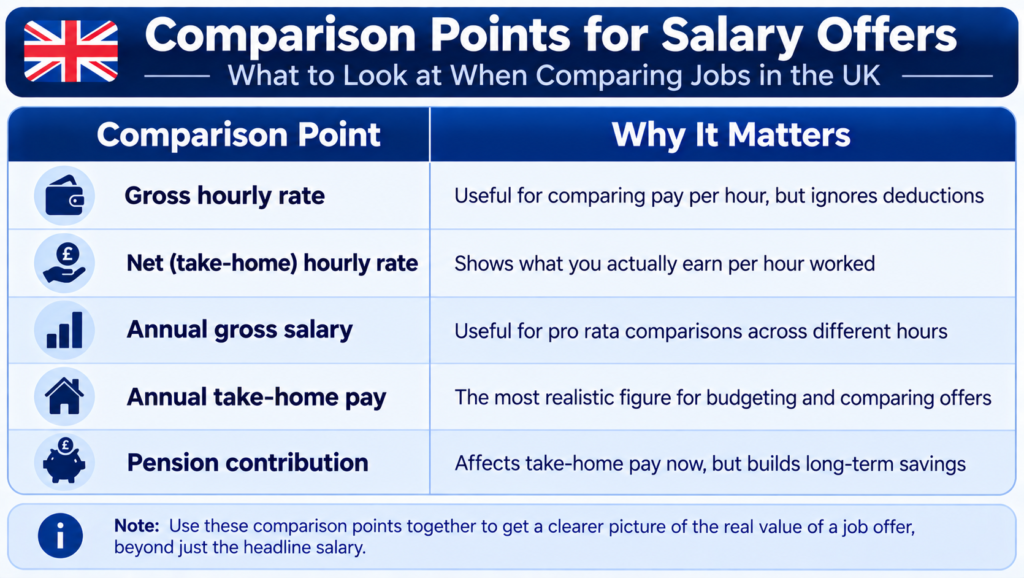
Relying on gross hourly rate alone can make a lower-paying role look better than it is, simply because it hasn’t accounted for how many hours you’d actually be working or what’s deducted along the way.
Key Takeaways
- Part-time pay follows the same tax and National Insurance rules as full-time pay — the rates don’t change, only how much of your income falls into taxable territory.
- A pro rata salary is a gross figure, calculated before deductions, and will always be higher than your actual take-home pay.
- Working two part-time jobs often means your second job is taxed at 20% from the first pound earned, since your Personal Allowance is usually only applied once.
- Term-time and variable-hours contracts can make monthly pay look inconsistent with weekly hours worked — smoothing and pay-period thresholds are usually the reason.
- Comparing take-home pay, not just hourly rate or gross salary, gives the most accurate picture when weighing up part-time job offers.
Final Thoughts
Working out part-time pay in the UK isn’t about applying different rules — it’s about applying the same tax and National Insurance system to a smaller, and often less predictable, income. The Personal Allowance, tax bands, and National Insurance thresholds all work exactly as they do for full-time employees; what changes is how much of your pay actually lands in taxable territory.
A part-time salary calculator UK tool takes the manual work out of this process, letting you enter your hours and rate to see a realistic take-home figure instead of relying on the gross pro rata number quoted in a job advert. Whether you’re comparing two part-time offers, weighing up extra hours, or simply trying to budget more accurately, running your numbers through a proper calculation gives you a far clearer picture than guesswork ever will.
FAQ’s
How is part-time salary calculated in the UK?
Part-time salary is usually calculated by multiplying your hourly rate by the hours you work, or by taking a full-time equivalent salary and reducing it in proportion to your part-time hours (pro rata). Part-Time Salary Calculator UK Tax, National Insurance, and any pension or student loan deductions are then applied in the same way as for full-time pay Part-Time Salary Calculator UK.
Do you pay less tax working part-time?
You don’t pay tax at a lower rate — the same Income Tax bands apply to everyone Part-Time Salary Calculator UK. However, part-time earners often pay less tax overall because a larger share of their income falls within the tax-free Personal Allowance Part-Time Salary Calculator UK.
How many hours can I work part-time before paying tax?
There’s no fixed number of hours that triggers tax. Part-Time Salary Calculator UK What matters is your total taxable income. Part-Time Salary Calculator UK You start paying Income Tax once your annual earnings exceed the Personal Allowance, currently £12,570, regardless of how many hours that represents Part-Time Salary Calculator UK.
Is pro rata salary the same as take-home pay?
No. Pro rata salary is a gross figure — what you’d earn before Income Tax, National Insurance, and pension deductions. Part-Time Salary Calculator UK Your actual take-home pay will always be lower than the pro rata amount quoted.
Do part-time workers get a workplace pension?
Part-time workers can be automatically enrolled into a workplace pension if they meet the earnings and age criteria, in the same way as full-time employees. Employment status alone doesn’t determine eligibility — earnings and age do.
Why is my second part-time job taxed more?
If you have two jobs, your Personal Allowance is usually applied to your main job only. Your second job is often taxed under a BR tax code, meaning Income Tax is charged at 20% on all of that income, with no tax-free portion.
How do I calculate my part-time hourly rate to a yearly salary?
Multiply your hourly rate by your weekly hours, then by 52 weeks. For example, £15 an hour at 20 hours a week comes to £15 × 20 × 52 = £15,600 a year, before tax and deductions.
Does National Minimum Wage apply to part-time workers?
Yes. Part-time workers are entitled to the same National Minimum Wage or National Living Wage as full-time workers, based on their age, regardless of how few or many hours they work.
Can a part-time salary calculator give an exact figure?
No calculator can be completely exact, since real payslips depend on your specific tax code, pension scheme, student loan plan, and any other personal deductions. A calculator gives a close estimate that’s useful for planning and comparison purposes.
Is student loan repayment different for part-time workers?
The rules are the same as for full-time workers — repayments only apply once your income crosses your plan’s specific threshold. Many part-time workers on lower hours simply don’t earn enough to cross that threshold, so no repayment is deducted.