Minimum Wage UK 2026/27 If you’ve just checked your payslip and wondered whether you’re actually being paid what you’re legally owed, you’re asking the right question at the right time. Minimum Wage UK 2026/27 Minimum wage rates changed on 1 April 2026, and the numbers on your payslip should reflect that — whether you’re working a Saturday job at 17, a part-time role at university, or your first full-time job after graduating Minimum Wage UK 2026/27.
This guide breaks down the Minimum Wage UK 2026/27 rates in plain English — no legal jargon, no confusing government wording, just the exact figures, who they apply to, and what’s changed since last year Minimum Wage UK 2026/27.
Whether you’re an employee checking you’re being paid correctly, a student weighing up part-time work, or an employer making sure your payroll is compliant, you’ll find everything you need below Minimum Wage UK 2026/27.
Rea More: Statutory Sick Pay – SSP Rates, Eligibility and Payment Guide
Minimum Wage UK 2026/27 at a Glance
Minimum Wage UK 2026/27From 1 April 2026, the National Living Wage for workers aged 21 and over rose to £12.71 an hour, up from £12.21. Minimum Wage UK 2026/27 Workers aged 18–20 now receive £10.85 an hour, while those under 18 and apprentices receive £8.00 an hour. Minimum Wage UK 2026/27 These rates are set by the government and reviewed every year based on Low Pay Commission recommendations Minimum Wage UK 2026/27.
Visit Now: https://www.taxsal.com/
What This Guide Covers
This guide is built to answer one thing clearly: what you’re legally entitled to be paid in the UK during the 2026/27 tax year. Minimum Wage UK 2026/27 Across this article, you’ll find:
- The exact minimum wage rates for every age band, from apprentices to workers aged 21 and over
- The difference between the National Minimum Wage, the National Living Wage, and the voluntary Real Living Wage
- Who qualifies for each rate, and common situations that catch people out
- Worked examples showing what these rates mean in real weekly and monthly pay
- What to do if you think you’re being underpaid, and how enforcement actually works
You don’t need any background in employment law to follow this. If you’ve ever looked at your payslip and felt unsure whether the numbers add up, this guide is for you.
What Is the National Minimum Wage and Living Wage
The National Minimum Wage (NMW) is the legal minimum hourly rate almost all workers in the UK must be paid, based on their age and whether they’re an apprentice. Minimum Wage UK 2026/27 It applies to full-time, part-time, casual, and temporary workers alike Minimum Wage UK 2026/27.
The National Living Wage (NLW) is the name given to the top rate of minimum wage, paid to workers aged 21 and over. Minimum Wage UK 2026/27 Despite the name, it isn’t the same as the “Real Living Wage” (covered in detail shortly) — it’s simply the legal minimum for the oldest age band Minimum Wage UK 2026/27.
Both rates are reviewed annually by the Low Pay Commission, an independent body made up of employers, unions, and economists, which recommends new rates to the government each year based on wage growth, inflation, and what businesses can reasonably afford. Minimum Wage UK 2026/27 The government has, in most recent years, accepted these recommendations in full Minimum Wage UK 2026/27.
Minimum Wage Rates 2026/27 by Age Group
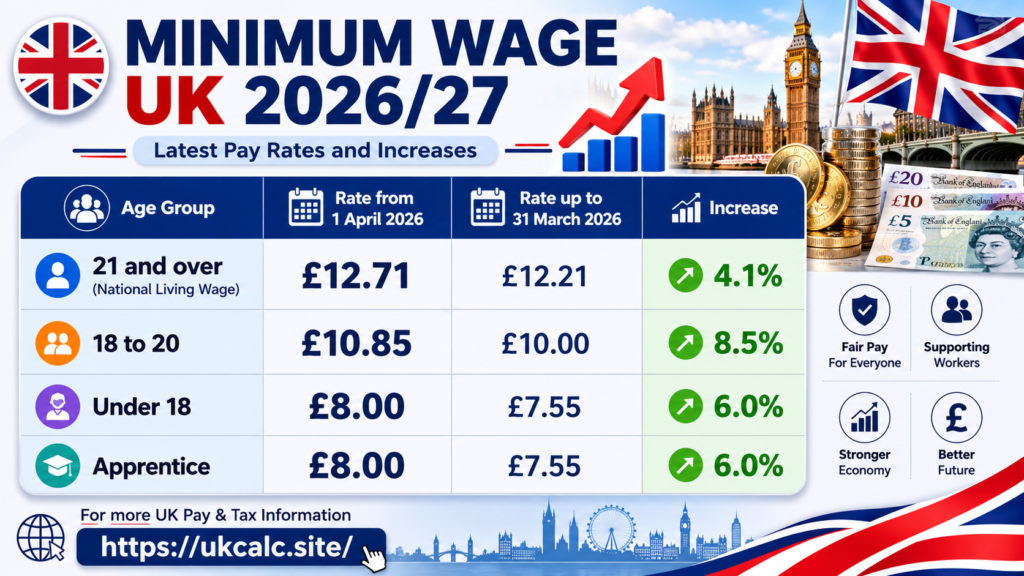
Here’s the full breakdown of rates that came into force on 1 April 2026:
| Age Group | Rate from 1 April 2026 | Rate up to 31 March 2026 | Increase |
| 21 and over (National Living Wage) | £12.71 | £12.21 | 4.1% |
| 18 to 20 | £10.85 | £10.00 | 8.5% |
| Under 18 | £8.00 | £7.55 | 6.0% |
| Apprentice | £8.00 | £7.55 | 6.0% |
A few things worth noting straight away:
- The apprentice rate applies to apprentices under 19, and those aged 19 or over who are in the first year of their apprenticeship. Minimum Wage UK 2026/27 Once an apprentice turns 19 and completes their first year, they move onto the rate for their age Minimum Wage UK 2026/27.
- The accommodation offset — the maximum amount an employer can charge for living accommodation before it affects minimum wage calculations — rose to £11.10 a day (from £10.66) Minimum Wage UK 2026/27.
- These rates apply UK-wide. Minimum Wage UK 2026/27 There’s no regional variation like there is with Scottish Income Tax bands Minimum Wage UK 2026/27.
Key Terms You Need to Understand First
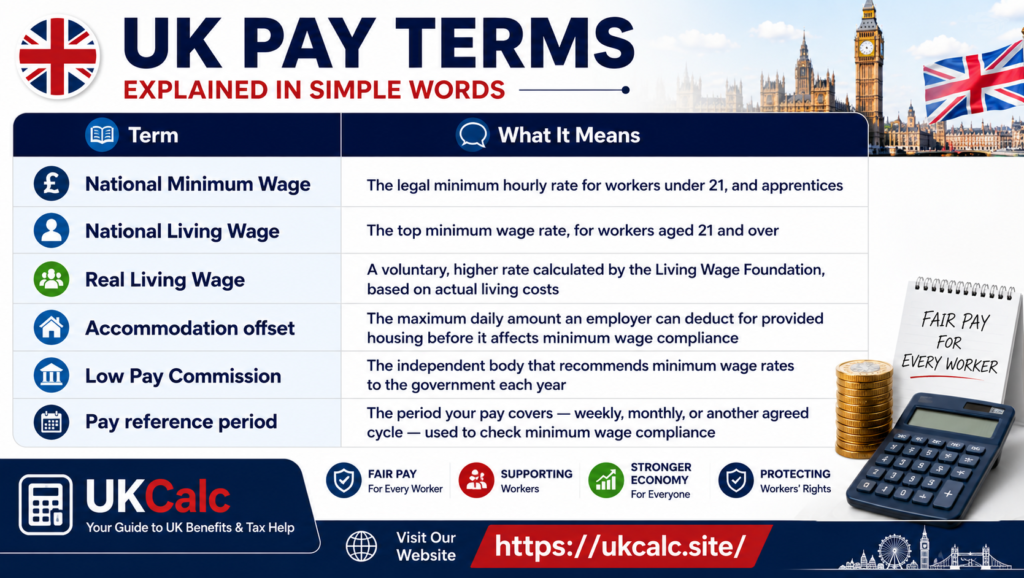
A few terms come up throughout this guide, so here’s what they actually mean Minimum Wage UK 2026/27.
| Term | What It Means |
| National Minimum Wage | The legal minimum hourly rate for workers under 21, and apprentices |
| National Living Wage | The top minimum wage rate, for workers aged 21 and over |
| Real Living Wage | A voluntary, higher rate calculated by the Living Wage Foundation, based on actual living costs |
| Accommodation offset | The maximum daily amount an employer can deduct for provided housing before it affects minimum wage compliance |
| Low Pay Commission | The independent body that recommends minimum wage rates to the government each year |
| Pay reference period | The period your pay covers — weekly, monthly, or another agreed cycle — used to check minimum wage compliance |
That last term matters more than people expect. Minimum Wage UK 2026/27 Minimum wage compliance isn’t checked hour by hour — it’s checked across your entire pay reference period, which is why irregular shifts or unpaid extra time can sometimes tip someone below the legal minimum without it being obvious from a single payslip Minimum Wage UK 2026/27.
Why This Topic Matters, Especially for Students
If you’re a student working part-time, minimum wage rates affect you directly and immediately. Minimum Wage UK 2026/27 Most student jobs — retail, hospitality, tutoring, campus roles — are paid at either the 18–20 rate or the under-18 rate, depending on your age Minimum Wage UK 2026/27.
Here’s why getting this right matters:
- Age-based pay rises automatically. Turn 18, and your employer should move you onto the 18–20 rate without you needing to ask. Turn 21, and you’re entitled to the full National Living Wage Minimum Wage UK 2026/27.
- Underpayment is more common than people think. HMRC’s enforcement reports consistently show thousands of workers, many of them young or part-time, being underpaid each year — sometimes deliberately, often just through payroll errors Minimum Wage UK 2026/27.
- Understanding your rate helps you budget realistically. Knowing exactly what you should be earning per hour makes it much easier to plan around rent, travel, and everyday costs while studying Minimum Wage UK 2026/27.
Even if you’re not currently working, this knowledge matters the moment you take on a part-time or holiday job — and it’s useful to know before you accept an offer, not after your first payslip leaves you confused Minimum Wage UK 2026/27.
Common Misconceptions About Minimum Wage
A few myths persist and catch people out repeatedly Minimum Wage UK 2026/27.
“Under-18s and apprentices are paid the same as adults doing the same job.”
Not true. Age and apprentice status directly determine which rate applies, regardless of the type of work being done Minimum Wage UK 2026/27.
“The National Living Wage and the Real Living Wage are the same thing.”
They’re not. The National Living Wage is the legal minimum. The Real Living Wage is a separate, voluntary, and higher rate that only some employers choose to pay
.
“Tips count toward minimum wage.”
They don’t. Tips, gratuities, and service charges cannot be used to make up minimum wage pay — your base hourly rate must meet the legal minimum on its own.
“Salaried staff can’t be underpaid because they’re not paid hourly.”
They can. Minimum wage compliance is calculated by dividing total pay by hours actually worked in the pay reference period, so unpaid overtime or long unpaid shifts can quietly pull someone below the legal rate.
National Minimum Wage vs National Living Wage vs Real Living Wage
These three terms get mixed up constantly, so here’s a direct comparison.
| Feature | National Minimum Wage | National Living Wage | Real Living Wage |
| Legal requirement | Yes | Yes | No — voluntary |
| Who it applies to | Under-21s and apprentices | Workers aged 21+ | Any employer who chooses to sign up |
| Set by | Government, via Low Pay Commission | Government, via Low Pay Commission | Living Wage Foundation |
| 2026/27 rate | £8.00–£10.85 depending on age | £12.71 | £13.45 (UK), £14.80 (London) |
| Based on | Affordability for businesses | Two-thirds of median earnings | Actual cost of living |
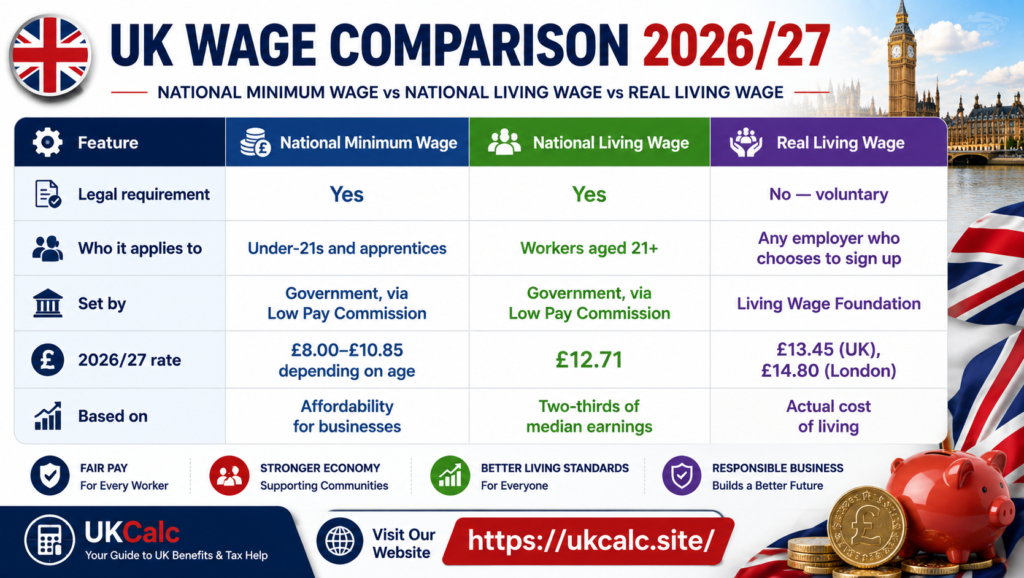
The gap between the legal National Living Wage and the voluntary Real Living Wage is worth understanding, especially if you’re comparing job offers — an employer accredited by the Living Wage Foundation is paying above the legal minimum by choice, not by requirement.
How to Check You’re Being Paid the Right Minimum Wage
Working out whether you’re being paid correctly isn’t just about looking at your hourly rate — it’s about checking your total pay against your total hours worked in a given pay reference period. Here’s how to do it properly.
Step 1: Confirm Your Age Band
Your minimum wage rate is based on your age on the first day of the pay reference period, not the last. So if your birthday falls partway through a pay period, the higher rate typically doesn’t apply until the next one starts.
Step 2: Add Up All Your Hours Worked
This includes more than just your scheduled shifts. Time that usually counts toward minimum wage calculations includes:
- Training sessions your employer requires you to attend
- Time spent travelling between work sites during your shift
- Time spent waiting on-site if you’re required to be there
- Trial shifts, in most circumstances, if genuine work is carried out
Time that usually doesn’t count includes rest breaks, travel from home to your normal workplace, and time spent on call away from your employer’s premises (though on-call time while at work often does count).
Step 3: Calculate Your Total Pay for the Period
Add up your gross pay for the period, before tax and National Insurance are deducted. Then subtract certain deductions that reduce your pay for minimum wage purposes — these include:
- Deductions for uniform or tools that are essential for the job
- Charges for accommodation above the accommodation offset limit
- Any deduction that benefits the employer rather than the worker
Step 4: Divide Total Pay by Total Hours
Total pay for the period ÷ total hours worked = your effective hourly rate. Compare that figure to your age band’s minimum wage rate.
If the result is lower than what you’re entitled to, you may be being underpaid — even if your contract states an hourly rate that looks correct on paper.
Worked Examples: What the New Rates Mean in Real Pay
Numbers on a page are one thing — seeing what they translate to in actual weekly and monthly pay makes it much clearer.
Example 1: A 19-Year-Old Working Part-Time
A 19-year-old working 16 hours a week at the 18–20 rate of £10.85 an hour would earn:
- Weekly pay: 16 × £10.85 = £173.60
- Monthly pay (roughly): £752.27
Example 2: A 17-Year-Old on a Weekend Job
A 17-year-old working 8 hours a week at the under-18 rate of £8.00 an hour would earn:
- Weekly pay: 8 × £8.00 = £64.00
- Monthly pay (roughly): £277.33
Example 3: A Graduate Starting Full-Time Work
A 22-year-old working a standard 37.5-hour week at the National Living Wage of £12.71 an hour would earn:
- Weekly pay: 37.5 × £12.71 = £476.63
- Annual pay (before tax): 37.5 × 52 × £12.71 = £24,784.50
Example 4: A First-Year Apprentice
An 18-year-old apprentice in their first year, working 30 hours a week at the apprentice rate of £8.00 an hour, would earn:
- Weekly pay: 30 × £8.00 = £240.00
- Monthly pay (roughly): £1,040.00
Once that apprentice turns 19 and completes their first year of training, they’d move onto the 18–20 or 21+ rate, whichever matches their age at that point — a jump most apprentices don’t realise applies automatically.
Common Mistakes Employers and Workers Make
A surprising number of minimum wage breaches happen without any deliberate intent to underpay. Minimum Wage UK 2026/27 These are the mistakes that come up again and again Minimum Wage UK 2026/27.
- Not updating pay when a worker’s age changes. If someone turns 18 or 21, their rate should change from the start of the next pay reference period. Minimum Wage UK 2026/27 Missing this is one of the most common compliance failures HMRC identifies Minimum Wage UK 2026/27.
- Charging for uniforms or equipment that push pay below the minimum. If a worker has to buy branded clothing or tools as a condition of the job, and that cost brings their effective hourly rate below the legal minimum, it’s a breach — even if their contracted rate looks fine Minimum Wage UK 2026/27.
- Not paying for mandatory training time. If your employer requires you to attend training, that time usually counts as working time and must be paid at least at minimum wage Minimum Wage UK 2026/27.
- Averaging pay across an unusual pay period. Minimum wage compliance is checked per pay reference period, not averaged across a whole year, so one particularly busy or low-paid month can trigger a breach even if annual pay looks reasonable Minimum Wage UK 2026/27.
- Confusing minimum wage with the Real Living Wage. Some employers assume paying “at least the government rate” automatically satisfies any Living Wage commitment — the two are calculated completely differently Minimum Wage UK 2026/27.
Best Practices for Workers Checking Their Pay
- Keep a personal record of your hours worked, especially if your shifts vary week to week. Payslips don’t always show hours clearly, so your own log is useful if a dispute arises Minimum Wage UK 2026/27.
- Check your payslip every pay period, not just occasionally. Errors are far easier to fix quickly than months later Minimum Wage UK 2026/27.
- Know your correct rate before your birthday, so you can flag it if your pay doesn’t update on time Minimum Wage UK 2026/27.
- Ask HR or payroll directly if something looks off. Most underpayment is a payroll error, not intentional — a quick query often resolves it without any formal process Minimum Wage UK 2026/27.
Expert Tip: Understand How Deductions Interact With Minimum Wage
One detail that catches a lot of workers out: not every deduction from your pay reduces your minimum wage calculation. Deductions for tax, National Insurance, pension contributions (where you’ve agreed to them), and repayment of a genuine loan you requested generally don’t count against minimum wage compliance, because they’re either required by law or something you’ve voluntarily agreed to for your own benefit Minimum Wage UK 2026/27.
But deductions that primarily benefit your employer — like a uniform charge, a cash shortage deduction, or a training cost recovery clause — are treated differently. These can reduce your effective pay for minimum wage purposes, even though your contracted hourly rate looks compliant Minimum Wage UK 2026/27.
If you’re ever unsure whether a deduction is affecting your minimum wage entitlement, it’s worth checking gov.uk’s guidance directly or contacting the Acas helpline, which offers free, confidential advice.
Important Note: Minimum Wage and Holiday Pay Are Linked
Holiday pay should also be calculated using at least your minimum wage rate for the hours you’d normally have worked. This becomes particularly relevant for workers on irregular hours, where holiday pay is often calculated as an average of recent earnings. If that average dips below what minimum wage would require for the hours covered, it’s worth double-checking the calculation rather than assuming it’s correct.
Advanced Concept: The Direction of Future Minimum Wage Policy
It’s worth understanding the direction of travel here, not just this year’s rates. The government has stated an intention to gradually move toward a single adult minimum wage rate that applies to all workers regardless of age, rather than maintaining separate bands for 18–20-year-olds and those under 21.
This shift has already been happening gradually — the National Living Wage age threshold dropped from 25 to 23 in 2021, then from 23 to 21 in 2024. The 8.5% increase applied to the 18–20 rate this year, noticeably higher than the increase for the 21+ rate, reflects this ongoing effort to narrow the gap between age bands over time.
For students and younger workers, this matters because it suggests the pay gap between under-21s and the full National Living Wage is likely to keep shrinking in future years, rather than staying fixed.
Minimum Wage vs Real-World Living Costs
While the legal minimum wage rose by 4.1% for the National Living Wage this year, it’s worth understanding how that compares with independently calculated living costs.
| Measure | 2026/27 Rate | Basis |
|---|---|---|
| National Living Wage | £12.71/hour | Two-thirds of median UK earnings |
| Real Living Wage (UK) | £13.45/hour | Actual cost of essentials: rent, food, travel, energy |
| Real Living Wage (London) | £14.80/hour | Same as above, adjusted for London’s higher costs |
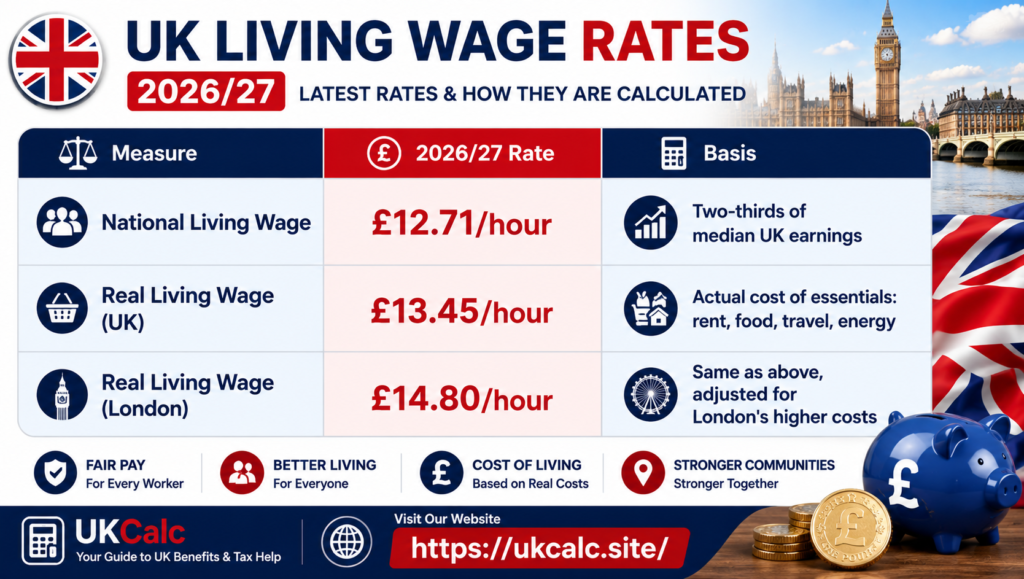
The gap between the legal minimum and the Real Living Wage is one reason some workers on the National Living Wage still find their pay doesn’t stretch as far as expected, particularly in higher-cost areas like London, where there’s no regional uplift built into the legal minimum.
What to Do If You’ve Been Underpaid
If you’ve worked through the calculations above and your effective hourly rate falls below your correct minimum wage, don’t panic — this happens more often than most people expect, and there’s a clear process for putting it right.
Step 1: Raise It With Your Employer First
Most underpayment comes from a genuine payroll error rather than intentional wrongdoing. Start with a simple, direct conversation or email to HR or payroll, explaining your calculation and asking them to review it. Keep a written record of this request.
Step 2: Contact Acas If It Isn’t Resolved
If your employer doesn’t respond or disputes your calculation, the Acas helpline offers free, confidential advice on minimum wage issues and can help you understand your next steps without needing a solicitor.
Step 3: Report It to HMRC
HMRC enforces minimum wage law and investigates complaints. You can report suspected underpayment anonymously through the gov.uk minimum wage complaints service. HMRC has the power to order employers to repay arrears going back several years and can issue penalties on top of that.
Step 4: Know Your Time Limits
Minimum wage claims through an employment tribunal typically need to be brought within three months of the underpayment, so it’s worth acting promptly rather than waiting, even if you’re hoping to resolve things informally first.
Advanced Tip: How HMRC Enforcement Actually Works
It’s worth understanding what happens once a complaint is made, since it affects how seriously employers tend to take compliance. HMRC caseworkers can request payroll records going back years, not just recent payslips, which means a long-standing underpayment issue can result in a much larger arrears bill than most employers expect.
Employers found to have underpaid staff are required to repay the arrears at current minimum wage rates, not the rate that applied at the time of the underpayment — meaning the amount owed can end up higher than the original shortfall once rates have risen since. On top of that, HMRC can issue financial penalties and publicly name employers who breach the rules, which is a significant reputational risk many businesses actively try to avoid.
Frequently Overlooked Point: Unpaid Trial Shifts
One area that catches a lot of younger and first-time workers out is unpaid trial shifts. If you’re asked to complete a “trial” that involves doing genuine, productive work — serving customers, stocking shelves, taking orders — that time should generally be paid at least at minimum wage, even if it’s labelled a trial or unpaid assessment.
A short, observational trial where you’re mainly shadowing someone else, rather than doing real work, sits in a greyer area. If you’re ever unsure whether a trial shift should have been paid, it’s worth checking gov.uk’s specific guidance on this, since it’s one of the more commonly misunderstood parts of minimum wage law.
Minimum Wage Rate History: How Things Have Changed
Seeing how rates have moved over recent years helps put the 2026/27 increase in context.
| Year | National Living Wage (21+) | 18–20 Rate | Under-18/Apprentice Rate |
| April 2024 | £11.44 | £8.60 | £6.40 |
| April 2025 | £12.21 | £10.00 | £7.55 |
| April 2026 | £12.71 | £10.85 | £8.00 |
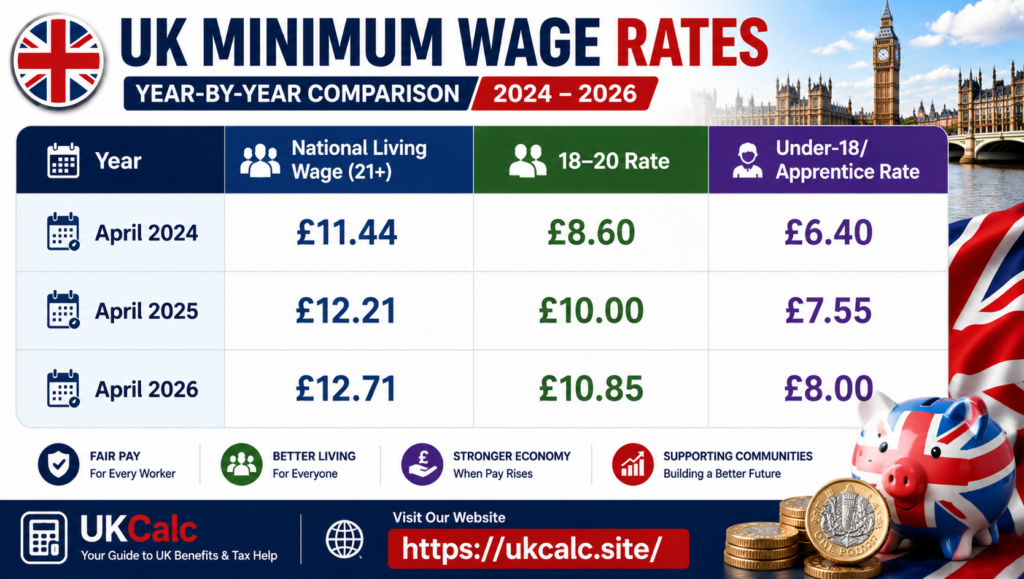
Two things stand out here. First, the National Living Wage age threshold dropped to 21 in April 2024, bringing many more workers onto the top rate. Second, the 18–20 rate has been rising faster in percentage terms than the 21+ rate in recent years, consistent with the government’s stated aim of eventually merging the age bands into a single adult rate.
Key Takeaways
If you’re underpaid, raise it with your employer first, then Acas, then HMRC if it remains unresolved — claims generally need to be brought within three months.
From 1 April 2026, the National Living Wage for workers aged 21 and over is £12.71 an hour, up from £12.21.
Workers aged 18–20 now receive £10.85 an hour, and those under 18 or in the first year of an apprenticeship receive £8.00 an hour.
Minimum wage compliance is calculated per pay reference period, based on total pay divided by total hours worked, not just your contracted hourly rate.
Tips cannot be counted toward minimum wage pay, and certain deductions — like uniform costs — can reduce your effective pay below the legal minimum even if your contract looks compliant.
The Real Living Wage, a separate voluntary rate calculated by the Living Wage Foundation, is higher than the legal minimum at £13.45 (UK) and £14.80 (London).
Final Thoughts
Minimum wage rules can feel more complicated than they should, mostly because compliance depends on more than just the hourly figure on your contract. Once you understand how pay reference periods, deductions, and age bands actually work together, checking your own pay becomes far more straightforward.
For 2026/27, the key numbers to remember are simple: £12.71 for workers aged 21 and over, £10.85 for 18 to 20-year-olds, and £8.00 for under-18s and first-year apprentices. Staying on top of Minimum Wage UK 2026/27 rates isn’t just useful for employers trying to stay compliant — it’s essential for anyone earning an hourly wage who wants to be confident they’re being paid exactly what they’re legally owed.
If your pay doesn’t add up, don’t assume it’s a one-off or too small to matter. A quick calculation now can save you months of underpayment going unnoticed, and it’s always worth raising with your employer before assuming the worst.
FAQ’s
What is the minimum wage in the UK for 2026/27?
From 1 April 2026, the National Living Wage for workers aged 21 and over is £12.71 an hour. Workers aged 18–20 receive £10.85 an hour, and under-18s and first-year apprentices receive £8.00 an hour.
When did the new minimum wage rates start in 2026?
The new rates came into effect from 1 April 2026, applying from the start of each worker’s pay reference period on or after that date.
What is the difference between the National Minimum Wage and the National Living Wage?
The National Living Wage is the top rate of minimum wage, paid to workers aged 21 and over. The National Minimum Wage refers to the lower rates that apply to workers under 21 and apprentices.
Is the Real Living Wage the same as the legal minimum wage?
No. The Real Living Wage is a voluntary rate calculated by the Living Wage Foundation based on actual living costs. It’s higher than the legal minimum and only paid by employers who choose to sign up.
Do tips count toward minimum wage pay?
No. Tips, gratuities, and service charges cannot be used to make up an employee’s minimum wage. Base pay must meet the legal minimum on its own.
What is the minimum wage for an 18-year-old in 2026/27?
An 18-year-old is entitled to at least £10.85 an hour under the 18–20 rate, unless they’re a first-year apprentice, in which case the apprentice rate of £8.00 an hour applies.
Can my employer deduct money for a uniform if it brings my pay below minimum wage?
If a required uniform or equipment cost reduces effective hourly pay below the legal minimum, this is generally not allowed and may count as an underpayment.
What happens if my employer underpays me?
You can raise it directly with your employer, seek free advice from Acas, or report it to HMRC, which can investigate and require the employer to repay arrears at current minimum wage rates, plus penalties.
Does minimum wage apply to part-time and casual workers?
Yes. Minimum wage applies to full-time, part-time, casual, and temporary workers, regardless of how many hours they work.
How often does the UK minimum wage change?
Minimum wage rates are reviewed annually and typically take effect on 1 April each year, based on recommendations from the Low Pay Commission.