scholarships

Salary Sacrifice
scholarships

Salary Sacrifice Explained – Benefits and Drawbacks

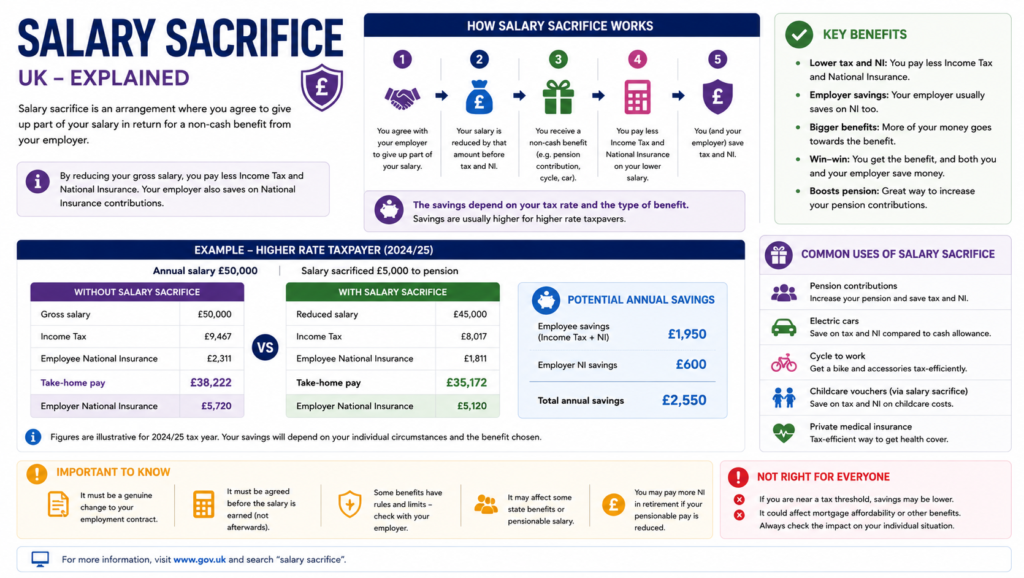
If you’ve seen “salary sacrifice” mentioned on your payslip, in a pension scheme, or in a cycle-to-work offer at your job, you’re not alone in wondering exactly what it means. It sounds complicated, but the idea behind it is actually quite simple once you break it down. In this guide, we’ll explain what salary sacrifice is, how it works in practice, and why so many UK employers offer it. We’ll also cover the real benefits and the genuine drawbacks — because while salary sacrifice can save you money, it isn’t the right choice for everyone. What Is Salary Sacrifice? Salary sacrifice is an arrangement between you and your employer where you agree to give up part of your salary in exchange for a non-cash benefit. Instead of receiving that portion of your pay as taxable income, it’s redirected into something like: Because your official salary is lower, you pay less Income Tax and less National Insurance on that reduced amount. Your employer also pays less employer National Insurance, which is why many businesses are happy to offer these schemes. Simple example: Say you earn £30,000 a year and agree to sacrifice £2,000 into your pension. Your taxable salary drops to £28,000. You still get the £2,000 — it just goes into your pension pot instead of your bank account, and you avoid paying tax and National Insurance on it. Visit Now: https://www.taxsal.com/ How Does Salary Sacrifice Work? The process itself is straightforward, but it does require a formal agreement between you and your employer. Here’s how it typically works step by step: This is the key point people often miss: it’s not that you’re avoiding paying for the benefit. You’re still paying for it — just before tax is taken out, rather than after. Common Types of Salary Sacrifice Schemes Not all salary sacrifice schemes work the same way. Here’s a quick breakdown of the most common ones in the UK. Scheme Type What It’s Used For Typical Saving Pension contributions Boosting retirement savings Tax + NI savings on contributions Cycle to Work Buying a bike and equipment Up to 40% off retail price Electric car leasing Leasing an EV through your employer Lower tax than company car schemes Childcare vouchers Paying for registered childcare Tax and NI savings (legacy scheme, closed to new joiners) Additional holiday Buying extra annual leave No tax saving, but useful for work-life balance Pension salary sacrifice is by far the most widely used, since almost every employer offers a workplace pension and the tax savings are significant over time. Benefits of Salary Sacrifice 1. Lower Income Tax and National Insurance This is the main attraction. Because your taxable salary is reduced, you pay less tax and less National Insurance overall. For higher earners, this can also help keep income below key thresholds — like avoiding the tapering of the Personal Allowance above £100,000. 2. Employer Savings Can Be Passed Back to You Employers save on National Insurance too. Many pass some or all of this saving back into your pension as an extra contribution, effectively boosting your retirement pot for free. 3. Bigger Pension Pot Over Time Because contributions go in before tax, more money ends up in your pension compared to contributing the same amount from your take-home pay. Over 20–30 years, this difference compounds significantly. 4. Access to Discounted Benefits Schemes like Cycle to Work or EV leasing let you access products at a lower effective cost than buying them outright, since you’re paying with pre-tax income. 5. No Extra Admin for Employees Once you’re signed up, the scheme runs automatically through payroll. There’s no need to claim anything back or fill out extra tax forms each year. Read More: Take Home Pay Calculator UK – Calculate Your Net Salary After Tax Drawbacks of Salary Sacrifice 1. Lower Official Salary Because your contractual salary drops, this can affect things tied to your salary level, such as: 2. Reduced State Pension Entitlement (in Rare Cases) If your salary drops too close to the National Insurance Lower Earnings Limit, it could affect your qualifying years for the State Pension. This is uncommon but worth checking if you’re on a lower salary. 3. It’s Not Always Reversible Quickly Salary sacrifice arrangements are usually set for a minimum period, often 12 months. If your circumstances change — say you need the extra take-home pay back — you may not be able to opt out immediately. 4. Not Suitable for Everyone If you’re close to the minimum wage, salary sacrifice generally isn’t allowed, since it can’t reduce your pay below the National Minimum Wage or National Living Wage. 5. Impacts Statutory Payments If you’re planning to take maternity or paternity leave soon, a lower salary could reduce the amount of statutory pay you receive, since it’s often calculated based on average earnings. Salary Sacrifice vs Regular Pension Contributions Feature Salary Sacrifice Standard Contribution Tax relief Automatic, no tax paid at all on sacrificed amount Tax relief claimed afterward National Insurance saving Yes No Employer NI saving passed on Sometimes No Effect on official salary Lower Unchanged Effect on mortgage applications Can lower borrowing amount No effect This comparison shows why salary sacrifice is often more efficient — but also why the salary reduction matters for anyone applying for credit or a mortgage soon. Is Salary Sacrifice Right for You? Salary sacrifice tends to work best if: It may be worth avoiding or reconsidering if: If you’re unsure, it’s worth speaking to your payroll or HR team, or a financial adviser, before committing — especially for larger sacrifices like pension contributions. Final Thoughts Salary sacrifice is one of the simplest ways to make your salary work harder — lowering your tax bill while boosting your pension or accessing valuable benefits like cycle schemes or electric car leasing. For most people, especially those focused on long-term pension growth, it’s a smart, tax-efficient option. That said, it’s not a one-size-fits-all solution. If you’re planning a mortgage application, expecting statutory

Emergency Tax UK
scholarships

Emergency Tax Explained – How to Claim a Refund

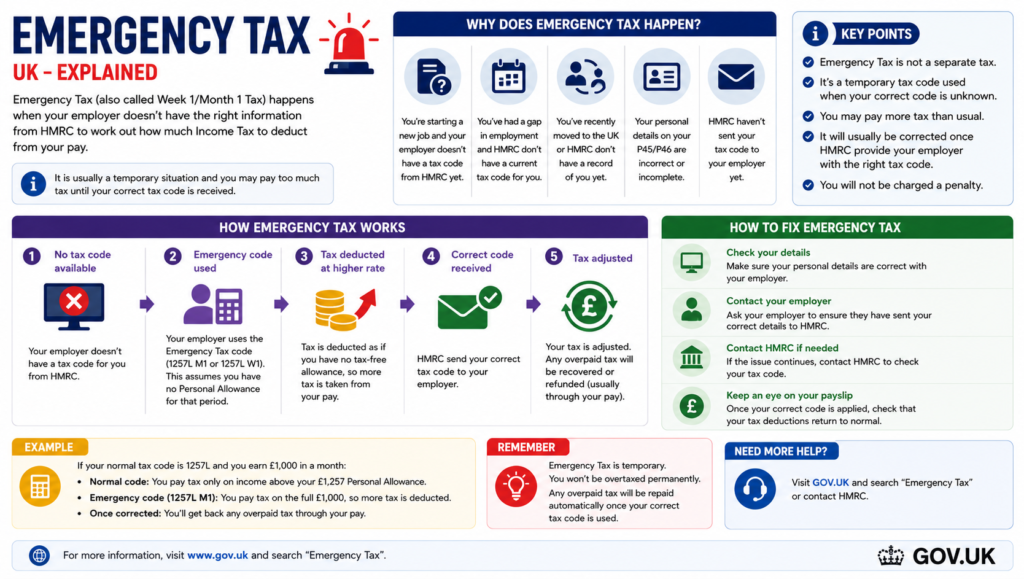
Ever opened your payslip and noticed way more tax taken off than you expected? If your tax code has “W1”, “M1”, or “X” after it, you’re likely on Emergency Tax Explained. It’s more common than people realise — especially when starting a new job, switching from self-employment, or picking up a second income. The good news: emergency tax is usually temporary, and if you’ve overpaid, you can claim it back.  Emergency Tax UK This guide walks you through what emergency tax actually is, why it happens, and exactly how to get your money back. What Is Emergency Tax? Emergency tax is a temporary tax code HMRC applies when they don’t yet have enough information about your income to calculate your tax correctly.  Emergency Tax UK Instead of using your full year’s earnings to work out your Personal Allowance, your employer taxes you based only on that single pay period — often assuming you have no tax-free allowance at all. This usually results in you paying more tax than you should, at least until HMRC receives your full details and issues a correct tax code. Visit Now: https://www.taxsal.com/ Why Does Emergency Tax Happen? There are a handful of common situations that trigger it: In all of these cases, your employer doesn’t have the full picture of your income history for the tax year, so they apply a temporary code as a safety measure. Read More: Rhodes Scholarship: 7 Powerful Benefits for Students Emergency tax codes usually look like your standard tax code, but with an extra marker attached. The most common ones are: Emergency Code What It Means 1257 W1 Calculated weekly, based only on that week’s pay 1257 M1 Calculated monthly, based only on that month’s pay 1257 X Non-cumulative code, similar effect to W1/M1 BR Basic rate (20%) applied to all income, no tax-free allowance 0T No tax-free allowance at all The “W1” and “M1” tags mean your tax is worked out fresh each pay period, rather than looking at your total earnings across the year.  Emergency Tax UK This is what usually leads to overpayment, since it ignores unused tax-free allowance from earlier months. Example: How Emergency Tax Affects Your Pay Let’s say you start a new job in July without a P45, and you’re placed on a 1257 M1 emergency code. Scenario Normal Tax Code Emergency Tax Code (M1) Monthly salary £2,500 £2,500 Tax-free allowance applied Full year’s allowance spread across months Only that month’s allowance Tax deducted Based on cumulative earnings Based only on this month, ignoring earlier unused allowance Result Correct tax Often overpaid If you’d already been unemployed for part of the year, a normal tax code would account for those unused tax-free months.  Emergency Tax UK An emergency code doesn’t — so you end up taxed as if you’d been earning that amount every month all year. How Much Extra Could You Pay? It depends on your income and how long you’re on the emergency code, but it’s not unusual for people to overpay several hundred pounds in a single month, particularly if: The longer it takes HMRC to issue your correct code, the more you could overpay — which is exactly why it’s worth sorting out quickly rather than waiting for it to fix itself Emergency Tax UK. Step-by-Step: What to Do If You’re on Emergency Tax Step 1: Check Your Payslip Look for your tax code next to your National Insurance number. If it ends in W1, M1, or X, or shows BR/0T unexpectedly, you’re likely on an emergency code. Step 2: Give Your Employer a P45 (If You Have One) If you left a previous job recently, hand your P45 to your new employer as soon as possible.  Emergency Tax UK This gives them your income and tax details for the year, allowing them to apply the correct code without needing HMRC to step in  Emergency Tax UK. Step 3: Complete a Starter Checklist (If You Don’t Have a P45) If you don’t have a P45 — maybe you’re starting your first job, or came from self-employment — ask your employer for a Starter Checklist. This form asks about your employment history and helps assign a more accurate code from the start. Step 4: Contact HMRC Directly If your emergency code hasn’t been corrected after your first payday, or you think you’re being taxed incorrectly, contact HMRC through: Have your National Insurance number, employer details, and recent payslips ready  Emergency Tax UK. Step 5: Wait for Your Tax Code to Update Once HMRC has the correct information, they’ll issue an updated PAYE Coding Notice, and your employer will apply it going forward. Step 6: Check for a Refund Emergency tax often corrects itself automatically.  Emergency Tax UK Once your proper tax code is applied, your employer will usually refund any overpaid tax through your payslip — either as a lump sum adjustment or spread across future pay periods  Emergency Tax UK. How to Claim Back Emergency Tax  Emergency Tax UKIf your tax code isn’t automatically corrected, or the tax year has already ended before you notice the overpayment, here’s how to claim it back: If the tax year has ended and you never claimed, you can usually go back and claim overpaid tax for up to four previous tax years. Emergency Tax on Pensions Emergency tax doesn’t just apply to employment — it’s also common when you first access a pension, particularly if you take a lump sum.  Emergency Tax UK Pension providers often apply emergency tax to the first payment because they don’t yet know your full tax position for the year. This can result in a much larger deduction than expected on that first pension withdrawal.  Emergency Tax UK The process to reclaim it is similar: check your tax code, contact HMRC or your pension provider, and claim back any overpayment using the relevant HMRC form for pension tax refunds. How Long Does It Take to Fix Emergency Tax? In most cases, once your employer has your correct details (through a P45 or Starter Checklist), your tax code updates

UK Tax Code
scholarships

Tax Codes Explained – What Your UK Tax Code Means

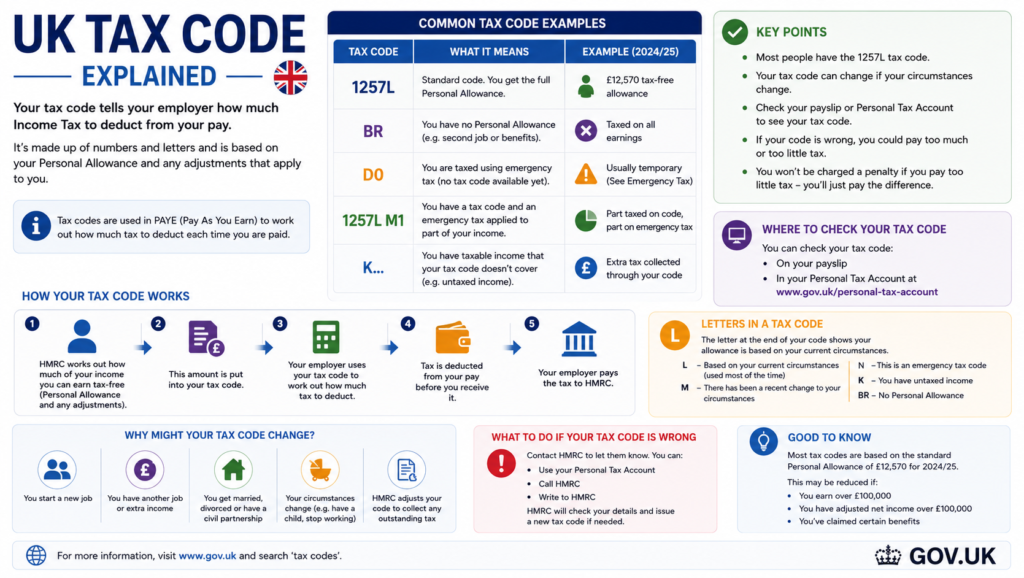
If you’ve ever looked at your payslip and seen something like 1257L next to your name, you’ve probably wondered what it actually means — and whether it’s even correct. You’re not alone. UK Tax Code Millions of people in the UK never check their tax code, yet an incorrect one can mean you’re paying too much or too little tax without realising it. This guide breaks down exactly what a UK tax code is, how it’s worked out, what the letters and numbers mean, and how to check whether yours is right. UK Tax Code No jargon, no confusing HMRC-speak — just a straightforward explanation. What Is a UK Tax Code? A UK tax code is a short combination of numbers and letters that tells your employer or pension provider how much tax-free income you’re entitled to before Income Tax is deducted from your pay. HMRC issues this code, and your employer uses it to work out how much tax to take off each time you’re paid. UK Tax Code Think of it as an instruction label: it tells your payroll system “this is how much of this person’s income should be tax-free, and here’s how to treat the rest.” Your tax code isn’t random.UK Tax Code It’s based on your Personal Allowance, any adjustments for benefits, extra income, or previous underpayments, and your specific circumstances that tax year. Visit Now: https://www.taxsal.com/ Where to Find Your Tax Code You don’t need to dig through paperwork to find it. UK Tax Code Your tax code appears on: If you can’t find any of these, you can log into your HMRC personal tax account online and check it in a couple of minutes. How to Read a UK Tax Code: The Numbers The number in your tax code tells you how much tax-free income you get in that tax year. Here’s the simple rule: multiply the number by 10, and that’s roughly your tax-free allowance. For example, the most common tax code is 1257L. That means: 1257 × 10 = £12,570 tax-free income This lines up with the standard Personal Allowance for most taxpayers. Anything you earn above that £12,570 is taxed at the normal rates for your income band. Example: How the Number Works in Practice Let’s say you earn £30,000 a year and your tax code is 1257L. Income Breakdown Amount Total salary £30,000 Tax-free allowance £12,570 Taxable income £17,430 Tax charged on £17,430 (at 20% basic rate) So instead of being taxed on your full £30,000, you’re only taxed on £17,430. UK Tax Code That’s the whole point of the tax-free allowance built into your code. How to Read a UK Tax Code: The Letters The letter tells HMRC (and your employer) something specific about your situation. Here are the most common ones you’ll come across. L – Standard Personal Allowance This is the most common letter. It simply means you’re entitled to the standard tax-free Personal Allowance with no special adjustments. M – Marriage Allowance (Received) You’ve received a transfer of 10% of your partner’s Personal Allowance under the Marriage Allowance scheme. N – Marriage Allowance (Given) You’ve transferred 10% of your Personal Allowance to your spouse or civil partner. T – Other Calculations Involved Your tax code includes other calculations to work out your Personal Allowance, often because of more complex income or benefits. 0T – No Personal Allowance Given You’re getting no tax-free allowance at all — every penny of income in this employment is taxed. UK Tax Code This often happens when you’ve started a new job without giving your employer a P45, or when your allowance has been fully used elsewhere. BR – Basic Rate Tax on All Income All your income from this job or pension is taxed at the basic rate (20%), with no tax-free amount applied. This is common for second jobs. D0 – Higher Rate Tax on All Income All income from this source is taxed at 40%, usually because you’re a higher-rate taxpayer with more than one income stream. D1 – Additional Rate Tax on All Income Similar to D0, but everything is taxed at the additional rate of 45%. UK Tax Code Typically used for a second income when your main income already uses up lower tax bands. K – Tax Code with a “Negative” Allowance A K code means you owe HMRC more than your tax-free allowance can cover — often because of company benefits (like a company car) or previous unpaid tax. Instead of reducing your taxable income, this adds to it. NT – No Tax Rare, but it means no tax is deducted at all. UK Tax Code Usually applies in very specific circumstances agreed directly with HMRC. Read More: GREAT Scholarships UK 2026 — Eligibility, Application Process & Deadlines Explained Common Tax Code Letters at a Glance Letter What It Means L Standard Personal Allowance M Received 10% of partner’s allowance N Transferred 10% of allowance to partner T Other calculations affect your allowance 0T No tax-free allowance applied BR Basic rate (20%) on all income D0 Higher rate (40%) on all income D1 Additional rate (45%) on all income K Extra tax due, added to taxable income NT No tax deducted Why Your Tax Code Might Change Your tax code isn’t fixed forever. UK Tax Code HMRC updates it when your circumstances change, including: Whenever your code changes, HMRC should send you a PAYE Coding Notice explaining exactly why. Emergency Tax Codes: What They Mean If you see a code like 1257 W1, 1257 M1, or 1257 X, you’re on an emergency tax code. This usually happens when: Emergency codes calculate tax based only on that pay period, rather than your full year’s earnings. This can mean you’re taxed more than necessary in the short term — though it usually corrects itself once HMRC has your full details, or you can claim back any overpayment. How to Check If Your Tax Code Is Correct Here’s a simple step-by-step way to check: What

National Insurance Contributions
scholarships

National Insurance Contributions Explained – Rates, Classes & Thresholds

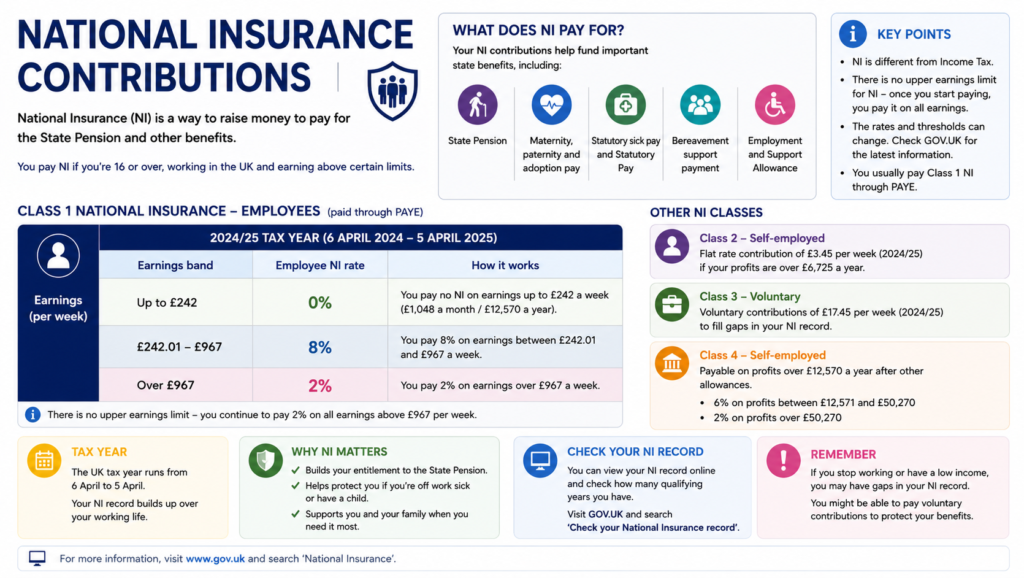
Most UK workers see “National Insurance” on their payslip every month, yet few could explain exactly what it pays for or how the deduction is worked out. National Insurance Contributions It’s not just another tax — it’s tied directly to your future State Pension, certain benefits, and statutory pay entitlements. This guide walks through everything you need to know about National Insurance Contributions: the different classes, current rates and thresholds, who pays what, and how it affects your take-home pay. What Are National Insurance Contributions? National Insurance Contributions (NICs) are payments made by employees, employers, and self-employed people in the UK. National Insurance Contributions HMRC collects them to fund the state pension, statutory sick pay, maternity pay, and certain other welfare benefits. Unlike Income Tax, which goes into general government spending, National Insurance is more directly linked to your personal entitlement record. National Insurance Contributions Your NI contributions build up “qualifying years,” and you generally need a minimum number of these to receive a full State Pension later in life. For most employees, NICs are deducted automatically through PAYE alongside Income Tax, so the two often get lumped together on a payslip even though they’re calculated separately. Visit Now: https://www.taxsal.com/ Why National Insurance Matters It’s easy to see NI as just another deduction, but it directly affects: If you have gaps in your NI record — from years of low income or living abroad, for example — it can reduce your State Pension later. National Insurance Contributions That’s why understanding your contributions isn’t just payroll admin; it’s about your long-term financial position. The Different Classes of National Insurance National Insurance isn’t a single flat charge — it’s split into classes depending on your employment status and how much you earn. Class Who Pays It What It’s For Class 1 Employees earning above the threshold Standard employee NI, deducted via PAYE Class 1A Employers NI on certain employee benefits (e.g. company cars) Class 1B Employers NI on PAYE Settlement Agreements Class 2 Self-employed (below a certain profit level, voluntary in some cases) Maintains State Pension entitlement Class 3 Anyone with gaps in their NI record Voluntary contributions to fill missing years Class 4 Self-employed earning above a profit threshold Additional NI based on profits Class 1: The One Most Employees Pay If you’re employed, Class 1 NI is deducted from your wages automatically. National Insurance ContributionsIt’s calculated based on how much you earn above a set threshold in each pay period. Class 2 and Class 4: Self-Employed Contributions If you work for yourself, National Insurance works differently. Class 2 contributions have effectively been phased out for most self-employed people with profits above the Lower Profits Threshold — meaning you’re credited for a qualifying year without actually paying Class 2, as long as your profits meet that threshold. Below that threshold, you can pay voluntarily to protect your State Pension record. Class 4 NI applies on top of this, calculated as a percentage of profits above a set threshold, and is paid through Self Assessment. Current National Insurance Rates and Thresholds (2025/26) Threshold Annual Amount Meaning Lower Earnings Limit (LEL) £6,396 Below this, no NI is paid, but it can still count toward benefit entitlement in some cases Primary Threshold (PT) £12,570 Employees start paying Class 1 NI above this amount Upper Earnings Limit (UEL) £50,270 The point where the NI rate drops for earnings above it Employee NI Rates (Class 1) A Worked Example Say you earn £35,000 a year through PAYE employment. This is deducted automatically by your employer, alongside Income Tax, before you receive your net pay. Employer National Insurance Employers also pay National Insurance on top of an employee’s wages — a separate cost to the business that doesn’t reduce the employee’s pay. Employer NI is charged above the Secondary Threshold, a lower figure than the employee’s Primary Threshold, meaning employers start contributing sooner. Self-Employed NI: Class 4 Rates Profit Band Rate Up to £12,570 0% £12,570 to £50,270 6% Above £50,270 2% Example for a Self-Employed Person If you’re self-employed with profits of £40,000 a year: This is calculated and paid through your Self Assessment tax return, alongside Income Tax. How National Insurance Is Calculated: Step by Step Step 1: Identify your employment statusAre you employed, self-employed, or both? This determines which class applies. Step 2: Check your earnings against the thresholdsCompare your gross pay (or profits, if self-employed) against the relevant threshold for your NI class. Step 3: Apply the correct rateEarnings below the threshold are NI-free. Earnings between the primary and upper thresholds are taxed at the standard rate. National Insurance Contributions Anything above is taxed at the reduced rate. Step 4: Deduct or declareFor employees, this happens automatically through payroll. For the self-employed, it’s calculated and paid via Self Assessment. National Insurance Categories (Letters) Just like tax codes, National Insurance has category letters that affect how much is deducted. Category Letter Applies To A Most employees B Married women and widows with reduced NI election (rare now) C Employees over State Pension age (no employee NI due) H Apprentices under 25 M Employees under 21 X No NI due Common National Insurance Questions People Get Wrong Do I Pay NI on a Second Job? Yes, NI is calculated separately for each job unless your employers coordinate through HMRC. National Insurance Contributions This can sometimes mean you pay slightly more NI overall, though you can apply for deferment if you have multiple jobs pushing you well above the Upper Earnings Limit. Read More: Chevening Scholarship 2026 in UK | Fully Funded Opportunity for International Students Do I Stop Paying NI at State Pension Age? Yes. Once you reach State Pension age, you stop paying Class 1 or Class 4 National Insurance, even if you continue working. National Insurance ContributionsEmployers still pay their share, though. Does NI Affect My State Pension Amount? Your State Pension is based on your NI record — specifically the number of qualifying years you’ve built up. National Insurance Contributions You

PAYE Explained
scholarships

PAYE Explained – How Pay As You Earn Works in the UK

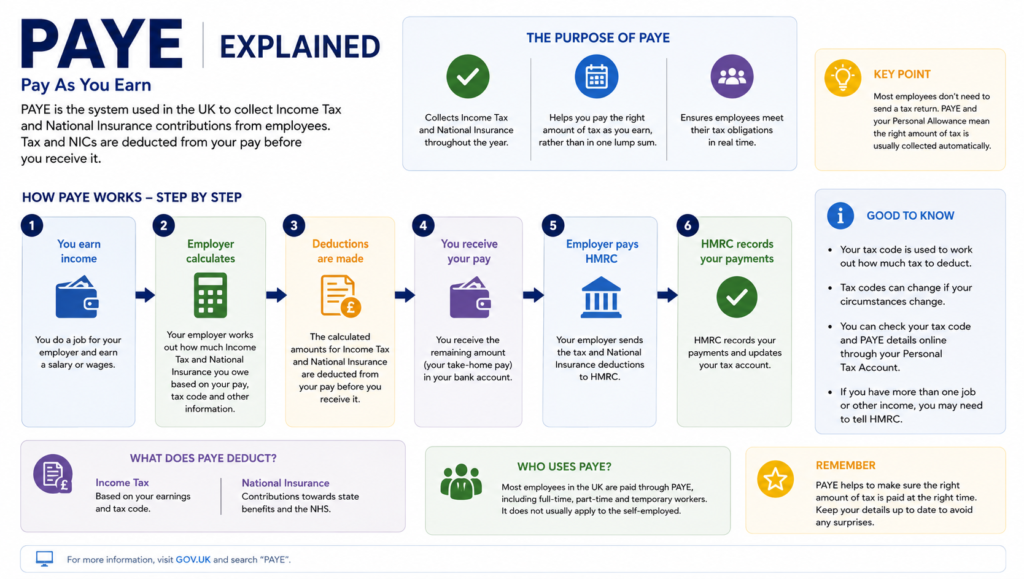
If you’ve ever looked at your payslip and wondered why the number you actually receive is smaller than the salary you agreed to, the answer is almost always PAYE.  PAYE Explained Short for Pay As You Earn, this is the system HM Revenue & Customs (HMRC) uses to collect Income Tax and National Insurance directly from your wages, before the money even reaches your bank account. This guide breaks down exactly how PAYE works, who it applies to, how your tax code affects your pay, and what to do if something looks wrong on your payslip. Whether you’re starting your first job, switching employers, or just want to understand your deductions properly, this article covers everything you need — in plain English. Visit Now:https://www.taxsal.com/ What Is PAYE? PAYE stands for Pay As You Earn.PAYE Explained It’s the method employers use to deduct Income Tax and National Insurance contributions (NICs) from employees’ wages or pensions, then pass that money to HMRC on their behalf. It’s the method employers use to deduct Income Tax and National Insurance contributions (NICs) from employees’ wages or pensions, then pass that money to HMRC on their behalf. PAYE Explained It’s the method employers use to deduct Income Tax and National Insurance contributions (NICs) from employees’ wages or pensions, then pass that money to HMRC on their behalf. Instead of paying a lump sum of tax once a year (like self-employed people do through Self Assessment), PAYE spreads your tax bill across every payday. PAYE Explained PAYE Explained Your employer does the calculation, deducts the right amount, and pays you the remainder — your net pay. In short: Who Needs to Pay Tax Through PAYE? PAYE applies to almost anyone who works for an employer in the UK, including: If you’re self-employed, PAYE doesn’t apply to you — you’ll handle tax through Self Assessment instead. However, many people are both employed and self-employed at the same time, in which case PAYE covers the employment income while Self Assessment covers the rest. How Does PAYE Actually Work? (Step-by-Step) Here’s what happens behind the scenes every time you get paid: Your employer registers with HMRCBefore hiring anyone, a business must register as an employer with HMRC and set up a PAYE scheme. You’re assigned a tax codeHMRC issues a tax code based on your personal allowance, benefits, and any other income.PAYE Explained Your employer uses this code to work out how much tax to deduct. Your employer calculates deductionsEach payday, your employer works out your gross pay, then deducts: You receive your net payThe remaining amount is paid into your bank account, and you get a payslip showing the breakdown. Your employer reports and pays HMRCEmployers must report pay and deductions to HMRC on or before each payday using Real Time Information (RTI). PAYE Explained They then pay the deducted tax and NI to HMRC, usually monthly. Understanding Your Tax Code Your tax code is the key to how PAYE calculates your deductions, yet it’s one of the most misunderstood parts of a payslip. A typical tax code looks like this: 1257L Common Tax Code Letters Letter Meaning L Standard tax-free Personal Allowance M Marriage Allowance – received a transfer from your partner N Marriage Allowance – transferred part of your allowance to your partner T Tax code includes other calculations to work out your allowance BR All income taxed at the Basic Rate (often used for second jobs) D0 All income taxed at the Higher Rate K You have income that isn’t being taxed elsewhere, so extra tax is deducted 0T No Personal Allowance applied (often temporary, e.g. missing details) If your tax code is wrong, you could end up overpaying or underpaying tax — so it’s worth checking it against your latest PAYE coding notice from HMRC. Read More: GREAT Scholarships UK 2026 — Eligibility, Application Process & Deadlines Explained Income Tax Bands Under PAYE (2025/26) PAYE ExplainedYour tax code determines your allowance, but the amount of tax you actually pay depends on which Income Tax band your earnings fall into. Band Taxable Income Tax Rate Personal Allowance Up to £12,570 0% Basic Rate £12,571 to £50,270 20% Higher Rate £50,271 to £125,140 40% Additional Rate Over £125,140 45% Note: these bands apply in England, Wales, and Northern Ireland. PAYE Explained Scotland has its own Income Tax bands and rates, which differ slightly. A Quick Example Let’s say you earn £30,000 a year with the standard tax code 1257L. Your employer automatically works this out and deducts it through PAYE, spreading the amount evenly across your pay periods. National Insurance Under PAYE Alongside Income Tax, PAYE also collects National Insurance contributions. These go towards your entitlement to certain state benefits and the State Pension. For most employees (Class 1 NICs), contributions are calculated based on how much you earn above a set threshold each pay period. The more you earn above that threshold, the more NI you pay, up to a certain point — after which the rate drops slightly for very high earners. Your employer also pays Employer’s National Insurance on top of your wages, but this doesn’t come out of your pay — it’s a separate cost to the business. What’s on a PAYE Payslip? Every payslip should clearly show: If any of these figures look off, don’t ignore it — a small tax code error can mean overpaying tax for months without realising. Common PAYE Problems and How to Fix Them Emergency Tax Code If you start a new job without giving your employer a P45, you might be placed on an emergency tax code temporarily. This can result in higher deductions until HMRC updates your code. Fix: Give your new employer your P45 as soon as possible, or complete a starter checklist if you don’t have one. Wrong Tax Code Sometimes HMRC has outdated information — for example, if you’ve changed jobs, started a second income, or stopped receiving a benefit. Fix: Check your tax code on your payslip or through your Personal

UK Scholarships 2026
scholarships

UK Scholarships 2026: 10 Best Fully Funded Programs

UK Scholarships 2026 are opening exciting opportunities for international students who dream of studying in the United Kingdom without worrying about expensive tuition fees. Every year, thousands of talented students apply for scholarships offered by the UK government, leading universities, and private organizations. These scholarships help students pursue undergraduate, master’s, and PhD degrees while receiving financial support for tuition, living expenses, travel, and other educational costs. For Pakistani and other international students, UK Scholarships 2026 provide a chance to study at world-renowned universities such as Oxford, Cambridge, Imperial College London, University College London, and many others. Whether your goal is academic excellence, research, leadership, or career development, there is a scholarship designed to support your ambitions. This guide covers the 10 best fully funded programs, eligibility requirements, application process, required documents, benefits, expert tips, and frequently asked questions to help you prepare a successful application. Visit Now: https://www.taxsal.com/ Why Choose UK Scholarships 2026? The United Kingdom is one of the world’s most popular study destinations. British universities consistently rank among the best globally and provide high-quality education recognized by employers worldwide. Here are some reasons why students apply for UK Scholarships 2026: Students receiving UK Scholarships 2026 can focus on their education instead of worrying about financial challenges. 10 Best Fully Funded Programs 1. Chevening Scholarship Chevening Scholarships are funded by the UK Government and are among the most prestigious scholarships for international students pursuing a one-year master’s degree. Benefits 2. Commonwealth Scholarships These scholarships support talented students from Commonwealth countries who wish to pursue postgraduate education in the UK. Benefits 3. GREAT Scholarships The GREAT Scholarship program is offered jointly by the British Council and UK universities. Benefits 4. Rhodes Scholarship The Rhodes Scholarship is one of the oldest and most prestigious scholarships available for postgraduate students at the University of Oxford. Benefits Read More: How UK Income Tax Works – Complete Beginner’s Guide 5. Gates Cambridge Scholarship Although based at the University of Cambridge, this scholarship is available to outstanding international postgraduate students. Benefits 6. Clarendon Scholarship The Clarendon Fund supports academically excellent students at the University of Oxford. Benefits 7. University of Westminster Scholarship This scholarship supports international students with outstanding academic achievements. Benefits 8. Edinburgh Global Research Scholarship Designed for international PhD students wishing to study at the University of Edinburgh. Benefits 9. Imperial College Scholarships Imperial College London offers various merit-based scholarships for master’s and doctoral students. Benefits 10. UCL Global Scholarships University College London provides scholarships for talented international students from around the world. Benefits Eligibility Criteria Although every scholarship has different requirements, most UK Scholarships 2026 require applicants to meet the following criteria: Required Documents Before applying for UK Scholarships 2026, prepare these documents: Preparing documents early can significantly improve your application experience. Read More: Study in UK Scholarship Guide: How to Apply & Get Selected Application Process Applying for UK Scholarships 2026 is generally straightforward if you follow the correct steps. Step 1 Research scholarship opportunities. Step 2 Check eligibility requirements. Step 3 Prepare all required documents. Step 4 Write a compelling personal statement. Step 5 Submit your university application if required. Step 6 Complete the scholarship application form. Step 7 Upload supporting documents. Step 8 Submit before the deadline. Step 9 Prepare for interviews if shortlisted. Step 10 Wait for the final decision. Tips to Increase Your Chances Competition for UK Scholarships 2026 is very high. These tips can improve your chances: Benefits of Fully Funded Scholarships Winning UK Scholarships 2026 provides many advantages beyond financial support. Some major benefits include: Common Mistakes to Avoid Many applicants lose opportunities because of avoidable mistakes. Avoid these errors: Best Fields of Study Many UK Scholarships 2026 support students in various academic disciplines. Popular fields include: Scholarship Timeline A typical timeline for UK Scholarships 2026 is: Stage Time Applications Open August–October 2025 Application Deadline October–January 2026 Interviews February–April 2026 Final Results April–June 2026 University Enrollment September–October 2026 Always verify the exact dates for each scholarship because they vary. Why Pakistani Students Should Apply Thousands of Pakistani students successfully receive scholarships every year. The UK offers excellent educational opportunities and globally respected qualifications. With UK Scholarships 2026, Pakistani students can study without paying high tuition fees while gaining international experience and building strong professional networks. Graduates from UK universities often secure excellent career opportunities in Pakistan and abroad due to the reputation of British education. Conclusion If studying in the United Kingdom has always been your dream, now is the perfect time to prepare for UK Scholarships 2026. Fully funded scholarships can remove financial barriers and allow you to study at some of the world’s best universities. Start researching scholarship opportunities early, prepare your documents carefully, improve your academic profile, and submit a strong application before the deadline. Persistence, preparation, and dedication can significantly increase your chances of success. Whether you are planning to pursue a master’s degree, PhD, or another eligible program, UK Scholarships 2026 can be the opportunity that transforms your academic and professional future. FAQ’s

UK Income Tax
scholarships

How UK Income Tax Works – Complete Beginner’s Guide

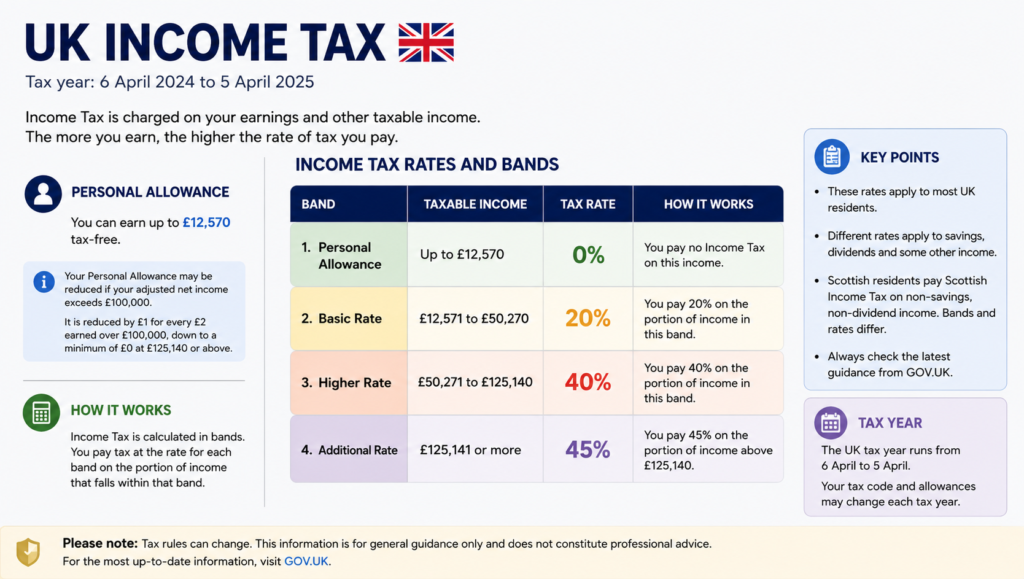
If you’ve ever looked at your payslip and wondered why the number at the bottom is so much smaller than the number you were promised at your job interview, you’re not alone.  UK Income Tax UK Income Tax confuses almost everyone the first time they earn money — and honestly, even people who’ve been working for years still get tripped up by it. The good news? Once you understand the basic logic behind UK Income Tax, it’s actually pretty simple. There’s no trick to it, no hidden catch — just a system of thresholds and rates that, once explained properly, will make sense in about ten minutes. This guide walks you through exactly how UK Income Tax works in plain English, using real numbers for the current tax year, so you can work out what you’ll actually take home. Visit Now: https://www.taxsal.com/ What Is UK Income Tax? UK Income Tax is a tax charged on money you earn — whether that’s from a job, self-employment, a pension, or even rental income. HM Revenue & Customs (HMRC) collects it, and the amount you pay depends on how much you earn in a tax year. The UK tax year doesn’t follow the calendar year.  UK Income Tax It runs from 6 April to 5 April the following year. So the “2026/27 tax year” means income earned between 6 April 2026 and 5 April 2027. Here’s the part that trips people up most: Income Tax is not a flat rate. You don’t pay one single percentage on everything you earn. Instead, your income is split into slices, and each slice is taxed at a different rate. This is called a progressive tax system, and it’s actually good news for you — it means you’re never taxed at a high rate on your entire salary, only on the portion that falls into a higher band. The Personal Allowance: Your Tax-Free Slice Before any tax is worked out, everyone gets a Personal Allowance — a chunk of income you’re allowed to earn completely tax-free. For the 2026/27 tax year, the Personal Allowance is £12,570. That means if you earn £12,570 or less in a year, you pay no Income Tax at all. UK Income Tax Anything above that gets taxed according to the bands below. Anything above that gets taxed according to the bands below. This allowance has been frozen at £12,570 since 2021, and it’s set to stay frozen until at least April 2031. That freeze matters more than it sounds — as wages rise with inflation, more of your income gets pulled into taxable territory even though the tax-free slice hasn’t grown. This effect has a name: fiscal drag, and it’s one of the quiet reasons take-home pay hasn’t stretched as far as it used to. What if I earn over £100,000? Here’s something a lot of beginner guides skip over. UK Income Tax If your income goes above £100,000, your Personal Allowance starts shrinking. For every £2 you earn above £100,000, you lose £1 of your allowance. Once your income hits £125,140, your Personal Allowance disappears completely — down to £0. This creates what’s often nicknamed the 60% tax trap, because within that £100,000–£125,140 range, you’re paying 40% tax on the income itself and losing tax-free allowance at the same time, which pushes your effective marginal rate up to around 60% on that slice of earnings. UK Income Tax Bands and Rates for 2026/27 Here’s the full breakdown for England, Wales, and Northern Ireland (Scotland has its own system, covered further down). Band Taxable Income Range Tax Rate Personal Allowance Up to £12,570 0% Basic Rate £12,571 – £50,270 20% Higher Rate £50,271 – £125,140 40% Additional Rate Over £125,140 45% A few things worth noting: How the Layered System Actually Works (Worked Example) This is where it clicks for most people. Let’s say you earn £45,000 a year. Step 1: The first £12,570 is tax-free (Personal Allowance). Step 2: The remaining £32,430 (that’s £45,000 minus £12,570) falls into the Basic Rate band and is taxed at 20%. £32,430 × 20% = £6,486 in Income Tax. You are not taxed 20% on the full £45,000 — only on the amount above your allowance. Now let’s try a higher earner on £70,000. Slice of Income Rate Tax Owed £0 – £12,570 0% £0 £12,571 – £50,270 (£37,700) 20% £7,540 £50,271 – £70,000 (£19,730) 40% £7,892 Total Income Tax £15,432 Notice that only the £19,730 sitting above £50,270 gets taxed at 40% — the rest of the income underneath it is still taxed at the lower rates. This “layer cake” approach is the single most important thing to understand about UK Income Tax. Read More: Study in UK Scholarship Guide: How to Apply & Get Selected National Insurance: The Tax’s Quiet Sibling Income Tax isn’t the only deduction on your payslip. Most employees also pay National Insurance Contributions (NICs), which fund things like the State Pension and NHS. For 2026/27, employees pay: So for someone earning £45,000, the combined bite of Income Tax and NI is more significant than Income Tax alone — which is usually why your payslip deduction feels bigger than the Income Tax bands alone would suggest. Income Tax in Scotland: Why It’s Different If you live in Scotland, your Income Tax works differently, because the Scottish Parliament sets its own rates and bands for non-savings, non-dividend income (salaries, self-employment profits, pensions, and rental income). For 2026/27, Scotland uses six bands instead of three: Band Rate Starter Rate 19% Basic Rate 20% Intermediate Rate 21% Higher Rate 42% Advanced Rate 45% Top Rate 48% Scotland’s starter and basic rate bands were widened for 2026/27, which gives lower earners a small tax reduction. But middle and higher earners in Scotland generally pay more than their equivalents in England — the Higher Rate kicks in earlier and at a steeper percentage, and the Top Rate of 48% starts well before England’s Additional Rate does. Which system applies to you depends on where

Study in UK Scholarship Guide
scholarships

Study in UK Scholarship Guide: How to Apply & Get Selected

Study in UK Scholarship Guide is a dream for thousands of students every year, but the price tag attached to it often feels out of reach. Tuition fees, living costs, flight tickets, accommodation — it adds up fast. That’s exactly where scholarships come in. Study in UK Scholarship Guide They’re not some rare lottery prize reserved for geniuses; they’re a real, practical way to fund your education if you know how the system works and how to position yourself properly. This guide walks you through everything you actually need to know to study in the UK on a scholarship — from finding the right one to writing an application that actually gets noticed. Visit Now: https://www.taxsal.com/ Why UK Scholarships Are Worth the Effort The UK is home to some of the world’s top-ranked universities — Oxford, Cambridge, Imperial College London, UCL, Edinburgh, and many more. But studying at this level isn’t cheap. International tuition fees can range anywhere from £15,000 to £40,000 a year depending on the course and university, and that’s before you factor in rent, food, and daily expenses. A scholarship changes that equation completely. Some cover full tuition, some include living expenses, and others offer partial fee waivers that still make a huge difference. Beyond the money, a scholarship on your CV also signals to future employers that you were selected based on merit — which opens doors long after graduation. Read More: Rhodes Scholarship: 7 Powerful Benefits for Students Types of Scholarships Available in the UK Before you even start applying, it helps to understand the different categories so you’re not wasting time on the wrong ones. Government-funded scholarships are among the most prestigious. Study in UK Scholarship Guide Chevening Scholarships, for example, are funded by the UK government and cover full tuition, living costs, and even flights for postgraduate students from eligible countries. The Commonwealth Scholarships work similarly, targeting students from Commonwealth nations. University-specific scholarships are offered directly by individual institutions. Study in UK Scholarship Guide Almost every major UK university has its own scholarship programs for international students, often based on academic merit, financial need, or specific subject areas. Subject-based scholarships are tied to a particular field of study — engineering, medicine, business, law, and so on. These are usually funded by industry bodies, research councils, or private foundations connected to that field. Country-specific scholarships are designed for students from particular regions or nations, often as part of bilateral education agreements between the UK and that country. Knowing which category fits you narrows your search massively and saves you from applying blindly to things you don’t qualify for Study in UK Scholarship Guide. Step 1: Check Your Eligibility Before You Get Excited Every scholarship has its own eligibility criteria, and skipping this step is the most common mistake applicants make. Before you fall in love with a scholarship, check: Your academic level — undergraduate, postgraduate, or PhD programs all have separate scholarship pools, and applying to the wrong category wastes time. Your nationality — many scholarships, especially government ones, are restricted to specific countries or regions. Your academic record — most scholarships have a minimum GPA or grade requirement, and some are extremely competitive. Your English language proficiency — IELTS or TOEFL scores are usually mandatory, and the required band score varies by scholarship and university. Take ten minutes to read the eligibility page properly instead of skimming it. A rejected application due to a basic mismatch is avoidable. Read More: Chevening Scholarship 2026 in UK | Fully Funded Opportunity for International Students Step 2: Research the Right Scholarships for You Don’t just search “UK scholarships” and apply to the first ten results. Study in UK Scholarship Guide Build a shortlist based on what’s actually realistic for your profile. Good places to start include the official UK government scholarship pages, your target university’s financial aid or international office page, and the British Council website, which maintains updated scholarship listings for international students. It’s also worth checking if your home country has a bilateral education agreement with the UK, since these often come with dedicated funding pools that are less competitive simply because fewer people know about them. Step 3: Get Your Documents in Order Early Most scholarship applications ask for a similar set of documents, so preparing them in advance saves you from last-minute panic. You’ll typically need: Academic transcripts and certificates, a valid passport, English proficiency test scores, a personal statement or motivation letter, letters of recommendation, and a CV or resume. Start collecting these months before the deadline. Study in UK Scholarship Guide Recommendation letters in particular take time — professors and employers are busy, so give them at least three to four weeks’ notice. Step 4: Write a Personal Statement That Doesn’t Sound Like Everyone Else’s Study in UK Scholarship Guide This is where most applications fall apart. Study in UK Scholarship Guide Scholarship committees read hundreds, sometimes thousands, of personal statements, and most of them sound identical — generic claims about “passion for learning” and “making a difference in the world” with nothing concrete behind them. What actually works is specificity. Instead of saying you’re passionate about engineering, talk about the actual project you built, the problem it solved, and what you learned from it. Instead of saying you want to help your community, describe a real situation where you did exactly that and what the outcome was. Tie your story directly to why you want to study this specific course at this specific university, and connect it to where you see yourself five or ten years down the line. Study in UK Scholarship Guide Selection committees aren’t just funding good grades — they’re investing in someone they believe will use the opportunity well and represent the scholarship positively. Keep your tone genuine. Avoid overly formal or stiff language that doesn’t sound like you. The best personal statements read like a confident, real person talking about their goals — not a template filled with buzzwords Study in UK Scholarship

GREAT Scholarships UK 2026
scholarships

GREAT Scholarships UK 2026 — Eligibility, Application Process & Deadlines Explained

If you’ve been dreaming of studying in the UK but the cost of tuition keeps holding you back, the GREAT Scholarships might be exactly what you’re looking for. Launched by the British Council in partnership with over 60 UK universities, this program was built specifically to help talented students from select countries access world-class postgraduate education without the usual financial burden. In this guide, we’ll walk you through everything you need to know about GREAT Scholarships UK 2026 — who can apply, how the process works, and when you need to get your application in. Visit Now: https://www.taxsal.com/ What Are GREAT Scholarships UK 2026? The GREAT Scholarships programme is a joint initiative between the British Council and the UK government’s GREAT Britain Campaign, designed to attract bright postgraduate students to UK universities. Each scholarship offers a minimum of £10,000 toward tuition fees for a one-year postgraduate course, and in many cases, individual universities top up that amount or add extra perks like accommodation support or living allowances. What makes this scholarship different from something like Chevening or Commonwealth is its scale. Rather than being a single centralized award, GREAT Scholarships are distributed across more than 60 universities in England, Scotland, Wales, and Northern Ireland. That means dozens of separate opportunities, each with its own subject focus, eligibility quirks, and deadline. Who Is Eligible for GREAT Scholarships? Eligibility depends on your nationality first, then your academic background. The programme is open to students from a specific list of countries, which typically includes: Bangladesh, China, Egypt, Ghana, India, Indonesia, Kenya, Malaysia, Mexico, Nigeria, Pakistan, Thailand, Turkey, and Vietnam. If you’re from one of these countries, here’s what universities generally look for: It’s worth noting that eligibility criteria aren’t identical across all 60+ universities. Some restrict the scholarship to certain faculties or subjects, while others keep it open to any postgraduate programme. Always check the specific university’s page rather than assuming the rules are the same everywhere. Read More: Rhodes Scholarship: 7 Powerful Benefits for Students How to Apply for GREAT Scholarships The application process is more decentralized than people expect, and that’s actually the part most applicants get wrong. There’s no single “GREAT Scholarship portal” where you submit one form and wait. Instead, here’s how it actually works: Step 1: Pick your university and course. Start by browsing the list of participating universities on the Study UK website. Each one runs its own version of the scholarship, so your choice of university matters from day one. Step 2: Apply for the course itself. In most cases, you need to have applied (or already hold an offer) for the postgraduate programme before you can apply for the scholarship. A few universities allow simultaneous applications, but it’s safer to assume admission comes first. Step 3: Complete the scholarship application form. This usually involves a short form covering your academic background, financial situation, and a personal statement explaining why you deserve the award. Some universities also ask for a reference letter. Step 4: Submit before the deadline. This is non-negotiable — late submissions are almost never considered, regardless of how strong your profile is. Step 5: Wait for the outcome. Most universities review applications through an internal scholarship panel and notify successful candidates by email, often around June or July for September intake. A small but important tip: don’t wait until your course application is fully processed to start preparing your scholarship documents. Get your personal statement and references ready early, because the scholarship deadline often falls before you’d expect. Deadlines to Keep in Mind Deadlines vary by university, which is the single biggest source of confusion for applicants. Some universities close applications as early as May for September entry, while others stay open until June or even later in the cycle. A rough rule of thumb for 2026 entry: if you’re aiming to start your course in September, you should have your scholarship application submitted no later than May or early June. Universities with limited scholarship slots (and most are limited) tend to fill up fast, so applying early gives you a real advantage over waiting until the deadline. Since every university sets its own date, your best move is to shortlist two or three universities you’re genuinely interested in and check their individual scholarship pages directly. Don’t rely on a single deadline you saw somewhere online — confirm it on the university’s own site. Why GREAT Scholarships UK 2026 Are Worth Applying For? Unlike scholarships that demand years of work experience or a long track record of leadership roles, GREAT Scholarships are relatively accessible for recent graduates and early-career professionals. The minimum £10,000 award can make a real dent in your tuition costs, and because so many universities participate, your chances aren’t limited to one shot — you can realistically apply to multiple GREAT-affiliated universities in the same admission cycle. It’s also a solid stepping stone. Even if you don’t win the scholarship at your first-choice university, having a strong, ready-to-go application means you can quickly redirect that effort toward another participating institution. Read More: Chevening Scholarship 2026 in UK | Fully Funded Opportunity for International Students Final Thoughts GREAT Scholarships UK 2026 offer a genuinely practical path for students who want to study in the UK without taking on the full financial weight themselves. The key to success isn’t just having good grades — it’s staying organized, picking the right universities early, and not missing those individual deadlines that quietly differ from one institution to the next. If you’re serious about applying, start now. Build your shortlist, check each university’s specific requirements, and get your documents ready well before deadlines hit. The earlier you move, the better your odds. FAQ’s

Take Home Pay Calculator UK
scholarships

Take Home Pay Calculator UK – Calculate Your Net Salary After Tax

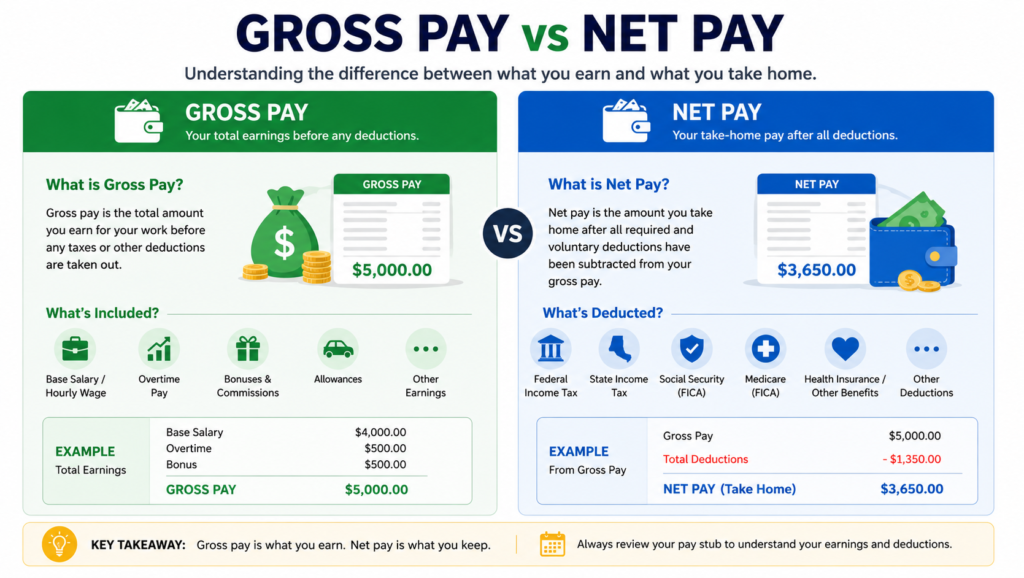
Knowing the actual income that one earns is critical since it influences one’s financial planning. Take Home Pay Calculator UK comes handy when one wishes to calculate their net income taking into consideration the deductions that apply like Income Tax, National Insurance, and pension. All one needs to do is key in their gross income to determine their net income monthly, weekly, or yearly. The tool can be used whether one is employed or self-employed. Visit Now: https://uaehrhub.com/ What Is a Take-Home Pay Calculator? Take Home Pay Calculator UK. The Take Home Pay Calculator is a calculator used on the internet to determine how much of your income is actually paid out after all the necessary deductions. From your gross income tax and national insurance contributions as well as the pension contributions, the calculator subtracts how much you make. Take Home Pay Calculator UK Using this process, there is no need for you to waste time in making calculations using complicated tax rates. All that you have to do is to enter your gross salary details, and then the calculator will estimate your take-home pay. How Does the UK Take-Home Pay Calculator Work? The UK Take Home Pay Calculator has the capability to calculate your net income depending upon your gross income using current tax laws prevailing in the UK. Take Home Pay Calculator UK The only thing you have to do is to put in your annual, monthly, weekly, or hourly salary figure, and the calculator will deduct income tax, national insurance, and anything else that can be deducted to show how much take-home pay you will get after all these deductions are taken out from your salary. This is very helpful for everyone who wants to know about their real income. How to Use the Take Home Pay Calculator UK Using the Take Home Pay Calculator UK is very straightforward and easy.Begin with entering your salary before any deductions, then choose if you are on an hourly wage, weekly wage, monthly wage, or annual wage. Take Home Pay Calculator UK You will then need to enter the other information required by the calculator such as your tax code, pension contributions, or student loans. Upon clicking on the calculate button, your net income will be automatically calculated according to the Income Tax and National Insurance of the UK. Your take-home salary will be clearly indicated. Read More: Chevening Scholarship 2026 in UK | Fully Funded Opportunity for International Students What Is Included in Your Take Home Pay? The take-home pay is actually what the individual receives after deductions from his or her gross salary. Take Home Pay Calculator UK The take-home pay comprises an individual’s net salary, and it is the money available for use in meeting personal needs. Net Salary: Net total earnings after making any deductions. Gross Salary Gross Salary refers to the total amount of money that one earns prior to deductions of Income Tax, National Insurance, and pensions. Gross salary is the total amount of salary that one earns through a contract with his/her employer. Basic Salary Fixed basic salary earned before any bonus payment. Overtime Payments Payments for extra hours worked. Bonus Payments Any payments apart from the basic salary earned due to performance or policies set by the organization. Allowances Additional payments apart from the basic salary earned. Income Tax Income Tax refers to the part of your gross earnings that is deducted depending on your taxable income and the relevant UK income tax bands. Personal Allowance: It is the amount of your income that you might not pay any tax on. Tax Bands: There are different income tax bands, and as you earn more, a different tax rate is charged. PAYE: Most people pay Income Tax as part of the PAYE system. Tax Code: It helps in determining your income tax. National Insurance National Insurance is money that will be automatically deducted from your income in the UK as part of the PAYE tax system, and the deduction is made to pay for government-sponsored benefits like the state pension, welfare payments in case of unemployment, and health care. Your contribution to National Insurance will depend on the level of your earnings; higher earners pay more contributions. Pension Contributions Aspect Description Meaning Pension contributions are amounts taken from your salary to help build your retirement savings for the future. Purpose They ensure you have financial support after retirement through a workplace or private pension scheme. Calculation Usually calculated as a percentage of your gross or qualifying earnings. Impact on Pay These contributions reduce your take-home pay but increase your long-term savings and retirement benefits. Student Loan Deductions Student loan deductions’ refer to deductions made from your paycheck if you have incurred any student loan within the UK. Take Home Pay Calculator UK Repayments will be based on the amount of money that you earn; you begin repaying when you earn beyond a set limit. Repayments will lower your take-home pay but assist in clearing your loan. Read More: UCL Global Undergraduate Scholarship 2026 in UK | Fully Funded Opportunity for International Students What Affects Your Take Home Pay in the UK? The amount of take home pay will be based on several factors like your gross salary and how much tax you will pay. Take Home Pay Calculator UK This takes into account things like your tax code and income tax and national insurance.Other deductions like pension deductions and student loan repayments may further reduce your take-home pay. Any variations in salaries and other aspects can lead to an influence in your pay after deductions. Annual Salary An annual salary is basically the sum total of all the money that you earn within a year from work before any kind of deduction has been deducted from it. It includes both your base salary and any additional bonuses or allowances that you might be earning. Tax Code ( Take Home Pay Calculator UK ) The tax code is a series of figures and

Scroll to Top