
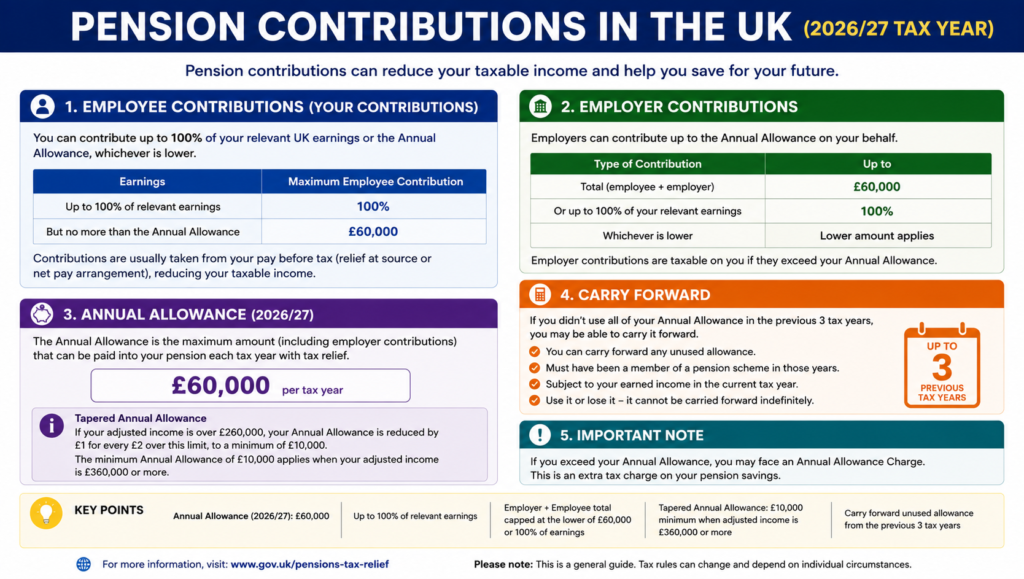
Pension Contributions UK – How They Affect Your Take Home Pay
Most people can tell you their salary down to the last pound, but ask them what actually lands in their bank account after pension contributions come out, and the answer gets vague fast.Pension Contributions UK That gap matters.Pension Contributions UK Understanding pension contributions UK rules — how much gets deducted, how tax relief works, and what it actually does to your monthly take-home pay — is one of the most useful bits of financial literacy you can pick up as an employee Pension Contributions UK. This guide walks through exactly how workplace pension contributions are calculated for 2026/27, what tax relief actually means in cash terms, and how different contribution methods change what you see on your payslip Pension Contributions UK. Visit Now: https://www.taxsal.com/ What Counts as a Pension Contribution A pension contribution is money paid into a registered pension scheme, usually made up of three parts: This third part is what makes pensions genuinely tax-efficient. Pension Contributions UK Every pound you contribute through certain schemes effectively costs you less than a pound out of your own pocket, because the tax you would have paid on it goes into your pension instead of to HMRC. Auto-Enrolment Rules for 2026/27 Who Gets Auto-Enrolled If you’re aged between 22 and State Pension age, and you earn more than £10,000 a year from one employer, you’ll be automatically enrolled into a workplace pension.Pension Contributions UK This threshold has stayed unchanged for 2026/27. You can opt out if you choose, but doing so means giving up your employer’s contribution too — effectively turning down free money. Pension Contributions UK Most financial advisers recommend staying enrolled unless there’s a genuine short-term financial reason not to Pension Contributions UK. If you earn less than £10,000, you can still opt in voluntarily, and your employer is required to contribute if you do — provided you earn at least £6,240 a year Pension Contributions UK. Qualifying Earnings Explained Here’s a detail that trips a lot of people up: minimum pension contributions aren’t calculated on your full salary. Pension Contributions UK They’re calculated on your qualifying earnings — the slice of your income between £6,240 and £50,270 for 2026/27 Pension Contributions UK. So if you earn £30,000 a year, your qualifying earnings are £30,000 minus £6,240, which is £23,760. Pension Contributions UK That’s the figure your contribution percentage gets applied to, not the full £30,000Pension Contributions UK. Minimum Contribution Rates 2026/27 Contributor Minimum Rate Applies To Employer 3% Qualifying earnings (£6,240–£50,270) Employee 5% Qualifying earnings (£6,240–£50,270) Total minimum 8% Qualifying earnings (£6,240–£50,270) Your employer can choose to contribute more than the 3% minimum, and some do, particularly as a benefit to attract staff. Pension Contributions UK If your employer contributes the full 8% themselves, you don’t have to contribute anything unless you want to. Read More: GREAT Scholarships UK 2026 — Eligibility, Application Process & Deadlines Explained How Pension Tax Relief Actually Works Tax relief is where things get genuinely interesting, because there are two completely different methods, and which one your employer uses changes how much your pension contribution actually costs you Pension Contributions UK. Net Pay Arrangement Under a net pay scheme, your pension contribution is deducted from your salary before income tax is calculated. Pension Contributions UK This means you only pay tax on what’s left. Example: You earn £3,000 a month and contribute 5% (£150) through a net pay scheme. Pension Contributions UK Income tax is calculated on £2,850, not £3,000. Pension Contributions UK If you’re a basic-rate taxpayer, that saves you £30 in tax that month (20% of £150) — so your pension effectively costs you £120 out of pocket, not £150 Pension Contributions UK. One catch: if your earnings are below the personal allowance (£12,570 a year, or £1,048 a month for 2026/27), you don’t pay income tax anyway — which means you get no tax relief benefit under a net pay scheme, since there’s no tax to reduce Pension Contributions UK. Relief at Source Under relief at source, your contribution is deducted after tax, but your pension provider then claims basic-rate tax relief (20%) directly from HMRC and adds it to your pot Pension Contributions UK. Example: You want to contribute £150 a month. Pension Contributions UK You actually only pay £120 from your take-home pay — the provider claims the other £30 from HMRC and adds it to your pension automatically Pension Contributions UK. The advantage of relief at source is that even low earners below the personal allowance still get the 20% top-up, since it isn’t dependent on you having paid tax in the first place. If you’re a higher-rate or additional-rate taxpayer under a relief-at-source scheme, you’ll need to claim the extra tax relief above the basic 20% through Self Assessment — it isn’t added automatically. Salary Sacrifice Salary sacrifice works differently again. You formally agree to reduce your salary by an amount, and your employer pays that same amount into your pension instead. Pension Contributions UK Because your official salary is lower, you pay less income tax and less National Insurance on that amount — a saving net pay and relief-at-source schemes don’t offer Pension Contributions UK. Example: You earn £35,000 and sacrifice £1,438 (5% of qualifying earnings) into your pension Pension Contributions UK. Many employers also pass on some or all of their own National Insurance saving (15% of the sacrificed amount) as an extra pension contribution, which makes salary sacrifice one of the most efficient ways to save for retirement if it’s offered Pension Contributions UK. How Pension Contributions Affect Your Take-Home Pay Let’s put real numbers against a full example so you can see the actual effect on a payslip. Worked Example — Salary of £35,000, 5% Employee Contribution Method Annual Pension Cost to You Effective Monthly Reduction in Take-Home Pay Net pay £1,438, tax relief saves £287.60 Around £96 Relief at source £1,150.40 paid, £287.60 added by HMRC Around £96 Salary sacrifice £1,438 sacrificed, £402.64 total tax + NI saved Around £86 Notice